

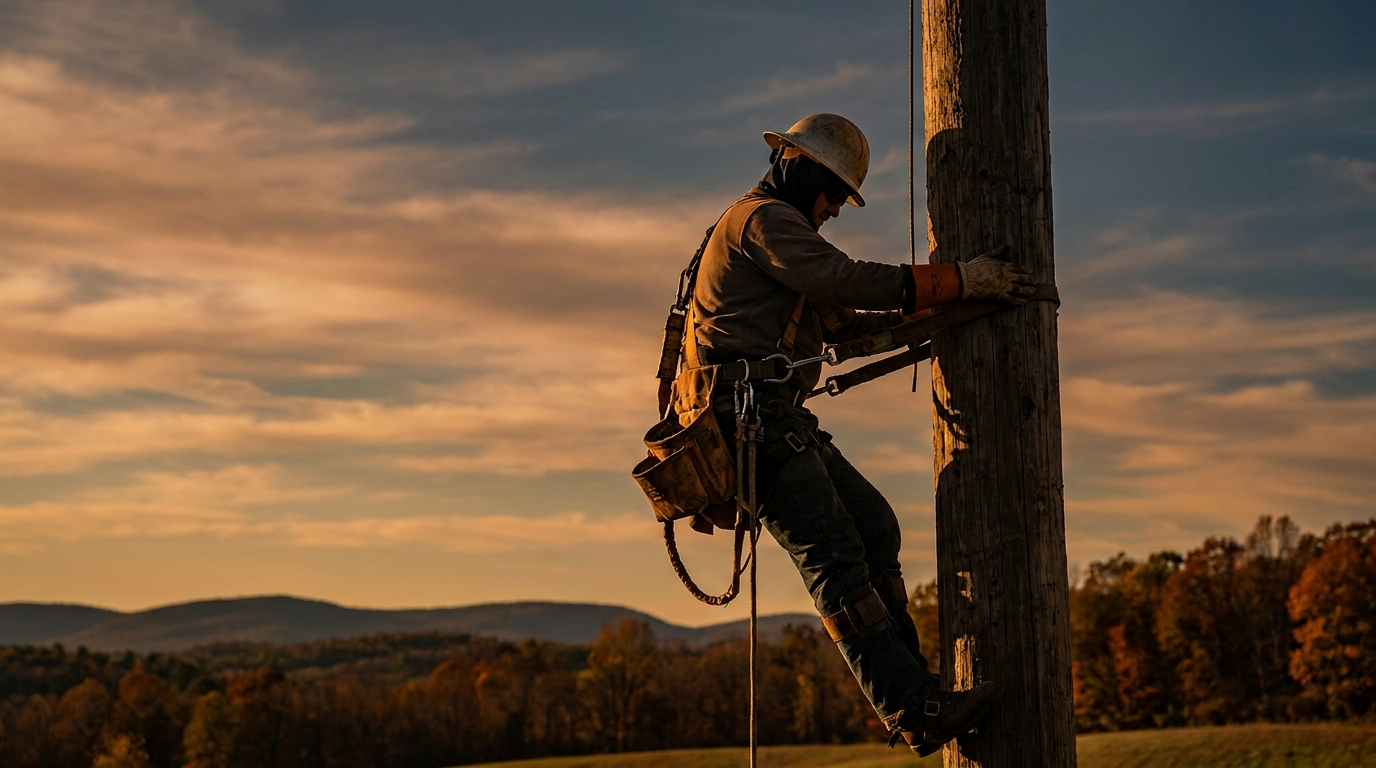
Mike Dombrowski graduated high school with a 1.87 GPA and a guidance counselor who had already decided where he was headed — and it wasn’t a four-year degree. What that counselor didn’t know was that the conversation meant to manage his expectations would end up pointing him toward one of the highest-paying trades in the country.
These days Mike runs his own tree service, helped found a lineman school, and has a growing crowd watching him drop trees on TikTok. He’s been a contract lineman, a municipal lineman, and a business owner — sometimes inside the same decade. People call him lucky. He’ll tell you the harder he works, the luckier he gets.
Here’s how he got from that guidance office to where he is now, and what he tells anyone standing at the same crossroads he was.
He Wasn’t Supposed to Go to College
Mike knew two things early. He didn’t want to sit in an office, and traditional school didn’t hold his attention. His dad ran Jim’s Music, and Mike spent his after-school hours polishing guitars and washing windows rather than cracking textbooks — he’ll be the first to tell you he can’t play a note.
So when a guidance counselor sat him down senior year and started running through options — aircraft technician, this program, that one — the unspoken message was clear enough. College wasn’t the plan. But buried in that list of alternatives was a word Mike hadn’t really heard before: lineman. The pay caught his attention first, then the retirement. For a kid who’d been told what he couldn’t do, here was a list of things he could — and one of them happened to sit near the top of the trades for money, with demand that isn’t slowing down.
Funny how the conversation meant to lower the ceiling ended up showing him the door.
How CDL Became His Stepping Stone
Here’s the part most people don’t see coming: before Mike could climb a single pole, he needed a Class A CDL.
Every lineman does. You can’t show up to an apprenticeship without one, because the trucks and the bucket rigs all require it. A lineman who lets that license lapse is a lineman who’s about to be unemployed. It isn’t a nice-to-have; it’s the cost of entry, and a lot of people who want the job don’t realize it until late. That’s exactly why Midwest Truck Driving School pairs CDL training with line school in the first place. For a future lineman, the two aren’t separate decisions — the CDL is the first rung on the ladder. Mike went to truck driving school back around 2012, well before he ever interviewed with a line crew, because that’s the order the trades actually run in.
If you’re looking at the trades and the CDL feels like the first real move, that’s because it often is. We put together a free guide for exactly that moment — Before The Wheel: A Future Trucker’s Playbook — that walks through what the first step actually involves before you commit a dime to it.
Why He Didn’t Finish Line School
Technically, Mike finished line school. Practically, he was gone before the last day.
He’d driven to Minnesota for an interview slot — the local IBEW was hiring like crazy for a big transmission project, the line they called the extension cord from Wisconsin to South Dakota. He got back to school on a Monday. Tuesday the apprenticeship called. By the time he hung up, his teacher standing right there, the general foreman had a simpler read on the situation than Mike did: tell your teacher to pass you, tell him you got a job. So Mike showed up in Hampton, Minnesota that Thursday at 7:30 and finished his books online.
There’s a lesson in that, and it isn’t “skip school.” It’s that the trades hire fast, and they hire for capability more than credentials. A lot of people freeze up thinking they need every certificate in hand before they’re allowed to start earning, and the trades just don’t work that way. When the work shows up, it shows up — and the goal of any program worth its tuition is to get you out the door and into a paycheck, not to keep you in a classroom a day longer than you need to be.
The Numbers — Contracting vs. Coming Home
Let’s talk money, because that’s usually the real question underneath all the others.
As a contract apprentice working seven twelves — seven days a week, twelve hours a day — Mike cleared over $130,000 as an apprentice. Then life happened. He and his wife had twin daughters, and the pull to get back home near family won out. He landed a municipal job and his pay settled around $100,000 — still strong money, but the contractor checks had been a different animal. He still remembers his foreman watching him open that first city paycheck: “Ain’t like that contractor money, is it, kid?”
What he gave up in dollars he got back in hours. Seven twelves became five eights. He went from fighting to find time to wash his clothes on a Sunday to being home every night with his wife and kids, which was the whole point. The takeaway isn’t that one number beats the other — it’s that the trades hand you that lever to pull depending on where you are in life. If you want to see what different careers might pay, our earnings calculator runs the comparison.
The Tree Job That Started a Business
The tree service started by accident, and it started with one number: $2,200.
That’s what a tree guy quoted Mike’s parents to take down a tree and clean it up. Mike — by then a lineman who owned spurs, a climbing belt, and the nerve to use them — looked at that quote and figured he could do it himself. His parents would rather pay him than the other guy, so he climbed it. He remembers the job to a T: four hours to cut the tree down, twenty hours to clean it up.
He laughs about the math now, but that messy first job planted something. Working five eights at the city had left him with time on his hands and an itch he couldn’t shake — he needed something to do after work, a little extra income, and honestly a way to stay sane after years of being run ragged on the road. Dombrowski Tree Service grew out of that itch. He knew nothing about species, nothing about running a business, and he learned the way the trades teach everyone — by doing it wrong a few times until he got it right.
Why He Walked Away From the Gravy Job
Here’s the part that surprises people. Most linemen who land a municipal job never leave it. It’s the goal — a steady check, great insurance, home every night — and Mike’s own mother had drilled the gospel of guaranteed insurance into him for years.
He left anyway.
By 2021 the side business had grown into four full-time employees and a yard full of equipment, and the politics of the municipality had worn on him — though Mike is quick to say every organization has them, co-ops and munis included. So he traded the guaranteed check for the thing he wanted more than security: flexibility. The night his kids had a 5:30 game, he just parked the truck and went, no request submitted and no three stamps of approval. At this point, he says, he’s basically unemployable — and he means it as a compliment to the life he built. It isn’t the right call for everyone, and there’s no shame in loving the steady check and the benefits. But it’s worth knowing the option is there, and that the trades can be the launchpad for it rather than the ceiling.
What He’d Tell His 17-Year-Old Self
Ask Mike what he’d tell the kid in that guidance office, and the answer comes fast: try it all.
Figure out what you actually enjoy, because you’ll be doing it a long time, and you won’t know whether you hate a job — or love it — until you’ve done it. Even the ones you hate tend to leave you with a tool in the toolbox. He’s got a high schooler working for him right now who’s headed for welding, and another bound for line school in August: different kids, different doors, same idea.
A few of his lines stick with you. Embrace the suck, because everything you mess up is something you learned. Be careful whose advice you take, because cheap advice is free and not all of it is worth acting on. And the one he keeps coming back to: if you’re the smartest person in the room, you’re in the wrong room. That’s not bad advice for anyone standing where he stood, wondering whether the trades are a real path or just the thing people land on when nothing else works out. Mike’s whole career is the answer to that question.
Hear the Whole Conversation
Mike’s full story runs longer and funnier than what fits here — the viral tree-felling videos, the 70-year-old foreman named Stretch they kept around for his brain, the philosophy he runs his business on. We sat down with him for a full episode of Built in the Midwest, the podcast where we talk to real people in the trades about how they actually got where they are.
Listen to the full conversation with Mike Dombrowski — and if the CDL piece of his story is the part sticking with you, grab the free Before The Wheel playbook before you make your first move.