

Most advice about starting a trucking career comes from two places: people trying to sell you training or people who drove a truck twenty years ago. Both have blind spots.
Recruiters sit in a different seat. They talk to hundreds — sometimes thousands — of candidates every year. They see who gets hired, who washes out in the first year, and who’s still building a career a decade later. They know what CDL school doesn’t teach you, what your first employer is actually screening for, and which mistakes are the most preventable.
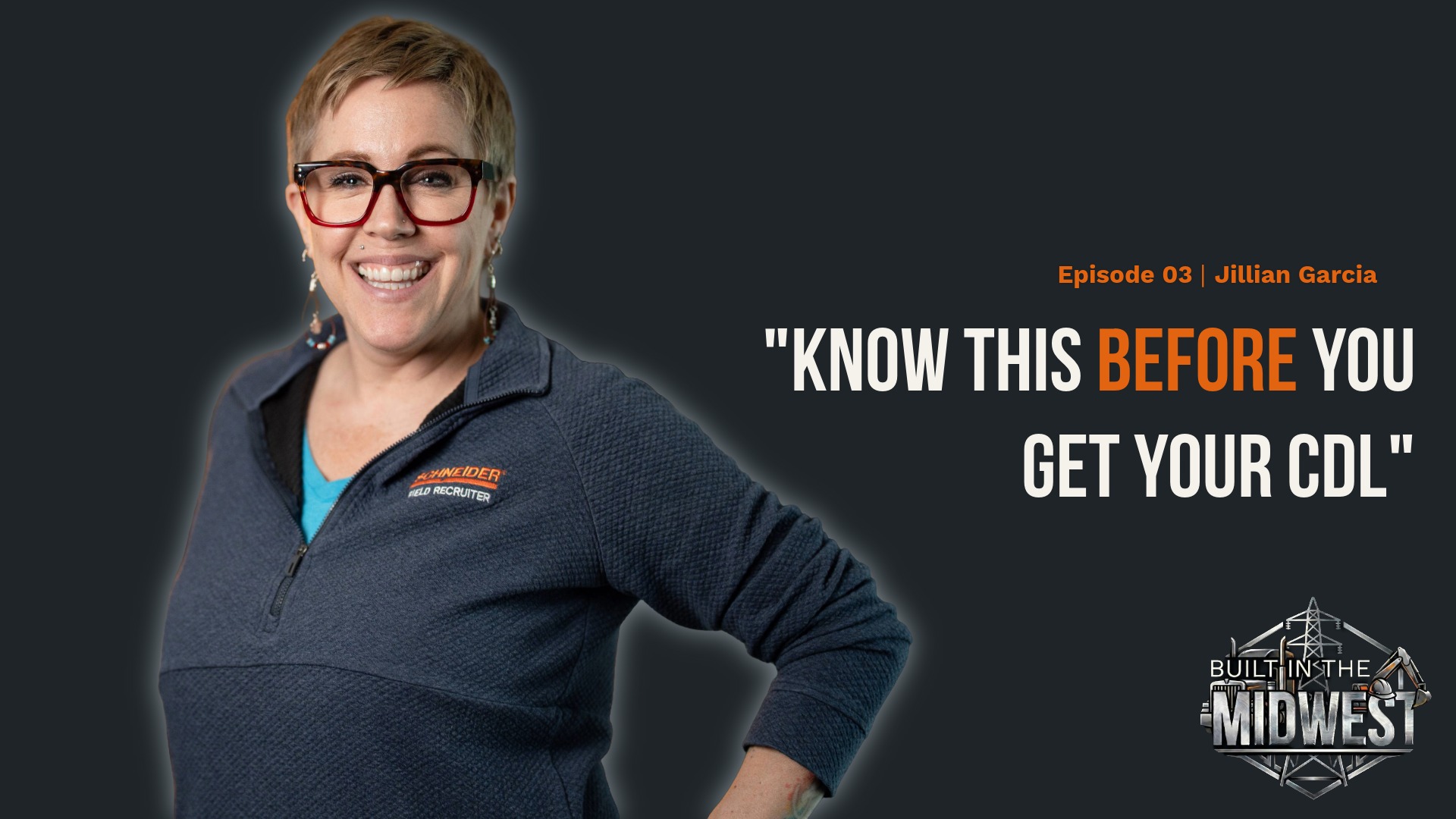
We recently sat down with Jillian Garcia, a Senior Territory Recruiter at Schneider National who covers Wisconsin and Upper Michigan. She’s been with Schneider for ten years and has evaluated more driver candidates than she can count. The conversation covered a lot of ground — from what she looks for in a candidate to why the first year is where careers are made or broken.
This article isn’t a recap of that conversation. It’s a deeper look at the themes she raised — expanded with industry context that anyone considering a CDL should understand before they commit.
The Industry Doesn’t Have a Driver Shortage. It Has a Quality Problem.
For years, every trucking headline said the same thing: there aren’t enough drivers. That narrative has shifted. At the October 2025 ATA Management Conference, the American Trucking Associations’ chief economist made the case that the real issue isn’t the number of people holding CDLs. It’s the number of those CDL holders who meet the safety, professionalism, and reliability standards that carriers actually need.
That distinction matters if you’re considering this career. Having a CDL gets your foot in the door, but it doesn’t guarantee you’ll stay. Carriers like Schneider are screening for more than a passing test score. They’re looking at your driving record, your attitude in the interview, how you handle their questions, and whether your expectations are grounded in reality.
The takeaway isn’t discouraging — it’s clarifying. The bar for entry isn’t impossibly high. But the people who clear it and build lasting careers tend to share specific traits that have nothing to do with how well they can back a trailer into a dock.
What Recruiters Are Actually Screening For
When Garcia described what makes a candidate stand out, driving skill barely came up. Here’s why.
CDL school teaches you to operate a truck. It teaches you the maneuvers, the regulations, the pre-trip inspection process. That’s the baseline. Every candidate who walks into orientation has that. What separates the ones who get called back from the ones who get passed over comes down to a handful of things that are harder to teach:
Realistic expectations. Garcia was blunt about this. If someone walks in expecting top pay, home every night, and a brand-new truck from day one, that’s a red flag. Not because those things don’t exist in trucking — they absolutely do — but because they come after you’ve put in time. Every career starts at the bottom. Trucking is no different.
Teachability. This was the word Garcia came back to more than any other. The drivers who succeed long-term are the ones who show up ready to learn — not the ones who think they already know everything because they passed their CDL test. She put it simply: “If you’re teachable, you’ll go far.”
Attitude over aptitude. Garcia has seen people with perfect test scores flame out in six months and people who struggled through training build ten-year careers. The difference is almost always mindset. Can you take feedback? Can you stay calm when things don’t go as planned? Can you treat the truck, the freight, and the people at the dock with professionalism even on a bad day?
These aren’t soft skills. In an industry where your safety record follows you everywhere and your reputation with dispatchers determines what loads you get, they’re survival skills.
Why the First Year Breaks So Many Drivers
The trucking industry has historically reported annual turnover rates above 80% at large truckload carriers. That number sounds alarming, but it’s important to understand what it actually represents. Most of that turnover is drivers moving between companies — not leaving the industry entirely. Still, the first twelve months are where the highest attrition happens, and the reasons are predictable.
Unmet pay expectations top the list. Many new drivers hear a salary range during recruiting and assume they’ll hit the high end immediately. In reality, first-year earnings at most carriers are lower than the advertised averages, which reflect what experienced drivers make. When that first paycheck doesn’t match the mental picture, frustration sets in fast.
Home time is the second killer. Over-the-road trucking means weeks away from home, especially early in your career when you haven’t earned seniority for better routes. Garcia emphasized that Schneider can get OTR drivers home every other weekend, and some positions offer weekly home time — but she was also honest that those options expand as you gain experience. If you walk in demanding daily home time on a long-haul position, you’re going to be disappointed.
The third factor is loneliness. This doesn’t get talked about enough. Trucking is a solo profession. You’re in a cab by yourself for ten, twelve, fourteen hours a day. Some people thrive in that environment. Others discover it’s not for them. Garcia made the point that doing your research before investing the time and money to get your CDL is essential — not just research on the pay and the work, but honest self-assessment about whether you’re built for the lifestyle.
What CDL School Doesn’t Fully Prepare You For
CDL school is designed to get you licensed. It teaches you to operate the vehicle, pass the skills test, and understand the regulations. What it can’t fully replicate is the reality of doing this job every day in unpredictable conditions.
Navigation under pressure is one example. In school, you practice routes. On the job, you’re driving to places you’ve never been, on roads you’ve never seen, through cities with bridge clearances you have to check yourself. GPS helps, but it’s not infallible — and a wrong turn in an 80,000-pound vehicle is a very different problem than a wrong turn in a Honda Civic.
Dealing with other drivers is another. Garcia pointed out that one of the biggest dangers truck drivers face isn’t their own skill level — it’s the behavior of the passenger vehicles around them. People cut off semis, brake-check them, and drive in blind spots without understanding the physics involved. A good driver has to anticipate irrational behavior from other people on the road every single shift.
Then there’s the business side. Managing your hours of service, handling paperwork at shippers and receivers, communicating with dispatch, planning your fuel stops, and keeping your truck maintained and livable. CDL school covers the regulations. It doesn’t simulate the cognitive load of doing all of this simultaneously while also driving safely.
This is exactly why companies like Schneider run their own orientation and training after you’re hired. Schneider’s program is proficiency-based — roughly three weeks, though it adjusts based on the individual. The goal is to bridge the gap between passing a test and being truly confident behind the wheel in real-world conditions. Garcia noted that most drivers understand this, but occasionally someone asks why they need more training after CDL school. The answer is that school gives you the license. Orientation gives you the career.
The Career Paths Most People Don’t Know Exist
One of the biggest misconceptions about trucking is that it’s a one-dimensional career. You drive a truck. That’s it.
The reality at a company like Schneider is dramatically different. Schneider operates across multiple divisions — over-the-road, dedicated accounts, regional, intermodal, tanker and bulk, team driving, and local routes. Drivers can request division transfers, often after just a few months, as they figure out which type of driving fits their life best.
The career ladder extends beyond the driver’s seat entirely. Schneider promotes from within into roles like Driver Instructor, Training Engineer, Driver Business Leader (the dispatcher role), Fleet Leader, and corporate positions in safety, operations, and — like Garcia herself — recruiting. Garcia started as a temp answering phones. Ten years later, she’s a Senior Territory Recruiter covering three states. That trajectory isn’t unusual at large carriers.
For drivers who stay behind the wheel long-term, the recognition is real. Schneider’s Haul of Fame honors drivers who reach three million safe miles or twenty consecutive accident-free years. As of 2025, over 400 drivers have been inducted, with personalized plaques at the company’s Green Bay headquarters. One driver recently became only the third in company history to reach five million safe miles.
The point isn’t that everyone needs to aim for five million miles. It’s that trucking isn’t a dead-end. The people who treat it like a career — not a gig — find that the doors keep opening.
The Safety Question You Should Be Asking Every Employer
Safety culture is one of the most important factors in choosing an employer, and it’s one of the least discussed during the job search. New drivers tend to focus on pay, home time, and equipment. Safety gets treated as a given. It shouldn’t be.
Garcia was clear on Schneider’s position: nothing in the trailer is worth risking a driver’s life. Drivers have full authority to shut down if conditions are unsafe, and no one — no dispatcher, no manager — will pressure them to keep going. That policy sounds obvious, but not every carrier operates that way. Some companies create implicit pressure to push through bad weather, tight delivery windows, or mechanical issues because the freight has to move.
Schneider invests heavily in technology to back up that culture. Their trucks are equipped with collision mitigation systems that automatically brake when a vehicle cuts in front. Lane departure warnings alert drivers to drifting. Forward-facing and side-facing cameras activate during incidents — and those cameras primarily serve to protect drivers from false accident claims, not to monitor their behavior.
The company is currently rolling out mirrorless truck technology, replacing traditional side mirrors with cameras and interior monitors that virtually eliminate the right-side blind spot. Schneider is one of the only carriers to receive a federal exemption to operate without physical mirrors.
When you’re evaluating potential employers, ask about their safety record, their in-cab technology, and what happens when a driver calls in to say conditions are too dangerous to drive. The answers will tell you a lot about whether the company sees drivers as assets or expenses.
How to Set Yourself Up Before You Start
Based on what Garcia shared — and what the broader industry data supports — here are the things you can do before and during CDL school that will put you ahead of most candidates:
Talk to your family first. Garcia emphasized this in her closing advice on the podcast. A trucking career affects everyone in your household, not just you. If your family isn’t prepared for the schedule — especially in the first year — it creates stress that follows you into the cab.
Research the lifestyle, not just the pay. Spend time in trucking forums. Watch day-in-the-life content from working drivers. Understand what OTR, regional, and dedicated routes actually mean for your daily reality. The more you know before you start, the less likely you are to be blindsided.
Choose your first employer carefully. Look for a company with a structured orientation program, a clear path beyond entry-level, and a safety culture you can verify. Large carriers like Schneider, Werner, and J.B. Hunt all have new-driver programs, but they differ in structure, length, and emphasis. Do your homework.
Stay teachable. This is Garcia’s most repeated piece of advice and it’s worth hearing one more time. The people who listen, ask questions, and accept feedback in their first year are the ones who are still driving five and ten years later. The ones who show up thinking they know everything tend to be gone within twelve months.
Hear It Straight from the Recruiter
This article covers the themes. The full conversation goes deeper.
In Episode 3 of Built in the Midwest, Jillian Garcia talks about her own unlikely path into trucking, what she’s learned from a decade of recruiting, and the personal story behind how a self-described introvert became someone who connects with thousands of people for a living.
Listen to Episode 3: What a Schneider Recruiter Learned from Talking to Thousands of Drivers
Explore CDL training at Midwest Truck Driving School: https://www.midwesttruckdrivingschool.com/cdl-courses/
Learn more about Schneider careers: schneiderjobs.com
Meet Schneider’s recruiting team: schneiderjobs.com/truck-driving-jobs/recruiting-events/team
Connect with Jillian: https://www.facebook.com/JillianGarciaSNI