
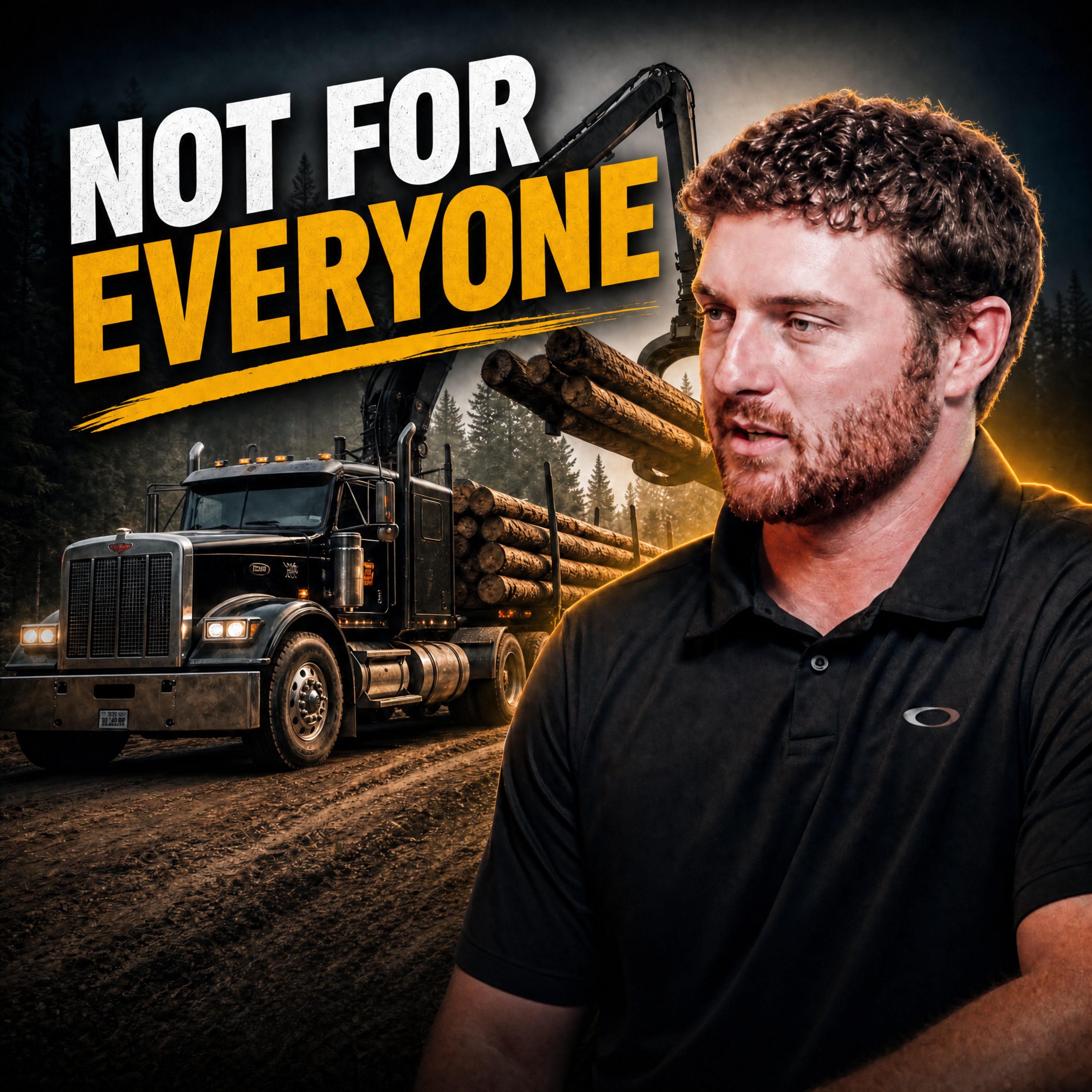
He got his CDL nine years ago and went straight into one of the hardest, most dangerous corners of trucking there is. Kyle has hauled logs out of swamps, flipped a pup on its side, and trimmed loads with a chainsaw over his head — and he’s still one of the youngest people left doing it. We sat down to talk about what the work actually takes, and why so few people his age are willing to do it.
Kyle came through truck driving school nine years ago and has spent his career since in towing, logging, and over-the-road freight. He’s seen the trade from inside the cab, on the loader, and out in the woods — and he doesn’t sugarcoat any of it.
Transcript
One guy told me he ain't a real log truck driver till you flip the pup on its side.
Speaker B:No, the most dangerous job out there is logging.
Speaker A:You can still make good money, but you are putting in a lot of hours.
Speaker A:Your minimum day is a short day.
Speaker B:Is like 12 hours to somebody maybe.
Speaker B:Thinking about the logging shoe, would you recommend going into it right out of truck driving school, or would you say, ah, get some other experience under your belt?
Speaker A:It's either you're gonna love it, you're not gonna mind the long days.
Speaker A:Not gonna mind.
Speaker A:Or you're gonna hate it.
Speaker A:If you're thinking about a career in the trades and you want to know what employers actually look for, what the work is really like, and what nobody.
Speaker B:Tells you before you get started, you're in the right place.
Speaker B:Built in the Midwest features conversations that'll help you figure out if this path is for you.
Speaker B:Welcome, Kyle, to Built in the Midwest podcast.
Speaker B:Thanks so much for being here today.
Speaker A:Well, thank you for having me.
Speaker B:No, absolutely.
Speaker B:And I'll tell you what.
Speaker B:So if I can give a backstory.
Speaker B:Kyle was a student of mine where I got to teach you how to drive a 10 speed and get in the industry and got your CDL.
Speaker B:And this was what?
Speaker A:This was eight years ago.
Speaker B:Nine years ago.
Speaker A:I want to say it was nine years ago.
Speaker B:Nine years.
Speaker B:Okay.
Speaker B:So it's been a minute.
Speaker A:h, it would have been June of:Speaker B:Yeah.
Speaker B:I'll be darn.
Speaker B:I'll be darn.
Speaker B:So.
Speaker B:And I'll tell you what, I'll never forget.
Speaker B:Kind of you riding in the truck because you were a quick study.
Speaker B:Picked it right up.
Speaker B:And in all honesty, like, here we are nine years later, and I've got to know your story pretty well over the years.
Speaker B:But.
Speaker B:But let's start right at the beginning.
Speaker B:Take me right through.
Speaker B:All right, you graduated truck driving school, got your cdl.
Speaker B:What happened then?
Speaker A:Well, it was actually kind of interesting because Jean Stone had a little poster on the thing.
Speaker A:Oh.
Speaker B:On the wall.
Speaker B:That they were hiring.
Speaker B:Yeah.
Speaker A:I walked in and I think we had an interview right then and there.
Speaker A:I'm like, hey, here, you guys are hiring.
Speaker A:And they're like, well, come on back.
Speaker A:It was Jamie Sprix, the owner of Gene's Towing.
Speaker A:And he's like, come on back.
Speaker A:We'll do this right now.
Speaker B:I'm like, okay, yeah, perfect.
Speaker A:And I want to say, it was like that day, or maybe the next day, they're like, yeah, we'll hire you.
Speaker A:I'm like, holy shit.
Speaker A:Like, this is insane.
Speaker A:That didn't take long, like.
Speaker A:So within a week, not even I had a job working at Gene's Towing.
Speaker B:And right out of.
Speaker A:Actually also I was hauling milk for the Bakers all the job.
Speaker B:Right out of school.
Speaker A:Yep, right out of school.
Speaker A:So I had two jobs.
Speaker A:One was Thursday and Friday and then the rest of the week I worked at Gene Stowing.
Speaker B:I know.
Speaker B:Nothing wrong with that.
Speaker B:Now did you know that's what you wanted to do right out of high school was get your CDL and get into this industry?
Speaker A:I.
Speaker A:Yes, because I mean originally it was for to become a lineman and then I started driving, went to the school that fall, went down to Georgia to school.
Speaker A:It was a 15 week school.
Speaker B:Oh yeah.
Speaker A:And it was pretty interesting, very fast paced.
Speaker A:But I mean they have a pretty good program down there.
Speaker A:And I, I will say like they have a pretty good success rate, very strict program, but they do pretty good.
Speaker B:It's good, but it's kind of like the CDL part where it's like, you know, it's full immersion.
Speaker B:You were talking about that.
Speaker B:There's so much that they cover every single day.
Speaker B:And it's like you've got to be there and give it up 100%, very high speed.
Speaker A:Because it's not like you're learning one subject a week, it's you, you're learning two subjects and then also like, you know, your other things like trying to get Crane certified and all that stuff.
Speaker A:Yeah, it's like you're getting a lot thrown at you at once.
Speaker A:And I think that's probably the toughest part is just trying to remember all of it.
Speaker B:Trying to remember everything.
Speaker B:And then you have your tests you were talking about that you have to pass.
Speaker B:And yeah.
Speaker A:And like, so you're doing a couple subjects a week, maybe even three.
Speaker A:So at the end of the week you'll have like three tests.
Speaker B:Oh, wow.
Speaker B:In one week.
Speaker A:In one week.
Speaker B:Yeah.
Speaker B:So.
Speaker A:And that gets kind of intense.
Speaker A:And then in the middle, like in these weeks, like you're doing cpr, first aid, like I said, the Crane stuff.
Speaker A:And then you're also going outside doing all the climbing and learning how, all that stuff.
Speaker B:Wow.
Speaker A:So it's, it's a lot thrown at you at once in 15 weeks.
Speaker A:I mean, I'll be honest, if I go back, I would do the NMU and where it's a whole year kind.
Speaker B:Of spread out a little.
Speaker A:Spread out more and more.
Speaker B:Gives you, you can give your morning a little easier, more time, more time with everything.
Speaker B:And you know, that's the Other thing is, you know, the fact that, that you can fail those programs that quickly, you know, that's, that's a, that's a deter.
Speaker B:Definitely you're only allowed to deterrent of going, going there, you know.
Speaker B:But you know, one thing that is interesting to me is, is you really dove right into the logging industry kind of.
Speaker B:Right.
Speaker B:Right after school.
Speaker A:Yeah.
Speaker B:And.
Speaker B:And you know, I will tell you, you know, everyone says the logging industry is one of the biggest industries here in, in the, in the Upper Peninsula.
Speaker B:But, but how did you get into it and how was that experience for you?
Speaker A:Well, that's actually kind of a funny story because I was dating a girl at a time and she had a family friend that was.
Speaker A:Had a log truck.
Speaker A:Her uncle or cousin used to drive it.
Speaker A:He's looking for a driver.
Speaker A:And you know, I was at Gene's Towing and they're like well hey, you interested in this?
Speaker A:And I'm like I'll give it a shot.
Speaker B:You know, looks kind of doesn't care.
Speaker B:I'll try a little bit of everything, you know.
Speaker A:You know, you see the trucks rolling down the highway.
Speaker A:You're like, that's pretty cool.
Speaker B:That's pretty cool.
Speaker B:Yeah.
Speaker A:Pretty badass if you ask me.
Speaker A:So let's give this a shot.
Speaker A:nd man, I remember that was a:Speaker A:Hi hood.
Speaker A:Yep, she was rough.
Speaker A:She was a rough, rough truck.
Speaker A:I remember meeting guys later on and they're like, yeah, I remember that you pulling in on that truck and we just all felt bad for you.
Speaker A:Man, that's rough.
Speaker B:Talk about getting your feet wet, you know, and just dive right on in.
Speaker A:And I mean, I want to say it was every other day that truck was breaking.
Speaker B:Really?
Speaker A:Yeah, just I remember one time the steering arm right off the steering box just turned a corner and that thing just popped right off.
Speaker B:Oh no.
Speaker A:And I'm telling you what, when you've got one missing because dual steer boxes on those trucks when you only have one.
Speaker B:Yeah, it's dual and those are 20,000 pound front axles.
Speaker B:So you need all of it.
Speaker A:Yeah, I was standing in the seat going hand over hand just trying to.
Speaker B:No.
Speaker A:Well, it was fully loaded though.
Speaker B:Oh yeah, exactly.
Speaker A:But yeah, it made for an.
Speaker A:That was quite the learning experience doing that.
Speaker B:Yeah.
Speaker B:You're not kidding.
Speaker A:Yeah, that was, that was a school of hard knocks.
Speaker B:Yeah.
Speaker B:There's only the handful of people throughout the course of a year that get into that.
Speaker B:I know that get into the logging industry.
Speaker B:It's probably one of the toughest Forms of trucking that I can think of out there.
Speaker B:And when did you decide to get into the owner operator logging side?
Speaker A:I want to say it was both.
Speaker A:Three years afterwards.
Speaker B:Okay.
Speaker A:So I did that and then I actually ended up working for Max Constantino.
Speaker A:He was a great teacher.
Speaker A:I will say that He's a little rough around the earth, but he's a great guy, honestly.
Speaker A:Yeah.
Speaker B:And you got to learn a lot from him.
Speaker A:Yeah.
Speaker B:He's been in this trade for many years.
Speaker A:And man, seeing even when I started with him to what he is now, like, that's awesome.
Speaker A:I am so happy to see that because the guy works his ass off to get where he's at and man, just.
Speaker B:He doesn't slow down.
Speaker B:He doesn't take time off.
Speaker B:No, just.
Speaker A:No, that guy, he just slowed down at all.
Speaker A:No, he literally runs.
Speaker A:He runs around the truck.
Speaker A:It's like, keep up or get out.
Speaker B:Exactly.
Speaker A:I remember a few times we got new driver when I was working for him and Guy did not.
Speaker A:I think he made it three days.
Speaker B:Really?
Speaker B:Yeah, he just couldn't cut it.
Speaker A:Just couldn't cut it.
Speaker A:No.
Speaker A:Well, I mean, you got to ride with me that one time.
Speaker B:Oh, just.
Speaker B:Now that's an experience.
Speaker B:Now I got to talk about that.
Speaker A:Just.
Speaker B:Just for a second because that was amazing.
Speaker B:So I've been, as you know, very interested in the log industry for some time and have.
Speaker B:Have years on the road.
Speaker B:Have had my CDL for 17 years, but never did anything with logging.
Speaker B:And I was like, Kyle, you gotta, you gotta.
Speaker B:Can you take me out?
Speaker B:I just, I just want to experience it.
Speaker B:And so we went out and.
Speaker B:And oh my God, some of the roads that we went down and.
Speaker B:And you know, you take log trucks down, roads that you wouldn't take a four wheeler down, but you're taking a fully loaded log truck and pop down.
Speaker A:Yeah.
Speaker A:And I'll be honest, like, the roads that I took you down were actually pretty nice.
Speaker B:They're pretty.
Speaker B:Oh yeah.
Speaker B:Well, that's great to hear.
Speaker B:You know that.
Speaker B:So.
Speaker A:But those are nice.
Speaker B:But it just blows.
Speaker B:Blows me away.
Speaker B:And then you were telling me stories.
Speaker B:Oh, yeah.
Speaker B:Sometimes you got to get pulled in and pulled out.
Speaker B:If it's really muddy or I've had,.
Speaker A:I'm pushing mud with the top of my bumper.
Speaker B:Oh.
Speaker A:And I had to get pulled all the way to the turnaround.
Speaker A:They had to turn me around with the dozer and then they pulled me to the pile.
Speaker A:I loaded the truck and then they pulled me all the way out.
Speaker A:Wow.
Speaker A:You were not getting in and out under your own power.
Speaker B:It was just that.
Speaker B:That bad.
Speaker B:And that money.
Speaker A:Like, in my opinion, after that you might as well just go home.
Speaker B:Yeah.
Speaker A:Like all you're gonna do is just break stuff.
Speaker B:Yeah, exactly.
Speaker B:There's no.
Speaker B:Nothing good's gonna come from, you know, trying to go through three feet of mud.
Speaker A:Yeah.
Speaker A:And I've seen some pretty rough roads where they're like, oh yeah, this is good.
Speaker A:And I'm like, you sure?
Speaker A:I mean like that's going right through a swamp.
Speaker A:You get on it and you can see the ground just doing the wave as you are driving from.
Speaker A:Oh yeah.
Speaker B:Oh wow.
Speaker B:And that's nerve wracking because you're like on a bog and.
Speaker A:Well, because like I remember this one time, it was just go down this hill.
Speaker A:It's a swamp.
Speaker A:And they're like, yeah, we.
Speaker A:So we found this rope.
Speaker A:We didn't know it was there, but we found it.
Speaker A:And I'm like, I mean like, did you guys add anything?
Speaker A:No, no, it looks good enough.
Speaker B:And we're like, you just found a road.
Speaker B:Like you find a quarter on the sidewalk.
Speaker B:I just found a road, so just go ahead and take it.
Speaker B:Yeah.
Speaker A:We didn't know it was there, but it's there.
Speaker A:But where we planned on putting the road anyways.
Speaker A:Perfect.
Speaker A:So we're just gonna use it.
Speaker A:And the road was just as.
Speaker A:I mean like, just as wide as the truck.
Speaker B:Oh.
Speaker B:Oh, man.
Speaker A:So if you made any little mistake, you went off.
Speaker A:Which I did.
Speaker A:End up doing it.
Speaker B:Well, when it's that tight.
Speaker B:Yeah, you're just.
Speaker B:You're bound to make a mistake and.
Speaker A:Yeah.
Speaker B:And you talk about like.
Speaker B:Like those Kenworth's high hood, you don't.
Speaker B:You can't see in front of you.
Speaker B:You can't see the sides.
Speaker B:And it's hard.
Speaker B:It's hard to know where you're at.
Speaker A:Yeah, it really is.
Speaker A:Because man, I. I drove the regular T800 sloped hood for a while.
Speaker B:Yep.
Speaker A:And then I had to hop in my guy who was.
Speaker A:I hauled for Andy Drayton, his high hood.
Speaker A:I drove that.
Speaker A:And I'm like, man, I can't see out of this thing.
Speaker B:No, no, exactly.
Speaker A:I'm like, man, but I look cool.
Speaker B:Yeah, it looks cool.
Speaker B:But I can't.
Speaker B:And they always have the tiny little windows.
Speaker B:And it's like.
Speaker A:And like he even said he's like.
Speaker A:Cuz he had hop in mine.
Speaker A:And he's like, man, I can actually like see the edges of the road way better.
Speaker A:And I'm like, yeah, makes a big Difference makes a difference.
Speaker A:Absolutely.
Speaker A:But it doesn't look as cool.
Speaker A:And I'm like, yeah, you're right.
Speaker B:It don't.
Speaker A:But I mean, sometimes practicality, you gotta ab.
Speaker B:Absolutely.
Speaker B:It's like you hop in a.
Speaker B:A Freightliner, you know, Century or Columbia or Cascadia.
Speaker B:You have the sloped hood.
Speaker B:You can see everything.
Speaker B:And then you get into a Pete or a Kenworth, and it's like, yeah, that's totally different.
Speaker B:So.
Speaker A:And I mean, don't be wrong.
Speaker A:I am running a 389pete right now.
Speaker B:Oh, you are.
Speaker A:Okay.
Speaker A:Beautiful truck.
Speaker B:Oh, yeah.
Speaker A:And.
Speaker A:But, yeah, visibility wise, I will say it is better than the Kenworth is lower.
Speaker B:Okay.
Speaker A:Which I actually enjoyed.
Speaker A:And.
Speaker A:Oh, very nice trucks.
Speaker A:I got no complaints.
Speaker B:Yes, you got a little better visibility there, which is nice.
Speaker B:Yeah.
Speaker B:And, you know, I'll never forget, then we got to the big.
Speaker B:It was all hardwood logs, you know, for the most part, where we were.
Speaker B:And you.
Speaker B:You hop in the chair and you're working that grapple, and you make it look so easy.
Speaker B:And like, you know, there's one stick and you pick it up and, you know, it's one of those things that if the majority of people never ran something like that.
Speaker B:But.
Speaker B:But how long did it take you to get good on that?
Speaker B:Because me, like, I. I struggle so much on those things.
Speaker B:I'm like, I feel like I'm learning a second language.
Speaker A:It took me years, years to get, like, get actually good to where you're being efficient on it.
Speaker A:Because, I mean, a lot of times you're just.
Speaker A:You don't think about it.
Speaker A:You're like, yep, just load it.
Speaker A:And then all of a sudden, next thing you know, you're looking at the pile, and it's just messed up because you were picking from the wrong spot.
Speaker A:Now you got two stops.
Speaker A:You got to make the next stop because you screwed it up.
Speaker B:Yeah.
Speaker A:So.
Speaker B:So you got to know.
Speaker B:You got to know what.
Speaker B:What you're loading.
Speaker B:And.
Speaker B:And that's where, like, talk about that from the.
Speaker B:From your perspective.
Speaker B:Like, you know, and some of the challenges that you face because you have different piles of logs, you have different grades of logs, different species of wood.
Speaker B:It goes to different places.
Speaker A:Yeah, you got different species.
Speaker A:Like, a lot of Aspen goes to LPs and Newberry and segola.
Speaker A:So you got that.
Speaker A:Potlatches, a lot of softwood, like red pine, jack pine.
Speaker A:So, I mean, you got all those, which really, if you don't know, just don't be ashamed to ask the logger.
Speaker A:I mean, Someone will teach you.
Speaker B:Yeah.
Speaker A:Just say, hey.
Speaker A:Like, man, I'm.
Speaker A:I'm not very.
Speaker A:Like, I'm not good at this.
Speaker A:Like, can you tell me certain ways to distinguish.
Speaker A:And it goes a long ways.
Speaker A:Just doing that.
Speaker A:Because once.
Speaker A:It's a lot better than accidentally grabbing the wrong stuff, the wrong place, and.
Speaker B:Then bring to the wrong place and then.
Speaker B:And then what?
Speaker B:It's like.
Speaker B:And depending, they might not take it and then.
Speaker A:Yeah, because I remember one time we got told we can bring.
Speaker A:I forgot what year it was.
Speaker A:I think it was spruce or balsam.
Speaker A:But anyways, Potlatch was not taking it.
Speaker A:I get there and they're.
Speaker A:They're looking at me like, what are you doing?
Speaker A:And I'm like, I was told you guys are taking this.
Speaker A:We haven't been taking this since, like, Christmas, and it's like, June.
Speaker A:No, it's like, middle of summer.
Speaker B:You told the wrong information.
Speaker A:Oh, yeah.
Speaker A:I was like, what the hell is this?
Speaker B:So what'd you have to do then?
Speaker A:Well, I had to make some phone calls.
Speaker A:And then there's like, we're sorry about that.
Speaker A:Like, do we get told the wrong thing?
Speaker A:And I'm like, well, my bad.
Speaker A:They're like, we'll pay you the mileage going up there and then also going back to Escanaba.
Speaker B:Okay.
Speaker A:Because the job actually was, like, out of.
Speaker A:I want to say, close to Foster City.
Speaker B:Gotcha.
Speaker B:Okay.
Speaker B:So you went all the way up there?
Speaker A:All the way up.
Speaker B:They didn't take it.
Speaker A:Yeah, they just took it.
Speaker B:So now you have to take that load down to Billarude or Verso.
Speaker A:Yeah, it would have been Verso at that time.
Speaker B:Okay.
Speaker B:Yeah, I'll be darn.
Speaker B:I'll be darn.
Speaker B:Yeah, no, that's.
Speaker B:And those are the.
Speaker B:Those are the challenges, I think, in logging that a lot of people don't talk about, you know?
Speaker B:And you know, because you really gotta know how to operate that grapple extremely well.
Speaker B:You got to be a problem solver.
Speaker B:What are some of the biggest problems or challenges that you ran into on in the logging side that just really made for a rough day.
Speaker A:Tipping a truck over.
Speaker B:Oh, really?
Speaker B:Okay.
Speaker B:I haven't heard about that.
Speaker A:It happens.
Speaker B:Yeah, it happens.
Speaker A:Well, as one guy told me, ain't a real log truck driver till you flipped a pup on its side.
Speaker B:No.
Speaker A:Which thankfully gets your feather in your cap.
Speaker B:I did it.
Speaker A:It's happened a couple times to me, and it's mainly been on the job road.
Speaker A:I've never lost it on a actual county road.
Speaker A:Never flipped one on Side, so.
Speaker B:Okay, well, that's good.
Speaker A:Yep, that's good.
Speaker A:We don't have that.
Speaker B:So what happens when that happens?
Speaker B:Does it like a corner too sharp or one side of the road kind of gives out or.
Speaker A:Well, say you get a little.
Speaker A:A little bit too close to the edge.
Speaker A:The all sudden the pup can just slide right off and then it goes right on its side.
Speaker A:Now I did have it happen one time where I was kind of coming up a hill.
Speaker A:It was in the winter and the road was crowned really good.
Speaker A:Some guy wanted to see what we were doing back there.
Speaker A:Some random guy from town just wanted to take a drive and there was a pull off spot.
Speaker A:And instead of just pulling into it, like you just straight in, like he backed into it and then the whole front end of his truck was just sticking out.
Speaker A:And I just moved off to the side and the whole pup went over and I felt the whole truck start to tip.
Speaker A:And then it came back down.
Speaker A:I was like, jesus Christ.
Speaker A:And it made a mess.
Speaker B:Oh, I can imagine.
Speaker B:Oh, just because someone was rubbernecking and wanted to check out.
Speaker A:Just want to check out what we're doing.
Speaker B:And you're like, so.
Speaker B:You're like, oh, I could, you know.
Speaker B:So it kind of put you in a real bad position.
Speaker B:It was like, okay, try to.
Speaker A:Well, cuz that was my load supposed to go back to Escanaba and this is all the way up in Lon.
Speaker B:Oh, wow.
Speaker A:So I had to go to the yard right outside of lots.
Speaker A:I forget the name of it, but I think it's bovine.
Speaker B:Okay.
Speaker A:And had to go there with half a load because the other half was in the ditch.
Speaker B:Yep.
Speaker A:And then I had to go back, reload the truck, come back, grab the pup, grab the pup load, and then head on out.
Speaker A:And that was.
Speaker B:Yeah.
Speaker A:Pay for a long day.
Speaker B:Yeah.
Speaker B:You're not kidding.
Speaker B:Now, did.
Speaker B:Did that.
Speaker B:Did it do any damage to the pump?
Speaker A:No, no, it didn't do a thing.
Speaker B:No, it just.
Speaker B:Just lost your load.
Speaker B:Just.
Speaker A:Yeah, just last load.
Speaker A:A little bit of the ego.
Speaker B:Yeah, exactly.
Speaker B:I imagine you had some.
Speaker B:A few choice words for that gentleman that decided.
Speaker A:I didn't even go near him.
Speaker A:Yeah, just get away from me.
Speaker A:Yeah, exactly.
Speaker A:I'm not dealing with this.
Speaker B:I hope you got to see what you wanted to see.
Speaker A:But he said he felt pretty bad.
Speaker A:I'm like, I hope you do.
Speaker B:Yeah, exactly.
Speaker B:Wow.
Speaker B:Crazy.
Speaker B:Crazy.
Speaker B:Well, you know, it's one thing that, you know, you've been able to really live breathe this industry in a way that the majority of people haven't.
Speaker B:And I get.
Speaker B:I get questions all the time, like, you know what I mean?
Speaker B:I want to get into the logging industry.
Speaker B:How do I get in the logging industry?
Speaker B:One, would you.
Speaker B:Would you recommend it?
Speaker B:One.
Speaker B:And two, how does someone get into the logging industry?
Speaker A:I mean, I will say this.
Speaker A:If you want to get like, I'm never gonna turn someone away from it because there is quite a age gap in that trade.
Speaker B:Absolutely.
Speaker A:To where a good example is.
Speaker A:Me and Corey McInerney are a couple years apart, and we both got into it at both the same time.
Speaker A:So I was 19, I think he was 20, 21.
Speaker A:And gotcha.
Speaker A:You know, you're gonna be the youngest guys in the industry at that time.
Speaker A:Well, now, fast forward eight years later, we're still the youngest guys.
Speaker B:He's still the youngest guys in the industry.
Speaker A:There's hardly anyone under us now.
Speaker B:Why is that?
Speaker B:Why aren't more people.
Speaker A:In my experience, you're putting in a lot of hours.
Speaker A:And, like, don't be wrong.
Speaker A:Like, you can still make good money, but you are putting in a lot of hours.
Speaker B:Yeah.
Speaker A:I mean, your minimum day is like, a short day is like 12 hours.
Speaker B:Minimum.
Speaker B:Minimum 12 hours.
Speaker A:Yeah.
Speaker B:So what time.
Speaker B:What time did you and a lot of other loggers like to wake up in the morning?
Speaker A:Well, it all depends if you want to be like Charlie Adams, you can get up before midnight.
Speaker B:Before midnight?
Speaker A:Yeah.
Speaker A:That guy, he's.
Speaker A:He's wild.
Speaker A:He.
Speaker A:He'll haul all the loads.
Speaker B:He doesn't slow down.
Speaker A:No, no.
Speaker B:If there's loads to be hauled.
Speaker A:No, he.
Speaker A:He always says, he's like, ah, I'm gonna slow her down a little bit.
Speaker A:And then it's like, he's up at midnight.
Speaker A:Talk to him at, you know, four in the morning, and he's like, yeah, I already got two loads in today.
Speaker B:And it's like, what are you.
Speaker A:I thought you said you were slowing down.
Speaker B:Yeah.
Speaker A:Yeah.
Speaker B:Sounds like you grabbed a gear.
Speaker A:Yeah, it's like, well, I just.
Speaker A:I can't sit at home.
Speaker A:Yeah, I guess not.
Speaker B:No.
Speaker B:You're not kidding.
Speaker A:But I mean, no.
Speaker A:You want to learn how to run, Talk to him on the phone, and he'll give you some tips.
Speaker A:He can run hard.
Speaker B:So something I was doing a Google search before this, and something I saw was that the most dangerous job out there is logging.
Speaker A:Really?
Speaker B:Yes.
Speaker B:Just in case you were wondering, in case you didn't know which, I found it interesting.
Speaker B:And, you know, from your own experience, you know, what have you seen of the dangers of Logging.
Speaker A:Well, I've seen a few.
Speaker A:Nothing too crazy.
Speaker A:But I mean, you should really start thinking about it.
Speaker A:Well, look at the way that we'll trim the trucks when you got long ones.
Speaker B:Yep.
Speaker A:You know, chainsaws right above your head.
Speaker A:You're just holding it onto it with one arm and you're.
Speaker B:And you're.
Speaker B:You're right up there.
Speaker A:Right there.
Speaker A:Just holding onto it and you're like, just wide open.
Speaker A:Exactly.
Speaker A:Cause that's the problem.
Speaker B:And so what, what Kyle's saying here.
Speaker B:You got a long log that sticks out the side of a truck.
Speaker A:Yeah.
Speaker B:You can only be so wide.
Speaker B:You gotta use your chainsaw to trim down the side of the truck and to make sure nothing's overhanging.
Speaker B:But sometimes it's 10ft up in the air, so you're straight up with the chainsaw.
Speaker B:That's kind of dangerous.
Speaker A:Yeah, that's pretty dangerous.
Speaker B:A little bit.
Speaker A:But I think the was.
Speaker A:I just.
Speaker A:I got into it so young that that's just right.
Speaker A:I got told that's how it's done.
Speaker A:If you can't do it, then you got to find a different job.
Speaker A:So I don't know how else you're gonna do it.
Speaker B:Push.
Speaker B:So it wasn't even push comes to shove.
Speaker B:It was like, no, this is the way it's done.
Speaker B:You can't haul it with stuff sticking out the side.
Speaker B:So get your.
Speaker B:Get up there and trim it.
Speaker A:Once you get better at running the loader, you can kind of find those ones that are high up.
Speaker A:Because actually, I. I will say probably the most dangerous part is trying to trim the ones all the way up on top to where you actually have to get on top of the load with a chainsaw.
Speaker B:Oh, yeah.
Speaker B:Because lean over the edge.
Speaker A:Lean like.
Speaker A:Yeah, lean over the edge.
Speaker A:And that's because, man, I have came close to falling off that pup quite a few times.
Speaker A:Just pulling chains quite a few times.
Speaker B:Yeah.
Speaker B:And talk to me about that, because you know how.
Speaker B:Now I seen you do it.
Speaker B:But I want to hear, you know, everyone to be able to hear it from you.
Speaker B:How do you get the chains to go over top of.
Speaker B:Of your load?
Speaker A:So you got chain boxes right in the front.
Speaker A:And then I hook the chains up to drop stakes if you have them.
Speaker A:If you don't.
Speaker A:Normally you got a hook on the one side of the drop stake, so you'll just hook it onto that.
Speaker A:And then you spin the loader to the side so you're closest to the wood on the trailer.
Speaker A:And you will just.
Speaker A:If you don't have a step that swings out.
Speaker A:You gotta hop.
Speaker A:And hopefully it's not a far hop.
Speaker B:And you're like 14ft up in the air.
Speaker B:Yeah.
Speaker A:And then you just grab the chains and you pull it over the top and there's airbags on the air binders on the other side, and you hook it up to those.
Speaker A:Wow.
Speaker B:So you're actually walking across the whole load on top.
Speaker A:Yeah.
Speaker B:There's no fall protection up there or anything, so.
Speaker B:Okay, so you're starting.
Speaker B:It's starting to make sense why this is the most dangerous occupation.
Speaker B:And not that you're hopping 14ft, hoping that it's not slippery or raining or snowy or icy.
Speaker B:I mean, there's.
Speaker A:I will say, in my opinion, stepping over is a lot easier than coming back to the loader.
Speaker B:Gotcha.
Speaker A:Because I don't know, for me, it was like, well, I can set my foot on this one log and then just kind of climb up it.
Speaker A:But then we're trying to come back over, See, it's raining.
Speaker B:This is kind of slick.
Speaker B:It's a little slippery.
Speaker A:Yeah.
Speaker B:Yeah.
Speaker B:So.
Speaker B:So there's a lot of.
Speaker B:There's a.
Speaker B:And I think that's important for people out there that are maybe interested in this.
Speaker B:That it is.
Speaker B:It's a dangerous job.
Speaker B:It's a danger.
Speaker B:And.
Speaker B:And there's some danger aspects.
Speaker A:It can be as dangerous as you want to make it.
Speaker A:I mean, don't be wrong.
Speaker A:You gotta do some stuff, but push come to shove.
Speaker B:Yeah.
Speaker A:You gotta be able to see what you're comfortable doing and what you're not.
Speaker A:But.
Speaker A:Absolutely.
Speaker A:Because, I mean, at the end of the day, we all want to go back to our family, so.
Speaker B:Yeah, exactly.
Speaker A:You know, how.
Speaker B:How dangerous do you want to be, exactly?
Speaker B:Wow.
Speaker B:Wow.
Speaker B:No, I think there's a lot of jobs out there that.
Speaker B:That have so many safety precautions in place.
Speaker B:Right.
Speaker B:That you can't.
Speaker B:You can't hurt yourself if you wanted to.
Speaker B:But logging there just.
Speaker B:I don't see a lot of that where there's just like.
Speaker B:You just gotta be extra careful in everything that you're doing.
Speaker B:But it's not like you have fall protection up there.
Speaker A:Well, a lot of.
Speaker A:It's just kind of common sense.
Speaker B:Yeah.
Speaker A:Which I know it's not very common nowadays, but you have to, you know, look around, be observant, be like, that doesn't look like a good place to be.
Speaker B:Yeah.
Speaker A:So I'll stay out of it.
Speaker B:Yeah, no, absolutely.
Speaker B:What.
Speaker B:What other, you know, what other advice would you give to somebody maybe thinking about the Long issue.
Speaker B:Would you recommend going into it right out of truck driving school or would you say, ah, get some other experience under your belt?
Speaker B:What's, what's, what's a good recommended path?
Speaker A:I think it all depends on the person.
Speaker A:I mean I.
Speaker A:Because really I think you're either cut out for it or you're not.
Speaker A:It's either you're gonna love it, you're not gonna mind the long days, not gonna mind the hard work, or you're gonna hate it.
Speaker B:Yeah.
Speaker A:And there really seems to be no in between.
Speaker B:No, no.
Speaker B:Love it or hate it.
Speaker B:Like you were talking about the one guy made it three days, you know, that you were working with and he just, just couldn't cut it.
Speaker B:And.
Speaker A:Yeah, and it was like the trimming, that's what really got him.
Speaker B:Oh, really?
Speaker A:Yeah, he's like, no, like chainsaw over.
Speaker B:Top of my head.
Speaker B:Like you gotta swing it up like you're in a circus and land it just right.
Speaker A:Oh, yeah.
Speaker A:Well, you can.
Speaker A:If you got enough muscle, you can power it up there.
Speaker B:But it's not bad.
Speaker B:Oh, you know, I think if there was a chainsaw safety instructor listening, you know, he's just rolling his eyes right now.
Speaker B:Oh, boy.
Speaker B:Not only do you not have two hands on it, but then you're over your head and you're trying to get it to bite up there.
Speaker A:You know, open it, don't kick.
Speaker B:Yeah, exactly.
Speaker A:And then I don't know, the best way I learned was you don't want to have it like too far forward.
Speaker A:You're actually almost better off to be directly under it.
Speaker B:Like, I'm not lying right over top of your head.
Speaker B:That's.
Speaker B:That's ideal.
Speaker A:That's actually.
Speaker A:When that piece falls off, it's going to hit the muffler of the.
Speaker A:Which mufflers don't last long, but it's going to hit the saw and then bounce away.
Speaker B:Gotcha.
Speaker B:All right.
Speaker A:It's always going to hit the softers.
Speaker B:So like a, like a ping pong ball, it's just going to bounce off the saw.
Speaker A:Had them where I'm like, I'll just stand a little bit back and I start.
Speaker A:And then it rolls back and it rolls right onto you.
Speaker B:Oh, and it rolls down the saw onto you.
Speaker A:Yeah, it rolls back.
Speaker A:Where a lot of times they'll either go forward or backward.
Speaker A:Well, if you're underneath the saw, it's either going to land behind you or in front of you.
Speaker B:Interesting.
Speaker B:It's the safest place.
Speaker A:It really.
Speaker A:It doesn't sound like the Safest place.
Speaker B:No, it doesn't.
Speaker B:It doesn't.
Speaker B:I. I'm going to have to take your word for it on that one.
Speaker B:All right.
Speaker A:So I've been told.
Speaker A:I. I tend to do dangerous stuff safely.
Speaker B:Yes.
Speaker B:Okay.
Speaker B:All right.
Speaker B:That's.
Speaker B:Yeah, that's an oxymoron.
Speaker B:You know, dangerous stuff safely.
Speaker A:Like, you know, you're doing it.
Speaker A:Dangerous thing, but you're just trying to do it as safely as possible.
Speaker B:Oh, my God.
Speaker B:No, that's.
Speaker B:That's good stuff.
Speaker A:Well.
Speaker B:Well, you know, what's.
Speaker B:If you could go back, you know, and like I said, you got your CDL nine years ago, and you've been in different aspects of the trucking industry, including over the road.
Speaker A:Right.
Speaker B:You know.
Speaker B:You know, would you do anything differently or did it all kind of lead you to where you are now?
Speaker A:I think it all kind of led me to where I am now.
Speaker A:It's all experience that I, you know, it'll come in handy one of these days.
Speaker B:Absolutely.
Speaker A:I know it will.
Speaker A:But there's a lot of things that you get to see, different perspectives.
Speaker A:Because, man, I don't know.
Speaker A:When I was in a log truck, I'm like, man, those over the road guys just got it so easy.
Speaker A:It's not, you know, I'm not knocking over the road driving, because there's its own demons in that.
Speaker B:Oh, exactly.
Speaker B:And it's tough in its own right.
Speaker B:Just.
Speaker B:Just being away.
Speaker B:Just being away from home.
Speaker B:Just being away from home and.
Speaker B:And not being able to eat dinner with the family on a regular basis.
Speaker B:That's.
Speaker B:That's tough.
Speaker B:Yeah.
Speaker A:Or, you know, like, it's like, oh, well, someone's birthday is coming up and I'm not home for that.
Speaker A:So that's.
Speaker A:That sucks.
Speaker B:Yep.
Speaker B:Or a holiday, like you just said.
Speaker A:Yep.
Speaker A:I was gone for Memorial Day and.
Speaker A:Which, I mean, like, wasn't a huge deal.
Speaker A:Obviously, I'm single, no kids, so not a big deal.
Speaker A:But.
Speaker B:But it would be, if you had.
Speaker B:It would be, you know, a wife and kids.
Speaker B:And that's something you got to think about.
Speaker A:Yeah.
Speaker A:So, I mean, like.
Speaker A:But that's just a part of doing that job, is sometimes you're gonna get stuck out on the road and there's nothing you can do about it.
Speaker B:No, exactly.
Speaker B:And I think it's important for people that are.
Speaker B:That are looking at, you know, these different trades is to kind of understand what they're getting into and know that they're not.
Speaker B:They're not maybe as easy as you make it in there in your mind and that it's going to require a lot of hard work and sacrifice and.
Speaker A:Well, and you know my opinion, if you're not willing to make some sacrifice, you're probably in the wrong industry.
Speaker B:Yeah, yeah, exactly, exactly.
Speaker A:I guess another big thing is for the guys who are just getting into the trucking industry, you're not going to get the top pay like right away.
Speaker A:No, you got to simmer it down.
Speaker A:It takes years.
Speaker B:It's like anything, it takes years.
Speaker B:You got to work your way up.
Speaker B:Right.
Speaker B:I mean, you're not going to start where a 20 year season bet is.
Speaker B:Right.
Speaker B:So you're going to start down here.
Speaker A:Met so many guys who, it's like they're a year or two in like, man, I should be getting this.
Speaker A:And I'm like, I don't know.
Speaker A:I've been on the phone with you and I've heard you fuck up some, several things like to where it's like, come on dude, like, what are you doing?
Speaker B:But you're lucky you still have a job.
Speaker B:You're looking for a raise.
Speaker B:I'm wondering why you're still employed and.
Speaker A:I'm sure you've seen it too.
Speaker A:Or it's like, man, I don't, I don't know, maybe you should just shut your mouth and you know, learn.
Speaker B:Yeah, exactly.
Speaker B:Well, and especially early on, that's something I encourage all the, all the students that, you know what, don't be too picky, choosy.
Speaker B:Get that experience under your belt.
Speaker B:And your experience is more important than the money that you make because that experience will build the foundation that you can build on the rest of your life.
Speaker A:Well, and then even when someone's trying to teach you how to do something and you think you already know it, just sit there with your mouth shut.
Speaker A:Listen.
Speaker A:Because there might, might throw in something that you weren't doing before that you should have been.
Speaker B:Yeah.
Speaker A:Because every day you learn something.
Speaker B:No, I, I love that.
Speaker B:I love that.
Speaker B:And you know, I always enjoyed talking and learning from older, older guys in the industry that have been in the industry for 30 years and they have all little tips and tricks to make it more efficient and effective and you know, maximize your time out there.
Speaker B:So.
Speaker A:Well, and that's a big thing in a lot of the industry is just trying to do the most you can with your time and not just be sitting there twiddling your thumbs because you mess something up or whatever.
Speaker B:Exactly.
Speaker A:That's huge.
Speaker A:Especially like with, well, a lot of the logging is you get paid by the court or you get paid by the load or there's some guys that do it by the hour, but it's not very many, honestly.
Speaker B:Yeah.
Speaker A:And at least that I've seen a lot of it is by the load or, you know, if you're cutting so many good.
Speaker B:Maximize as much on that truck and pup as you can, you know, and that's how you stack it and.
Speaker A:Yeah.
Speaker A:And just trying to be as efficient as you can.
Speaker A:That's huge.
Speaker A:And also not tearing stuff up.
Speaker B:Yeah, yeah, that's.
Speaker A:It's not cheap to fix some things.
Speaker A:And I'll, I'll say this right now, like the rates are not up where they should be.
Speaker B:Yeah.
Speaker A:ooking at my rate sheets from:Speaker B:And over.
Speaker B:Over 20 years.
Speaker A:Yeah.
Speaker B:Wow.
Speaker A:Not very much.
Speaker A:o one guy and he's like, yep,:Speaker A:And for the truck, pop loader, rack, everything, I paid 150,000 for it.
Speaker B:Wow.
Speaker B:Wow.
Speaker A:Like we were just saying, it's probably close to 600,000 to put together a new one and the rates have barely changed.
Speaker B:Wow.
Speaker B:Well, that definitely doesn't incentivize people to want to get in this industry.
Speaker A:That's.
Speaker A:I think that's where we are seeing the biggest problem is if you actually want to make money, you really have to just work.
Speaker B:Yeah.
Speaker A:Like really, really work.
Speaker A:It's not, you know, you do your 10 loads a week, whatever.
Speaker A:Normally you'd be sitting really good and just feels like that's not the case.
Speaker B:That's not the case anymore.
Speaker B:So clearly there's, there needs to be some catching up on, on that regard.
Speaker B:And yes, and hopefully, hopefully we see a big, big change in that because, you know, the log industry is, is one of the biggest industries in the upper.
Speaker B:You know, the fact of the matter is if you're in the log industry, you got to be able to provide for your family, but you got to be able to, you got to be in the black.
Speaker B:I mean, you just.
Speaker B:It, it has to work.
Speaker A:It's got to make sense.
Speaker A:It's gotta.
Speaker A:I mean, none of us are, none of them.
Speaker A:We're looking to get rich.
Speaker A:No, it just.
Speaker B:But you want to make a good living.
Speaker A:You want to make a living.
Speaker B:Yeah, absolutely.
Speaker B:And if you're taking out a $600,000 loan for a brand new truck and puppet, guess what?
Speaker B:You know, you deserve to make A good living and willing to work the hours that you do so well.
Speaker A:And the thing is is it's now getting to the point where it's.
Speaker A:You don't even wanna try and go all new.
Speaker A:Just forget it.
Speaker A:Because that payment's gonna be astronomical.
Speaker A:I mean 600,000, you're probably looking that close to a. I would say close to a fucking $14,000 a month payment.
Speaker B:Yeah.
Speaker B:So trying to haul that many loads.
Speaker A:Yeah.
Speaker B:On top of your regular maintenance and everything else.
Speaker A:Yeah.
Speaker A:Top your regular.
Speaker B:Yeah.
Speaker A:So any other payment you have.
Speaker B:Yeah, exactly.
Speaker A:I mean, yeah, probably some people can do it, but I wouldn't want to.
Speaker B:No.
Speaker A:I wouldn't want to be that guy.
Speaker B:That's.
Speaker B:And that's a lot of stress because that one log truck goes down or has a bad breakdown.
Speaker A:There's no income coming.
Speaker B:Yeah, none.
Speaker B:It's so it's, it's tough.
Speaker B:So that's where hopefully the industry can change kind of for the better.
Speaker B:To be able to, to really give all the loggers out there kind of the right, the rate pay that they need to be able to do the job.
Speaker B:Otherwise we're going to be chasing loggers away and we're not going to get young people into it because no one's going to work for free anymore.
Speaker B:Plain and simple.
Speaker B:It ain't going to happen.
Speaker A:Well and the other thing is it's just.
Speaker A:There's not a whole lot of people who actually just want to sit down and just put in a bunch of hours.
Speaker A:It's.
Speaker B:Yeah.
Speaker B:Those people are, are becoming rare.
Speaker A:Well plus how do you incentivize people to get in the logging?
Speaker A:Like hey kids, look at me.
Speaker A:You want to go work 80 hours a week and.
Speaker B:And be bring home 75 bucks?
Speaker A:You know, in question life choices.
Speaker A:You know, at the end of the day it's, it's got to make sense for everyone.
Speaker B:Exactly, exactly.
Speaker B:And so, and so for you, you've, you've looked at everything and said you know what?
Speaker B:Okay well if this isn't where it needs to be, I'm going to find something that is plain and simple.
Speaker B:So, so yeah, I don't.
Speaker A:I did drive for someone else's lock truck and I didn't mind that.
Speaker A:Just I will say the only reason I switched over the road was just because we're having very.
Speaker A:An inconsistent like they even said they're like this is the most inconsistent summer we ever had like in years.
Speaker A:And it was just like, just how.
Speaker B:The loads worked out.
Speaker B:Yeah.
Speaker A:So I was just trying.
Speaker B:But that doesn't work for somebody that wants a full time position either.
Speaker A:Well, and like we, we made, we were making it work like, you know, we, we would rotate on because there was a few times there where it's like, well, there's not enough loads for everyone.
Speaker A:And well, you know, this guy sat last week, so I'll set this week or not the week, but I'll set a couple days.
Speaker B:Yeah.
Speaker A:And then, you know, next week someone else will sit.
Speaker A:And so it just kind of rotated.
Speaker A:Very, very fair.
Speaker B:Yeah.
Speaker A:I mean, you really can't argue it.
Speaker A:They treated me really good.
Speaker A:Like they're really nice people.
Speaker A:Great people, honestly.
Speaker A:But yeah, just try to get something more consistent.
Speaker B:Exactly.
Speaker B:And it's.
Speaker B:Yeah, one of those things that sometimes you can't help kind of where the industry's at and you can't put your life on hold.
Speaker B:So it's like, all right, time to move on and do what's best for you.
Speaker B:Well, I want to be respectful of your time, Kyle.
Speaker B:And I will tell you, I think definitely gave a lot of great information to people out there that are interested in the trades, thinking about the, you know, the logging industry and, and gave them a little bit more to chew on.
Speaker B:Right.
Speaker B:And you know, and it's not.
Speaker B:And it's not all roses and rainbows.
Speaker B:And I think it's important that people understand some of those expectations.
Speaker A:Yeah, hopefully they do.
Speaker A:I mean, like we talked, it's not all it's cracked out to be.
Speaker A:There's a lot more work involved than I think some people expect.
Speaker A:Maybe not.
Speaker A:But yeah,.
Speaker B:Some things.
Speaker B:Yeah.
Speaker A:Need to change and hopefully they do.
Speaker B:Exactly, exactly.
Speaker B:Well, you know what, I appreciate you for keeping it real with me.
Speaker A:Yeah, anytime.
Speaker B:All right, thank you.
Speaker B:Great having you, Kyle.