
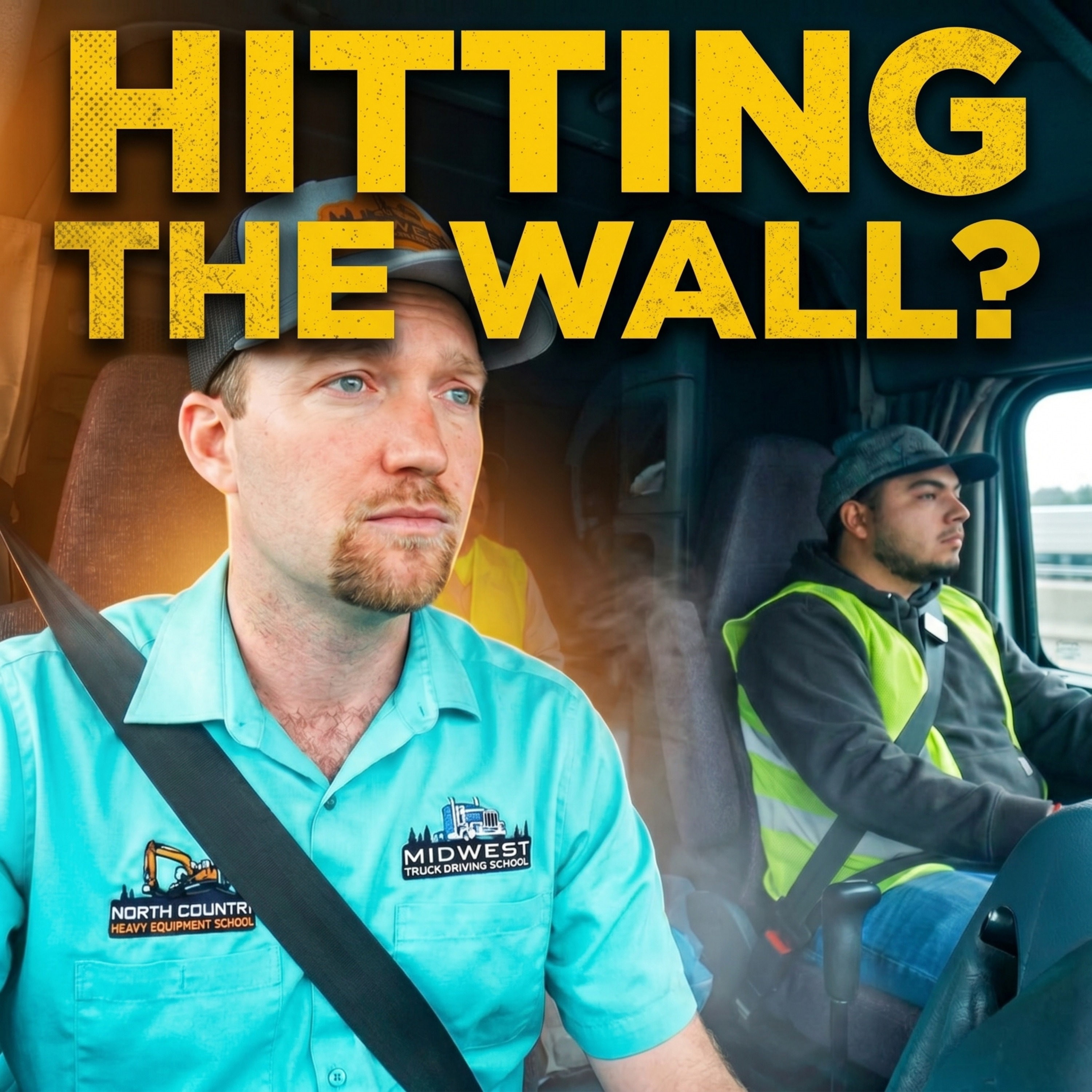
Quick heads up before you press play: we recorded this one inside a moving training truck during an active class day, so the audio gets scratchy in spots. We cleaned up what we could — some of it just is what it is when you record on the road. Bear with us. The conversation makes it worth it.
THE PREVIEW
This one’s a behind-the-scenes episode. No table, no studio, no script — just a mic in the cab and two students riding along on a real training day.
Both of them are in the middle of the course, and they came at it from completely different places in life. But somewhere around the middle of training, almost every student we’ve ever had hits the same wall — and almost nobody talks about it before they enroll.
Different ages. Different reasons. Different jobs on the other side of it. Same program. Same wall in the middle. Same way through.
WHAT WE GET INTO
- The wall almost every student hits around the middle of the course — and why Josh says it’s a good sign, not a bad one
- The night Nate had to “get the stress out” — and the gear that put him there
- The job Jason interviewed well for and still didn’t get — for one reason he couldn’t argue with
- Whether eight hours a day in a truck feels like a grind or a normal day once you’re a few weeks in
- A live look at something most schools never show you: reading a truck stop before you commit to pulling in
TIMESTAMPS
00:00 — Why this one sounds different 01:20 — The wall every student hits — and why Josh says it’s a good sign 02:20 — Meet Nate 03:46 — The moment trucking got its hooks in him 06:06 — Why right now might be the best window Josh has seen to get in 06:48 — The night Nate had to “get the stress out” — and the gear that put him there 08:37 — A live look at the kind of detail nobody shows you on a brochure 10:35 — Driver switch — meet Jason 13:12 — Where 16 years in this industry can take you 15:10 — Does eight hours a day feel like a lot? Jason answers honestly 18:31 — The job Jason didn’t get — and the advice that came out of it 22:16 — Where this drive was actually headed 23:21 — Signing off from the side of the highway
🔗 LINKS
Listen wherever your get your podcasts: https://built-in-the-midwest.captivate.fm/listen
Midwest Truck Driving School: midwesttruckdrivingschool.com
North Country Heavy Equipment & Electrical Line School: https://ncheschool.com/
Submit your Questions: https://webforms.pipedrive.com/f/6WfGT9X1zlYC6WvssJqfWxOOkvVa1AjzqgnAIIHOq70WWiNo5czEWXpBMqxVTW7UST
💬 CONNECT
Email: marketing@midwesttruckdrivingschool.com
Facebook: https://www.facebook.com/CDLMidwest
Instagram: https://www.instagram.com/midwesttruckdrivingschool/
TikTok: https://www.tiktok.com/@midwesttruckdrivingskool
Transcript
If you're thinking about a career in the trades and you want to know what employers actually look for, what the work is really like, and what nobody tells you before you get started, you're in the right place.
Speaker A:Built in the Midwest features conversations that'll help you figure out if this path is for you.
Speaker A:Well, hello, everybody, and welcome to the Built in the Midwest podcast.
Speaker A:We are taking the podcast on the road today as we.
Speaker A:As we do what we do best.
Speaker A:And that's, of course, class A CDL training, heavy equipment operator training, and lineman training.
Speaker A:So I'm here today with none other than Nate.
Speaker A:All right, Nate, say hello, but don't take your eyes too long off the road.
Speaker A:All right?
Speaker A:This is probably the epitome of distracted driving right here, but we are on the highway.
Speaker A:We got a long, straight stretch right here, and we got multiple sets of eyes, all right?
Speaker A:So we are paying attention.
Speaker A:I do promise you that.
Speaker A:And then behind me, we have Jason as well.
Speaker A:Jason, say hello.
Speaker A:And RJ Next to him as well.
Speaker A:As we're, like I said, taking the podcast on the road today.
Speaker A:So today, what I wanted to be able to do is talk to some students that are in the course.
Speaker A:They're right in the meat of the course.
Speaker A:They're in the middle.
Speaker A:Of course, they're studying every night.
Speaker A:They've gone through some hurdles, some struggles, and I don't know what they are, but I know they have, because every student, every single one, gets frustrated at some point in this course.
Speaker A:And that's not a negative thing.
Speaker A:That's not a bad thing, because that.
Speaker A:This course challenges you.
Speaker A:It pushes you.
Speaker A:It forces you to grow.
Speaker A:It forces you to get out of your comfort zone.
Speaker A:And it's a tough course.
Speaker A:And frustration is a good thing.
Speaker A:Frustration means you're struggling.
Speaker A:Frustration means you're overcoming hurdles.
Speaker A:And as long as you're here, giving it 110%, like I tell all students, you will succeed at this.
Speaker A:That's the biggest thing, is to be here and give it 110%.
Speaker A:And I will tell you after training with these gentlemen so far this morning, they are doing that, and they're making it happen.
Speaker A:So I'm gonna go on over to Nate here.
Speaker A:Nate, we're gonna multitask here a little bit.
Speaker A:All right?
Speaker A:So, Nate, go ahead and tell me about yourself a little bit.
Speaker B:Well, I'm 23, did a lot of carpentry for a long time, learned from my dad.
Speaker B:And then some things changed in my life, and I wanted to try something different and dig in.
Speaker B:I know that this career, really, there's a lot of people looking for drivers, and I wanted to make myself more valuable, more or less.
Speaker B:And I felt like I can.
Speaker B:My stepdad also was kind of pushing me, you know, so.
Speaker B:And he was.
Speaker B:He's a truck driver, too.
Speaker B:He drives for one of the companies where I'm from, so it's something I want to do, you know, just for myself.
Speaker A:Okay, so you have some family in this as well.
Speaker A:So do you still want to do some carpentry, or are you kind of getting burnt out from the carpentry side of things?
Speaker B:I want to do carpentry, too, but I want to do it for my pleasure and not get mad at it.
Speaker A:Yeah, you know, Exactly.
Speaker A:So you want to work on your own stuff.
Speaker A:Correct.
Speaker A:You know, it's funny you say that, because I have a buddy that he's a contractor, and his wife has been bugging him for, like, 10 years for him to build them a house.
Speaker A:And he's like, well, if I build my own house, then I'm not making any money because I gotta build other people's houses.
Speaker A:Right.
Speaker A:And so it's like this constant battle where it's like, that's what she wants.
Speaker A:And he wants to, too, but he's so busy building other people's homes and remodeling other people's homes, he just can't get to that.
Speaker A:So kind of going back to the trucking side of things.
Speaker A:So where did your interest.
Speaker A:Interest in trucking come from?
Speaker B:Well, I'll say my stepdad.
Speaker B:I mean, he.
Speaker B:He took me to this thing at the Resch Center.
Speaker B:It was.
Speaker B:I can't remember, Truck country or something.
Speaker B:They had a big show, and the company gave him two tickets to go.
Speaker B:And so we went down there, and they had the new trucks there, and they had different vendors and stuff, so I got to sit in at the time, it was when the Transformers movie, one of the last ones, came out with the Western Star truck, and they had that there.
Speaker B:So I got to sit in that.
Speaker B:And I remember that pretty clear.
Speaker B:So certain moments like that kind of dug into it and.
Speaker A:Absolutely.
Speaker A:You know, it's funny.
Speaker A:Yeah.
Speaker A:Different things like that.
Speaker A:I. I have a very unique memory when I was younger with my grandpa, and he was.
Speaker A:I had a bunch of family in the trucking industry.
Speaker B:Right.
Speaker A:So I was.
Speaker A:I was just born to be a trucker myself.
Speaker A:And I remember hopping in, and he had me hop in the.
Speaker A:In the driver's seat.
Speaker A:And I was maybe 8, 9 years old.
Speaker A:And he put in gear, and we started Moving, I'm like, you know, but I'll never for get that memory because it's like, wow, I'm behind the wheel of a big rig and you know, and it was on a back road, but still it was like that memory was implanted in me and I, you know, it was just an itch I had to scratch.
Speaker A:Right.
Speaker B:I mean, as soon as I got.
Speaker A:Old enough, I got my cdl, got in the truck industry.
Speaker A:And I've been in the truck industry now for 17 years.
Speaker A:And so it's been a great, great thing for me and a great career and I've really enjoyed it.
Speaker A:So what do you want to do after you gradu the program?
Speaker B:I want to definitely get into a job somewhere local though, that I can be home every night.
Speaker A:Yep.
Speaker B:So I did move away from home for a while and now I want to get closer to my mom and my grandpa, just be there.
Speaker B:But, you know, it's something I like to do.
Speaker B:So I got some friends who have different inns there, different job or places, so the connections are there.
Speaker A:Awesome.
Speaker A:And I will tell you, after being in this industry 17 years, I got a good kind of read on where it is.
Speaker A:And I will tell you, 17 years ago, if you came through the school, your options were primarily otr, where there was a lot of job opportunities, but not local or regional.
Speaker A:They were mainly OTR sub regional, but that's where people went.
Speaker A:And then today, today there is more local and regional job opportunities in trucking than I've ever seen before.
Speaker A:And this was an article in transport topics a handful of months back, but they said 125,000 open driver position across the country right now, you know, including many local, many regional, and of course, many OTR positions.
Speaker A:So right now it really is, in my experience, one of the best times to get into the truck industry.
Speaker A:And something that.
Speaker A:Something that there's all these great opportunities that you can take advantage of.
Speaker A:Okay, so you're in the middle of the course.
Speaker A:How has it gone thus far?
Speaker B:It's had its ups and downs.
Speaker B:There's been nights where it's like, man, I gotta get your stress out and you just gotta show up the next day because it's gonna be better.
Speaker B:It's a new day, you know.
Speaker B:Yep, I know.
Speaker B:For instance, Monday this week, it.
Speaker B:I missed a gear right at a critical moment, and I struggled and found it then afterwards.
Speaker B:So I was able to get the truck rolling again.
Speaker B:But from that point it kind of messed with me a little bit.
Speaker B:But then Tuesday came back and it Was a much better day.
Speaker A:I felt.
Speaker B:Felt more confident that I could figure things out, you know?
Speaker A:Absolutely, absolutely.
Speaker A:It's one of those things that you're gonna make mistakes, right.
Speaker A:And it' important to not let that error or that mistake affect you.
Speaker A:Right.
Speaker A:You know, it's hard to let stuff go, but it's important you miss a gear or you stall the truck out.
Speaker A:It's like, okay, we gotta let that go, we gotta move on because we gotta look to the road ahead, essentially.
Speaker A:Right.
Speaker A:And not let that affect kind of what we're doing now.
Speaker A:So that's important.
Speaker A:What's been the most challenging so far in the course?
Speaker A:I would.
Speaker B:The pre trip has been okay so far.
Speaker B:Some of the wording and stuff of how things are said, more or less, you know, But I think off the bat it was kind of getting used to my mirrors and trusting them because you can't just look back and see where the trailer is, you know, for like yard maneuvering, you know.
Speaker B:But I'm coming out of that pretty good, I guess.
Speaker B:This driving in general, having the ability to try and see everything what's going on and do your downshifting and then get up to speed properly merge.
Speaker B:Right.
Speaker B:And that's probably about the biggest struggle.
Speaker B:But it's coming up, coming our own.
Speaker A:Absolutely.
Speaker A:All right, well, with that being said, we're going to stop right up here.
Speaker A:So let's get on that brake a little bit.
Speaker A:We're going to slow down, we're going to turn right into this truck stop up here.
Speaker A:All right, so now you get to have a little sneak peek of kind of behind the scenes, what this training is all about.
Speaker A:So I'm going to go and walk them through this right here.
Speaker A:But what a big piece of advice that we talked about before.
Speaker A:When we're looking at a truck stop, where do we want to go?
Speaker A:We always want to go where?
Speaker A:To the diesel pumps.
Speaker A:Diesel pumps, exactly.
Speaker A:So you see the diesel pumps over here, right?
Speaker A:So you have the entrance right here.
Speaker A:You see the gasoline pumps.
Speaker A:You can't always make it under the gasoline pumps.
Speaker A:So we'll take it nice and wide here and kind of go around back.
Speaker A:You see where those diesel pumps, if there's diesel pumps, you can make a educated assumption that those diesel pumps are for trucks.
Speaker A:Right.
Speaker A:Because all trucks run on diesel.
Speaker A:Diesel pumps are for trucks.
Speaker A:So typically they're separate.
Speaker A:We're looking for separate diesel pumps off site.
Speaker A:So as we make our turn here, we're going to watch our tandems.
Speaker A:We want to make sure we're not running anybody or anything on over.
Speaker A:And then go to the right for me.
Speaker A:Hug wide to the right.
Speaker A:Oh, we got a trailer right there.
Speaker A:That was in my blind spot as well.
Speaker A:So we'll take it nice and wide here, and we'll go around the outside.
Speaker A:Very good.
Speaker A:But it's one of those things that when you're on the road, some people see truck stops or gas stations and they think they can.
Speaker A:They can squeeze in there.
Speaker A:Don't assume right.
Speaker A:And always look for that sign on the gas pump to see what height it is, because if it doesn't say higher than 13 6, you're not going to be able to make another.
Speaker A:So it's really important to recognize.
Speaker A:So I always look for the diesel pumps.
Speaker A:You look for the diesel pumps, you know, you're going to be good, and you're going to be able to get underneath of them off to the side.
Speaker A:So thank you for your time, Nate.
Speaker A:All right, we're going to do a driver switch, and we're going to throw.
Speaker A:Throw Jason into the mix here.
Speaker A:Jason, let's go ahead and saddle up, cowboy.
Speaker A:How's Jason doing today?
Speaker C:Doing well, thank you.
Speaker A:Okay, Fancy.
Speaker C:How you doing?
Speaker A:Terrific.
Speaker A:It's a beautiful day.
Speaker A:You just.
Speaker A:You can't.
Speaker A:You can't beat it.
Speaker A:That's for sure.
Speaker A:You know what?
Speaker A:Anytime I get to train, all right.
Speaker A:It's a good day.
Speaker A:All right, so remember what we talked about before.
Speaker A:Push that clutch right to the floor.
Speaker A:I want to make sure that your foot should be fully extended.
Speaker A:It should be kind of hard to push your clutch to the floor.
Speaker A:If it's easy, move that seat back just a little bit.
Speaker A:All right.
Speaker A:All right, we'll go and put it in gear.
Speaker A:Pushing those brakes.
Speaker A:We're going to make a left out of here, and then we'll continue.
Speaker A:Will continue on.
Speaker B:All right.
Speaker A:And as we go, Jason, I want to.
Speaker A:I want to talk to you as well, Jason.
Speaker A:Tell me about yourself.
Speaker C:I'm 43 years old.
Speaker A:I did.
Speaker C:Worked all the previous jobs.
Speaker C:I worked in retail loss prevention for a number of years, and then most recently, I was probation and parole agent for a couple different counties in Wisconsin.
Speaker A:Oh, excellent.
Speaker C:But I just kind of wanted to change, and I've always, always, always been interested in the CDL program.
Speaker A:So we're gonna make a right at the stop site.
Speaker C:Wanted to do the CDL program.
Speaker C:And, you know, I knew some other friends that have done it and some family members, and once I was looking into, like, a new career change, I was kind of always interested in the CDL Program I was primarily interested in.
Speaker C:Primarily interested in working for.
Speaker C:Working for a county or a city, like a highway department.
Speaker A:Okay.
Speaker A:Like a Wisconsin public works or a road commission or something.
Speaker C:So doing snow plowing and you know, just kind of a general, general labor class.
Speaker A:Check that real good.
Speaker A:Looks like we're.
Speaker A:We get clear over there.
Speaker A:And once again, since we're merging on the highway, we want to get her up to speed as quickly as possible.
Speaker A:If you want to turn on those flashers till we get up to about 45 miles an hour.
Speaker A:There you go.
Speaker A:So it's one of those things that's always kind of a good idea.
Speaker A:Turn that blinker off for me so the flashers will kick on.
Speaker A:Flashers on.
Speaker A:There we go.
Speaker A:Until we get up to about 45 miles an hour and then we can turn those puppies off.
Speaker A:You know, it's one of those things that one.
Speaker A:There's a lot of great opportunity in trucking, but there's a lot of great mobility in trucking as well.
Speaker A:I mean, if you told me 16 years ago when I came through this school to get by cpl that I would be here years later instructing, I would have told you, Jason, you're crazy.
Speaker A:All right?
Speaker A:There's no way.
Speaker A:But that's kind of the beauty of trucking is you never know what opportunities are going to.
Speaker A:To present themselves to you.
Speaker A:Right.
Speaker A:So.
Speaker A:So.
Speaker A:All right, so you want to get some local home every night type type thing.
Speaker A:What would be like the ideal, ideal position?
Speaker C:Obviously, you know, Monday through Friday or four days, four day, four tens, I think would be the ideal position.
Speaker A:I still wish I had four tens.
Speaker A:All right, I'm going to put that plug in there.
Speaker C:Yeah, obviously home every night.
Speaker C:I got.
Speaker C:Got a family at home, so, you know, that's important to me as well.
Speaker A:Nope.
Speaker A:Absol.
Speaker A:It's one of those things.
Speaker A:I really enjoyed my time on the road when I was younger, but now I have a wife and four kids.
Speaker A:Right.
Speaker A:So now I really ideally need to have something home every night myself.
Speaker A:It just works out best for me for stuff like that, that's for sure.
Speaker A:Okay, so how's been your experience so far at the school?
Speaker A:Any frustrating moments?
Speaker C:Yeah, I mean, I think it's been going good, but yeah, there's always different parts of this be very challenging.
Speaker C:So some of those, I think the pre trip, you know, there's.
Speaker C:There's a lot of information on there.
Speaker C:So it's.
Speaker C:I think it's not about trying to, you know, memorizing everything in the first day Just every day, retain more of it and get better at it, and it'll come.
Speaker A:Exactly.
Speaker A:Too many people, they put that pressure on themselves thinking like, oh, yeah, I want to get this and get it today.
Speaker A:It's like, no, no, just.
Speaker A:But let's get a little bit every single day.
Speaker A:Let's practice every single day.
Speaker A:Let's rehearse this thing every single day, and we'll get better and better.
Speaker A:And, and that's, and that's important.
Speaker A:You're not gonna get this stuff overnight.
Speaker A:But that's also why.
Speaker A:And I'm curious how you feel about it, because a lot of students are like, wow, eight hours a day.
Speaker A:That seems like a lot and like, full immersion.
Speaker A:Do you know you've been doing it now for a few weeks?
Speaker A:Does it feel like a lot or does it feel like a normal day?
Speaker C:Yeah, I think the day goes pretty quick.
Speaker C:I mean, you got.
Speaker C:You do a little bit something different in the morning and something different in the afternoon.
Speaker C:Maybe you're doing, you know, practicing backing maneuvers the morning, maybe a little classroom, and then you're, you know, out on the road.
Speaker C:You take a lunch and then you're out on the road right after that.
Speaker C:So it seems like by the time you know it, you're already at that, you know, three o' clock range and might be a pre trip, you know, practice at the end, end of the day and then you're done.
Speaker C:So.
Speaker C:No, I think it goes, goes, goes pretty fast.
Speaker A:Yeah, no, no, I appreciate you saying that because it's.
Speaker A:It's that type of full immersion that I really believe helps you guys understand it and get it.
Speaker A:You know, that you're not just here for one to two hours, you're here for eight hours a day and you're doing yard maneuvers, you're doing road training, pre trip training, coupling and coupling.
Speaker A:You're doing this every single day.
Speaker A:So.
Speaker A:And like you said, a little bit of classroom as well, depending on kind of what we're covering.
Speaker A:To really reiterate all this stuff and practice this and really get our skills where they need to be for that, for that final test, but also to set you up for success kind of in the industry as well.
Speaker A:What has been the most frustrating thing for you?
Speaker A:You.
Speaker A:Was that CLP hard for you earlier?
Speaker C:No, I mean, I do, because I.
Speaker A:Know, you know, some people really struggle with that.
Speaker C:Yeah, I think I was.
Speaker C:I did well with the CLP to get the permit.
Speaker C:You know, I just, I did study.
Speaker C:I made some, some note cards, some flashcards, and those usually help me because you can read the question and then flip it over to the backside for the answer.
Speaker C:And, and then how I usually do it is the ones that I didn't get right, you know, I put those on a different pile from the ones I got right and then I through the ones I got wrong, you know, more often.
Speaker C:So that, that seems to help.
Speaker C:But yeah, I guess you can get frustrated at times, but you just want to keep your head up, I guess.
Speaker C:You know, some of the backing maneuvers and obviously the shifting.
Speaker C:I, I had manual cars, you know, in the past, but it is a little, little something that you need to practice with the double clutching or you might not have with.
Speaker A:It's very different than that of a synchronized transmission.
Speaker A:Yeah, definitely a bouldering.
Speaker A:Yeah.
Speaker C:So I just, every day I just, you know, maybe I'm not going to be perfect at shifting, but every day I try to get better.
Speaker C:And I think, I think that I'm doing that, that every day I can see a little improvement in my shift.
Speaker A:Well, just based on what you've done today, you're pretty smooth, you know, you've come along and if you miss a gear, you know how to correct yourself, right?
Speaker A:And that's the biggest thing.
Speaker A:Don't worry about making mistakes.
Speaker A:But if you miss a gear, how do you fix it?
Speaker A:How do you correct it?
Speaker A:And okay, little rev, little clutch and we can, we can get her back, get her back in.
Speaker A:So that's important.
Speaker A:What advice would you give a prospective student that's thinking about getting their CDL or thinking about getting in the industry?
Speaker A:What advice would you give them on making that decision?
Speaker C:I would say just, you know, if you have, if you can, if you have the time and you know, you put in the effort, I would say go ahead and do it.
Speaker C:Because as you said earlier, there is a lot of jobs out, you know, if you want to be home every night and stuff like that, there is positions that you can, you know, that you can find doing it.
Speaker C:And I know last couple of years when I had an interest of doing the CDL school, I applied to some, you know, some county type highway positions.
Speaker C:And you know, the interview went well.
Speaker C:But you know, the thing that put me outside of some of the candidate candidates was that I didn't have a cdl.
Speaker A:So, so literally you didn't get that.
Speaker C:Job because pretty much, I mean, have that cdl.
Speaker A:That's why you go, you go to.
Speaker C:The interview and I guess if you don't have a cdl, you hope everybody that does the interview doesn't have A cdl.
Speaker C:Because if you go to the interview, even if you do really well, like I think I did well in interview, he's just like, oh, you know, when other candidates have a cdl, it just, it's gonna put you at a disadvantage.
Speaker C:So.
Speaker A:And I like, that was one thing you said, like if you're, if you're willing to put in the effort, you know, and I think, I think too many people maybe don't have the right expectations with this, where you need to put in a great effort and you need to be committed kind of to the caus where this is a really intense program.
Speaker A:It takes a lot of energy, a lot of effort, a lot of time.
Speaker A:And you got to be committed to that.
Speaker A:Right.
Speaker A:And you got to be able to.
Speaker A:Willing to put in that effort.
Speaker A:And I think that's important.
Speaker A:That's huge.
Speaker A:That's huge to say the least.
Speaker A:Now, what else, if you don't mind me asking, Jason, what made you go with Midwest as opposed to somebody else?
Speaker C:I heard good things about the program and I also know somebody back home that went through the Midwest program and I believe he also did the heavy equipment program as well.
Speaker C:But you know.
Speaker A:Excellent.
Speaker A:Where are you from again?
Speaker C:I'm from like central Wisconsin by Stevens Point.
Speaker A:Okay, excellent.
Speaker C:And I like to SnowMobile and ride ATVs.
Speaker C:So.
Speaker A:Yes.
Speaker C:To be up in the UP.
Speaker C:You know, I wasn't always liking that.
Speaker A:No, absolutely, absolutely.
Speaker A:So you're, you're kind of, you're still right at home that way.
Speaker C:Yeah.
Speaker C:And when I was looking to, you know, apply, they, you know, you guys had had an opening and it was because they, you know, you guys offer, you know, classes pretty much every month.
Speaker C:I was able to, you know, get in for the start of the very next class.
Speaker C:Which was helpful than having to wait.
Speaker A:Several months or whatever.
Speaker A:Exactly.
Speaker A:No, they do, they do one, one, one of the month long classes every single month.
Speaker A:So, you know, and typically they do book up, you know, a few months in adv and so people can get in when they want to.
Speaker B:Right.
Speaker A:You don't have to, you don't have to wait six months or even a few months.
Speaker A:You know, a lot of times you can get into that next month's class and it kind of works out, works out good.
Speaker A:Well, you know, I will tell you, you know, you're right in the middle.
Speaker A:But there's, there's going to be a lot more that we cover here throughout.
Speaker A:I'm thinking of like endorsements, like we still got to go through the has materials endorsement.
Speaker A:We Got to go through doubles, triples endorsement.
Speaker A:We have taper endorsement that we're going to be getting into.
Speaker A:So ye.
Speaker A:Treat it just like a.
Speaker A:Just like a lane change, left lane, ground check that here and get on over.
Speaker A:That's perfect.
Speaker A:So, but, and you know, then of course, we have all of our mock tests, and then today.
Speaker A:What.
Speaker A:What are we doing today?
Speaker A:We didn't even talk about that.
Speaker A:What.
Speaker A:What is the purpose of this trip today?
Speaker C:Well, today we are driving up to Marquette and we're going to do the Adopt a Highway.
Speaker C:So we're going to be picking up litter and trash on the side of the highway, and then after that, we're going into Marquette and going to do some practice with roundab training.
Speaker A:Excellent.
Speaker A:All right, let's go and start slowing down, because I feel like the adoptive highway is coming up here.
Speaker A:Let's go ahead and slow down a little bit here.
Speaker A:Here we go.
Speaker A:Okay.
Speaker A:Yeah, let's.
Speaker A:We're in a curve here, so let's keep going straight here a little bit.
Speaker A:We'll get on a straightaway, straightaway stretch.
Speaker A:There we go.
Speaker A:All right.
Speaker A:And let's go ahead and let's put that right turn signal on and we'll get off to the side of the road here.
Speaker A:So.
Speaker A:Well, I think this is a kind of a good.
Speaker A:A good indication of kind of where.
Speaker A:Where we're at and being able to kind of end this podcast as we.
Speaker A:As we get.
Speaker A:Get cleaning up the side of the road.
Speaker A:And then we're gonna head to Marquette, where we're gonna be doing Head to Marquette, where we're going to be doing Roundabout day, right, Going through a bunch of roundabouts and doing all.
Speaker A:All sorts of stuff up there.
Speaker A:So thank you so much for your time, Jason.
Speaker A:I really appreciate it.
Speaker A:Thank you.
Speaker A:And you know what?
Speaker A:It's a pleasure being at the.
Speaker A:Thank.
Speaker A:You.