
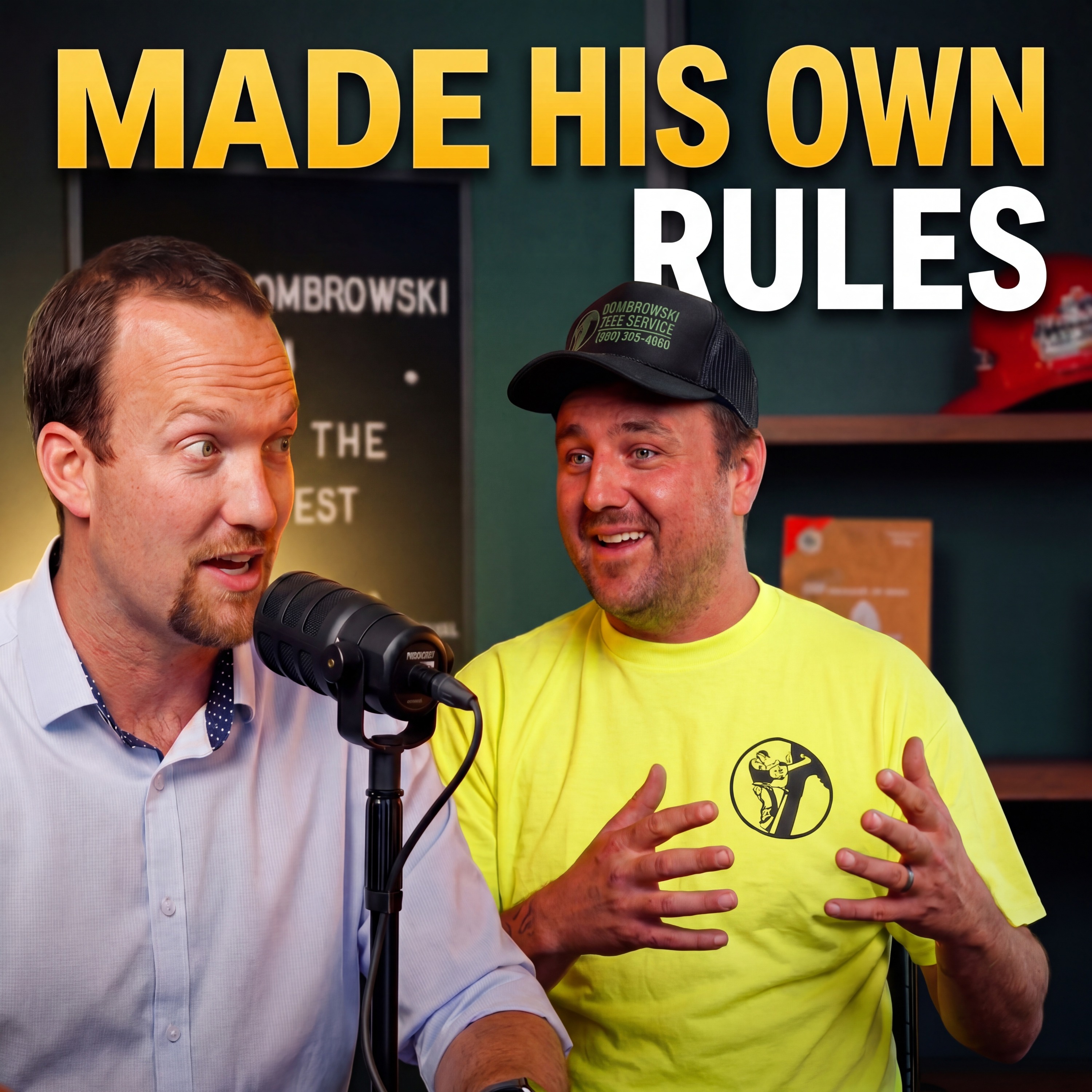
This episode is for the kid being told he has one option. It’s for the apprentice trying to figure out if going local is worth the pay cut. It’s for the lineman wondering if the side hustle is real. Mike’s career didn’t follow a plan. It followed a series of decisions — and the ones that paid off weren’t the ones anyone told him to make.
WHAT WE GET INTO
- The guidance counselor conversation that introduced him to the trades
- Why he didn’t finish line school — and why his teacher told him not to
- What he made as an apprentice on the road vs. as a municipal lineman at home
- The tree job at his parents’ house that accidentally started a business
- Why he walked away from the “gravy job” most lineman never leave
- The advice rule he uses: “Be careful who you take advice from”
ABOUT MIKE DOMBROWSKI
Mike Dombrowski grew up around Jim’s Music — his dad’s store. He knew young he didn’t want an office. He went from high school to CDL to line school to apprentice contracting work in Minnesota, came home as a municipal lineman, started a tree service on the side, and went full-time around 2021. He’s also one of the founding members of the MTDS Lineman School. You may have seen some of his videos go viral on TikTok and Facebook.
- https://www.tiktok.com/@dombrowskitreeservice
- https://www.facebook.com/dombrowskitreeservice/
🔗 LINKS
Listen wherever your get your podcasts: https://built-in-the-midwest.captivate.fm/listen
Midwest Truck Driving School: midwesttruckdrivingschool.com
North Country Heavy Equipment & Electrical Line School: https://ncheschool.com/
Submit your Questions: https://webforms.pipedrive.com/f/6WfGT9X1zlYC6WvssJqfWxOOkvVa1AjzqgnAIIHOq70WWiNo5czEWXpBMqxVTW7UST
💬 CONNECT
Email: marketing@midwesttruckdrivingschool.com
Facebook: https://www.facebook.com/CDLMidwest
Instagram: https://www.instagram.com/midwesttruckdrivingschool/
TikTok: https://www.tiktok.com/@midwesttruckdrivingskool
Transcript
I think I told you before is I'm unemployable.
Speaker A:I got back on Monday to line school.
Speaker A:Tuesday they called me.
Speaker A:My teacher was right there.
Speaker A:He's like, yep, you're showing up in Hampton, Minnesota on Thursday.
Speaker A:Be here at 7:30.
Speaker A:And I'm like, well, I gotta finish line school.
Speaker A:And the general foreman goes, well, tell your.
Speaker A:Tell your teacher to pass.
Speaker A:You tell him you got a job.
Speaker A:People call me lucky.
Speaker A:The more I do, the luckier I get.
Speaker A:$800 Tire was blown out before 10.
Speaker A:I was $1,600 down.
Speaker A:Just, just today, literally before 10am Slow is smooth, smooth is fast.
Speaker A:If you can be, you know, if you can be smooth with something, it'll.
Speaker A:It'll become faster and faster and faster.
Speaker B:If you're thinking about a career in the trades and you want to know what employers actually look for, what the work is really like, and what nobody tells you before you get started, you're in the right place.
Speaker B:Built in the Midwest features conversations that'll help you figure out if this path is for you.
Speaker B:Well, good morning and welcome to Built in the Midwest podcast.
Speaker B:I have the man, the myth, the legend.
Speaker B:All right, Mike Dombrowski with Dombrowski Tree Service.
Speaker B:All right, coming on the show, coming on the show today.
Speaker B:So thank you very much for being here today.
Speaker B:You know, this podcast is all about interviewing professionals in different industries.
Speaker B:And you know, when I was talking to RJ about this, I was like, you know, I can interview Mike on the lineman side, on the tree treatment side, the CDL side, the entrepreneurship side.
Speaker B:And it's just you've done a little bit, and now I'm seeing some of your stuff go viral on TikTok and Facebook.
Speaker B:I like to think I'm one of your biggest fans on there.
Speaker B:But you've had some viral posts and reels, and I would say you're almost influencer status now as well.
Speaker B:So you're doing a little bit of everything.
Speaker B:Awesome.
Speaker B:Well, let's get started with kind of where you began.
Speaker B:Because one thing, we work with a lot of kids, a lot of kids in high school, junior high, that have a lot of ideas, but they have no idea where to start.
Speaker B:Right.
Speaker B:So if we can talk about that kind of where you started and your journey over the last however long it's been 15 years or so till you got to this point here.
Speaker A:Well, as you know, dad, he had the music store, hey, Jim's music, which.
Speaker B:Is very different from what you're into now.
Speaker A:Yeah, everyone I talk to, they're like, well, do you play any music?
Speaker A:I can't.
Speaker A:But I mean, I knew from a young age that I didn't like being cooped up in an office.
Speaker A:I saw my dad working in the office all the time and he'd rather be outside, you know.
Speaker A:And then I'd go to gyms after school and I'd, you know, polish guitars or wash windows or whatever.
Speaker A:Right.
Speaker B:Did you play any instruments?
Speaker A:Trumpet.
Speaker B:Trumpet.
Speaker A:A little bit.
Speaker B:Okay.
Speaker B:Does that count?
Speaker B:No, no, no.
Speaker A:But I mean, I knew from.
Speaker A:I knew from a young age, like, I didn't want to work in an office, I guess.
Speaker A:So then in high school hit.
Speaker A:Right.
Speaker A:And the.
Speaker A:I worked at.
Speaker A:I worked at Red Pine Equipment.
Speaker B:Oh, yeah.
Speaker A:Yeah.
Speaker A:I worked there.
Speaker B:And that was in high school.
Speaker A:That was in high school.
Speaker A:Wow.
Speaker A:After.
Speaker A:And then right after high school, I remember thinking about.
Speaker A:I remember wanting to be a lineman because I knew they made a lot of money.
Speaker B:So did you have.
Speaker B:Okay, it wasn't, it wasn't your dad that was a lineman or anything.
Speaker B:Did you have a family member or a friend that was alignment?
Speaker B:What, what was the seed there that got planted?
Speaker B:Because I don't think I knew what alignment was when I was a senior in high school.
Speaker A:So this is, this isn't.
Speaker A:This probably isn't good on a podcast, But I remember 12th grade, right?
Speaker A:I was.
Speaker A:Or.
Speaker A:Yeah, it was 12th grade.
Speaker A:But one of the guidance counselors, they're like, hey, like, what do you think?
Speaker A:Let's.
Speaker A:How about like an aircraft technician or you can go to school to be an aircraft technician, or you can go do this or that or whatever.
Speaker A:And I think that's when I discovered what alignment was because I was looking at, you know, what they.
Speaker A:All the different trades.
Speaker A:Because basically what they were telling me is you're.
Speaker A:You're not college fit.
Speaker B:You're not.
Speaker A:Right.
Speaker A:Like, I graduated with like a 1.87, I think it was.
Speaker B:Yeah, but that doesn't mean.
Speaker B:That just, that just meant just the education, the traditional education didn't interest you 100%.
Speaker B:Yeah.
Speaker B:Yeah.
Speaker A:But I think that's when I realized what alignment was or what they got paid, you know.
Speaker B:Okay, so you saw that side of things.
Speaker B:It's a. Whoa, wait a second.
Speaker B:Yeah, because it's one of the highest of all the trades.
Speaker A:Yeah.
Speaker A:Yeah.
Speaker A:And then including the retirement and stuff like that.
Speaker B:Oh, absolutely.
Speaker A:That's.
Speaker A:I guess that's where.
Speaker A:That's where I first saw it.
Speaker A:But I mean, I went to.
Speaker A:this truck driving school in:Speaker A:Am I jumping too much?
Speaker B:What's that.
Speaker B:No, not at all.
Speaker A:uck driving school I think in:Speaker A:Or:Speaker B:Yeah.
Speaker A:You know, and I mean it was.
Speaker B:Because you needed your CDL to get, to be alignment.
Speaker A:Yeah.
Speaker B:And to get into line school as a part of line school.
Speaker B:And they, and it's, it's one thing that's, that's why we do the CDL first for all alignment is because you, you can't apply Movali or Elbat or that CDL every lineman.
Speaker B:You're unemployment.
Speaker B:Yeah.
Speaker B:And a lot of linemen don't, don't realize that or, or people that want to be linemen.
Speaker B:You know, it's like, no, that's, that's imperative that you have that and that you get that and that you hold on to that because you're not alignment without that.
Speaker A:Yeah.
Speaker B:So that's, that's huge.
Speaker B:So after, after getting, getting your cdl and getting, getting through line school, you know, you talk, you talk to a lot of guys that struggle after line school getting employed and get into an apprenticeship.
Speaker B:What did that process look like for you?
Speaker A:I didn't finish line school.
Speaker B:You didn't finish line school.
Speaker B:Okay.
Speaker B:That's kind of unheard of.
Speaker A:I, technically, I, technically I finished it.
Speaker A:But I remember Mo Valley had open or not open interviews, but they had an interview slot.
Speaker A:Right.
Speaker A:project going on called CAPEX:Speaker A:Basically the extension cord from Wisconsin over to South Dakota.
Speaker B:The extension cord from Wisconsin to South Dakota?
Speaker A:Yeah.
Speaker B:Wow.
Speaker A:Yep.
Speaker A:So I knew that they were hiring like crazy, so I went to local.
Speaker B:So you're working in Minnesota quite a bit.
Speaker A:That's all.
Speaker A:That's, that's where I worked.
Speaker B:Yeah.
Speaker A:But I didn't even.
Speaker A:I remember I got back on Monday to line school, right.
Speaker A:And Tuesday they called me, the, the, the apprenticeship called me and they tell me who to who I've got to, you know, the general foreman I've got to call and blah, blah, blah.
Speaker A:And I called them and my teacher was right there and he's like, yep, you're showing up in Hampton, Minnesota on Thursday.
Speaker A:Be here at 7:30.
Speaker A:And I'm like, well, I gotta finish line school.
Speaker A:And the general foreman goes, well, tell your, tell your teacher to pass.
Speaker A:You tell him you got a job.
Speaker A:You know, this is the point.
Speaker B:Yeah, exactly.
Speaker A:And yeah, so I mean I left and then I did Books online and whatever.
Speaker B:Yeah, but that, that is wild when you really think about it.
Speaker B:You know how many people in trade school or school literally gets hired before they graduate and they say, all right, yeah, like well, you know, you'll whatever, finish up online or we'll graduate.
Speaker B:You're early.
Speaker B:Because the fact of the matter is that is the goal.
Speaker B:The goal is to get you employed.
Speaker B:And so, and I love that mindset, right?
Speaker B:And I think, I think it's important that more institutions have that mindset that hey, when those opportunities arise, push your people out the door, take them, take advantage of them.
Speaker B:Because and this is what I hear from a lot of the schools graduates is they learn a lot in that apprenticeship and that's where really you learn almost everything.
Speaker B:You know what I mean?
Speaker B:But you got to get to, into the apprenticeship.
Speaker B:But from there you learn, you learn everything.
Speaker B:All right.
Speaker B:So that was, that would be considered the contracting side of things.
Speaker B:Right.
Speaker B:And after that you got into, I would say is a goal of almost all linemen I know is a goal is to, is to get back home.
Speaker B:Right.
Speaker B:So talk, talk about that and being able to come back home.
Speaker A:Yeah, well, while we were in Minnesota, we, we had twin daughters or we got pregnant and we had twin daughters.
Speaker A:So my, we were planning on moving back home or my wife was to be closer with family.
Speaker B:Absolutely.
Speaker B:And takes a village.
Speaker A:Yeah.
Speaker A:Oh yeah.
Speaker A:Oh yeah.
Speaker A:But I started applying.
Speaker A:I mean and even I was probably a second step apprentice.
Speaker A:I was calling Elger Delta, I was calling City Electric.
Speaker A:I was calling, you know, just.
Speaker B:See also, you weren't, you weren't a journeyman at that point.
Speaker A:No, no, I was a, I think I was a third or fourth step.
Speaker B:Apprentice or fourth step apprentice.
Speaker A:So.
Speaker A:Yeah.
Speaker B:So you still had a little ways to go.
Speaker A:Yeah, yeah, I was, I think I was, yeah, I was a four step.
Speaker A:I was a hot apprentice and I, I ended up the city let somebody go or whatever happened.
Speaker A:And I went there and I interviewed.
Speaker A:Well, that, that's, I mean that was it.
Speaker A:I, I took it right away.
Speaker A:You know, they called me on a Thursday and I told my boss, I said, I'll give you two weeks if you really need it.
Speaker A:And he goes, what do you really want to say?
Speaker A:I was like, I want to give you a two day notice.
Speaker A:He goes, oh, if you could finish this week.
Speaker A:It was like Wednesday.
Speaker B:Yeah.
Speaker A:And I was like, no, I mean like a two, like I'm leaving today.
Speaker B:No, I didn't, I didn't.
Speaker B:But that was two days.
Speaker B:No, no.
Speaker B:But when those Opportunities present themselves.
Speaker A:Take them.
Speaker A:I mean nine times out of ten, a municipality co, a co op, they don't want an apprentice because then they have to pay for, for their apprenticeship.
Speaker B:To finish up their apprenticeship.
Speaker A:Yeah, most journeymen won't go to these places because they're getting like another 12,.
Speaker B:$15 An hour being a contractor to stay contracting.
Speaker B:And you see that where some come off the road to go local and they're like, they missed those bigger paychecks.
Speaker B:Let's get back on the road for the contracting side.
Speaker B:So, so would you say that it's kind of, kind of depends on where you are in life a little bit?
Speaker A:Oh yeah, 100%.
Speaker B:And what, what, what might work best for you?
Speaker A:Yeah, I've met 55 year old journeyman out on the, in the trade that they've got, they, what do they call it?
Speaker A:The 3Ds, the, a divorce, a DUI and whatever the other people.
Speaker A:But like, I mean and I've met, I've met 40, 50 year old guys that are married, three kids and they're living on the road.
Speaker A:Right.
Speaker A:That's their lifestyle.
Speaker A:Yeah.
Speaker A:And then I've, I've met, you know, yeah, I met a 70 year old guy that was on the road.
Speaker A:No kidding.
Speaker A:His name was Stretch and he was.
Speaker B:Still, he was doing line work.
Speaker A:Yeah, well, I mean he was like a foreman.
Speaker B:Yeah.
Speaker A:Not working foreman.
Speaker A:They hired him for his brain.
Speaker A:He was smart, he was good.
Speaker B:A second set of eyes on the project with their bifolds just carried around binoculars.
Speaker B:No, that's awesome.
Speaker B:And it's one of those things that I think for everybody, different strokes for different folks, where you don't know what works for you, might not work for somebody else and vice versa.
Speaker B:And I really think, especially to the young people out there is the takeaway to some of this is to really embrace all opportunities.
Speaker B:And would you.
Speaker B:Now they say that opportunities present themselves when you least expect it.
Speaker B:Have you found that to be the case in your Life as well?
Speaker A:100%.
Speaker A:And something comes to mind.
Speaker A:People call me lucky.
Speaker A:Right.
Speaker A:And it's.
Speaker A:The more I do, the luckier I get.
Speaker A:Have you ever heard that?
Speaker B:Yep, yep.
Speaker A:Maybe I'm saying it wrong, but.
Speaker B:No, it's very much like that.
Speaker B:Like I've always heard, like the harder I work, the more luck I seem to have.
Speaker A:Absolutely.
Speaker B:And, and there's a lot of, there's a lot of truth to that because.
Speaker A:I've messed up more, I mean more times than I'd like to admit.
Speaker A:But I might be really Good at something.
Speaker A:But I've.
Speaker A:I've messed it up 25 times before I got it right.
Speaker A:Absolutely done it a lot more than you.
Speaker B:Absolutely, absolutely got.
Speaker B:I'm reading a book right now.
Speaker B:It's called the Richest man in Babylon.
Speaker B:Right.
Speaker B:A great book.
Speaker B:Great.
Speaker B:But I think anyone out there, you got to read this book.
Speaker B:It'll definitely change the way you think about finances and money and everything.
Speaker B:But that was one of the things that he talked about with that and how you look at stuff and invest stuff and how you work and kind of the frugality of it.
Speaker B:But also how, like, they had a long story short, they had a meeting and they talked to a lot of people, and every person in the room raised their hand at one point in time.
Speaker B:They.
Speaker B:ey could have grasped onto in:Speaker B:They let them slip through their fingers, every single person.
Speaker B:And this book was just like a thousand years old.
Speaker B:But it's so true.
Speaker B:And it's something that I think everybody out there, if you really think what was a great opportunity that you could have taken advantage of and you didn't, and looking back is like, ah, you know, you let it slip through your fingers.
Speaker B:So it's one of those things that, yeah, you kind of embracing those things and embracing those opportunities.
Speaker A:When you embrace the opportunities, embrace the suck.
Speaker A:Everything you're learning or everything you're messing up with or whatever it is in life.
Speaker B:Absolutely.
Speaker A:Right.
Speaker A:You're learning.
Speaker A:Yeah, you can.
Speaker B:Yeah, absolutely.
Speaker B:And that's the other thing is like, the fail faster.
Speaker B:And I actually just told my godson this the other day.
Speaker B:They failed a T ball game or little league game.
Speaker B:He was down on himself.
Speaker B:I was like, no, that's good thing.
Speaker B:I was like, failing is the.
Speaker B:Is the best thing.
Speaker B:I was like, when you win all the time, that's no fun because you don't learn anything from winning.
Speaker B:You learn when you fail.
Speaker B:You learn when you get knocked down.
Speaker B:That's when you.
Speaker B:That's when you learn.
Speaker B:Right later on in life.
Speaker A:It's.
Speaker A:If you're the smartest person in the room, you're in the wrong room.
Speaker B:You're in the wrong room.
Speaker B:Exactly.
Speaker A:I want to be.
Speaker A:I want to.
Speaker A:I want to be with other professionals, learning, like constantly.
Speaker A:I'm not learning.
Speaker A:I'm not having fun.
Speaker B:Progressing, growing.
Speaker B:Challenging.
Speaker B:Challenging.
Speaker B:You know, looking at what's.
Speaker B:What's the next thing or how can we better what we're doing?
Speaker B:And I think that's so important.
Speaker B:So important.
Speaker B:You Want people that are going to bring you up, build you up and that ingenuity and creativity.
Speaker B:And I would say you of all people have more of that than almost anyone I know.
Speaker B:And I mean that.
Speaker B:It absolutely blows me away.
Speaker B:Well, I want to continue on in your journey.
Speaker B:So came back and working for municipality as alignment.
Speaker B:And then I want to talk about your transition into Dombrowski tree service.
Speaker B:Right.
Speaker B:And what that's done.
Speaker B:Because that's something that I think a lot of people out there like the idea of entrepreneurship and business ownership.
Speaker B:But I would say, in my personal opinion, like, it is a great thing for some people and not a great thing for other people.
Speaker B:And it's important to know the pros and cons of it.
Speaker B:As somebody that has done both, a lot of both.
Speaker A:Right.
Speaker B:Talk to me about that.
Speaker A:The transition from the city.
Speaker B:Yeah, yeah.
Speaker B:Like something that's guaranteed.
Speaker B:They both have their guarantee.
Speaker B:Yeah.
Speaker A:So like working.
Speaker A:Can I use wages?
Speaker A:Can I say wait?
Speaker A:Yeah, of course.
Speaker A:Yeah, yeah, absolutely.
Speaker A:I went from.
Speaker A:I went from contracting to make.
Speaker A:Making like over 130,000 as an apprentice.
Speaker A:Wow.
Speaker A:To wow.
Speaker A:Working at the city.
Speaker A:I remember my.
Speaker B:Okay, I didn't even know that.
Speaker A:Oh, yeah.
Speaker A:As a contractor, I was working seven 12s.
Speaker B:Okay, so I was working seven 12s.
Speaker A:I worked seven 12s.
Speaker B:You were busting your hump.
Speaker A:Yeah, almost two years.
Speaker A:But I remember, I still remember.
Speaker A:Right.
Speaker A:Like we're talking about guarantees of things.
Speaker A:So working, contracting.
Speaker A:And then I remember coming to the city and we got paid every two weeks at the city.
Speaker A:I remember I got my check and my foreman was sitting right next to me.
Speaker A:He goes, it ain't like that contractor money, is it, kid?
Speaker A:And I go, is this it?
Speaker A:Am I getting another?
Speaker A:No, but I mean, still working at the city, you made right around $100,000.
Speaker A:And I was home every night, right.
Speaker A:And I went from, you know, seven twelves to five eights.
Speaker B:And with three kids and a wife, that's.
Speaker A:That was the goal, right?
Speaker B:Yeah, absolutely.
Speaker A:So I was happy, but I was from two years, you know, working 7:12, so that was like burned into me.
Speaker A:I work Saturday, I work Sunday.
Speaker A:I remember fighting just to be able to clean my clothes on a Sunday.
Speaker A:To find time.
Speaker A:Right.
Speaker B:Just to do the basic laundry.
Speaker A:Yes.
Speaker A:Yeah, just.
Speaker B:And then go back to work.
Speaker A:Yes.
Speaker A:So like when I got to the city, I'm sitting there, I'm twiddling my thumbs, I'm working five eights.
Speaker A:We were living with her mom at the time.
Speaker B:And did you feel like that was a part time job?
Speaker A:Oh, yeah, 100%.
Speaker B:Like, like 4 to 30, we show up.
Speaker A:40 Hours.
Speaker B:40 Hours a week.
Speaker B:And that's something I think it's important to recognize because some people work 40 hours a week.
Speaker B:They're like, oh, God, 40 hours is.
Speaker A:I don't even wish that.
Speaker A:But like, 40 hours, that's.
Speaker A:It's part time.
Speaker B:It's part time.
Speaker B:It's important for people to recognize that, like, 40 hours ain't nothing.
Speaker B:Ain't nothing.
Speaker B:Especially when you were seven 12s.
Speaker B:Now that's insanity.
Speaker A:There was a guy, nine to five will feed the family.
Speaker A:Five to nine will feed your future, right?
Speaker B:Oh, I like that.
Speaker A:That was always.
Speaker A:Especially when I got into entrepreneurship.
Speaker A:That's where, you know, that's where that grew.
Speaker A:But anyways, the working, working at the city.
Speaker A:We were living with her mom at the time.
Speaker A:So I was working 5, 8.
Speaker A:I got done at 4 o'.
Speaker A:Clock.
Speaker A:I was.
Speaker A:I'm twilling my thumbs.
Speaker A:I'm like, I gotta do this, I gotta do that.
Speaker A:I was trying to do trim.
Speaker A:I can't do trim.
Speaker A:You know, I'm trying to help.
Speaker A:And mom and dad, they were getting a tree cut down.
Speaker A:re like, well, the guy wants $:Speaker A:And I was like, shit, I can do that.
Speaker A:You know, I got.
Speaker A:I'm a lineman or, you know, I'm still an apprentice.
Speaker A:Yeah, but.
Speaker B:But you've done a little bit of that in the tree.
Speaker A:A little bit.
Speaker A:Snap cuts, you know, you cut down poles or trim a tree or whatever.
Speaker A:It's very small.
Speaker B:I can use a chainsaw.
Speaker A:I had a climbing belt.
Speaker A:I had spurs.
Speaker A:I had, you know, I had, I was able to climb.
Speaker A:So I was like, well, I can do that.
Speaker A:You know, and they're like, well, we'd rather pay you than pay him.
Speaker A:So I, I went there, I cut it all down.
Speaker A:I remember this to a T. I.
Speaker A:It took me like four hours to cut it down.
Speaker A:I was like, hell, yeah.
Speaker A:You know, I, I just.
Speaker A:Then it took me 20 hours to clean it up.
Speaker B:Yeah, right.
Speaker A:But that's kind of.
Speaker A:That was like the transition from, you know, I was like, oh, I can do this.
Speaker A:You know, And I needed, I needed something to do after work, you know, supplement some income, plus just to stay sane.
Speaker B:Yeah, exactly.
Speaker B:Because it was ingrained in you to work and stay busy and.
Speaker B:Yeah.
Speaker B:You get too much free time.
Speaker B:It's like, okay, I gotta do something, I gotta go.
Speaker A:Yep.
Speaker A:And so I went From, I mean, that's kind of how the tree service was started, you know, I knew nothing.
Speaker B:That's awesome.
Speaker A:I knew nothing about trees, I knew nothing about species.
Speaker A:I knew nothing.
Speaker B:But right there, that's right there.
Speaker B:You know what I mean?
Speaker B:You wouldn't think at the time.
Speaker B:You don't think that's a big opportunity, right.
Speaker B:That time.
Speaker B:Right, Whatever.
Speaker B:You know, parents need a tree cut down, like, hey, let me save you a few bucks.
Speaker B:It was almost your generosity and wanting to help that kind of got you into something great, you know what I mean?
Speaker B:Which is something to be said about kind of being a good person.
Speaker B:Right.
Speaker B:You know Pete Miller, I don't remember him, you know, God bless his soul, he passed away.
Speaker B:But, you know, he said, you know, why do you do the right thing?
Speaker B:Because it's the right thing to do.
Speaker B:But it was like one of those things where you didn't know that opportunity was going to be there, but it was, and you took advantage of it.
Speaker B:And then boom, that seed was planted and it's bloomed and blossomed and grew and grew everything else.
Speaker B:So take me to still working at this city and then still had Dombrowski Tree Service.
Speaker B:At what point in time did you decide, all right, I want to do this full time?
Speaker B:This is, this is, this is what.
Speaker A:I want to do?
Speaker A:It was, I mean, I was in, I was in business.
Speaker A:I started the business in:Speaker A:What, what made me switch?
Speaker A:I mean, there was a, there was a.
Speaker A:My.
Speaker A:Well, growing up, my mom, right.
Speaker A:She, she was very set on insurance.
Speaker A:You have to have insurance.
Speaker A:But there, that.
Speaker A:I had very good insurance at the city.
Speaker A:And I remember my mom always told me, she's like, you know, you got that guaranteed check, you got that insurance, you got to have insurance.
Speaker A:Got to have insurance.
Speaker A:And I remember in the week that I quit, we were, I mean, we grew substantially.
Speaker A:I had four full time guys, you know, a bunch of equipment and stuff like that.
Speaker B:Absolutely.
Speaker A:And at that point, you know, I was just, I guess I was fed up with the politics.
Speaker B:Yeah.
Speaker A:In any organization, you're going to have them.
Speaker B:Yeah, absolutely.
Speaker A:But.
Speaker B:And I think municipalities, you do have more.
Speaker B:Yes, there is.
Speaker B:It's just one of those things.
Speaker B:I've seen that across the board.
Speaker B:You know what I mean?
Speaker A:Not even, I mean, munis, co ops, it's tough.
Speaker A:You're always going to have that.
Speaker B:Absolutely.
Speaker B:But you get to a point where it's like, all right, kind of enough is enough.
Speaker B:I can, I can do this, you know, but it's, it's really interesting because there's very few people out there that I know that, you know, kind of got that, I don't want to say gravy job, but got that gravy job in a municipality after going out contracting.
Speaker B:That's kind of the goal, right?
Speaker B:And most people, boom, they're done after that.
Speaker B:They're good.
Speaker A:But not.
Speaker B:Yeah, no, they settle rated.
Speaker B:No, seriously, that's.
Speaker B:That's it.
Speaker B:That's it.
Speaker B:And you.
Speaker B:As opposed to just settling down and that's it.
Speaker B:No, you, you jumped into that 37 degree cold plunge, all right?
Speaker B:And you said, I'm going to wake the hell up because I'm ready for my next adventure.
Speaker B:Right.
Speaker B:And for, for people that, that don't know.
Speaker B:Mike Dombrowski was one of the founding members of the, of the lineman school as well.
Speaker B:And so who knew that you were going to get into that as well and kick that off and look at how that seed has blossomed and people coming from all over the Midwest and really all over the country for that program as well.
Speaker B:Looking at, I think I love your story and all the different things, but to somebody that kind of going back to that person in high school right now, that, that guy or gal that's being pushed and pulled in different, different ways, you know what I mean?
Speaker B:What other advice would you give to that, to that person right now?
Speaker A:Try it all.
Speaker B:Try it all.
Speaker A:Try it all.
Speaker A:I mean, like, put your nose, put your nose down to the grindstone, but figure out what you enjoy.
Speaker A:Do you.
Speaker A:If you don't enjoy working with your hands, you know, if you don't enjoy working in the cold.
Speaker A:Right.
Speaker A:Find out what you enjoy.
Speaker A:You've got a pretty good idea.
Speaker A:In high school, if you enjoy studying or if you enjoy the book, work.
Speaker A:Well, maybe college if you don't try a trade, if you enjoy welding.
Speaker A:I was telling you before, I got a guy that works for me, a high schooler, and he's going to be a welder.
Speaker A:I've got another kid that works for me.
Speaker A:He's going to the lion school in August.
Speaker B:You know, that's awesome.
Speaker B:So that's awesome.
Speaker A:I, you know, you got to figure out what you enjoy and run with it because you're doing it for the rest of your life.
Speaker B:No, absolutely, Absolutely.
Speaker B:And so, you know, the other thing is, did you always enjoy every job that you had?
Speaker A:No.
Speaker B:No.
Speaker B:Right.
Speaker B:So.
Speaker B:So.
Speaker B:And I think that's important because I had a lot of jobs that, that I not only did not enjoy, but I kind of hated.
Speaker B:Kind of hated and looking for it.
Speaker A:But you'll never know.
Speaker A:You'll never know if you hate that job unless you try it.
Speaker B:No, you know, exactly.
Speaker B:But there's also.
Speaker B:There's some jobs.
Speaker B:There's one in particular I really did not like, but if I could go back, I would do it again for the simple fact of the skill sets, how much you learned and how much I learned from that job.
Speaker B:And that's what.
Speaker B:And that's what kind of blows myself away, where it's like, okay, you hated that job, you didn't like it, but yet you would go back and do that again.
Speaker B:Like, yeah, I would.
Speaker A:It's another tool in the tool set.
Speaker B:It's another tool in the toolbox.
Speaker B:Right.
Speaker B:And so I think from a young person, where, yes, look at what you enjoy, what you like, but also try new things and dabble in different things, and if you don't enjoy it, that's okay.
Speaker B:There might be other really positive things and things that you might learn that you maybe never thought about.
Speaker B:Right.
Speaker B:You can still hate something, but also learn from it, you know, and use.
Speaker A:Those things throughout life.
Speaker B:Absolutely.
Speaker B:Especially now in kind of more.
Speaker B:My more of a school director role is like, I think back to some of the managers and some of the bosses I had growing up, Right.
Speaker B:And, like, some of the ones I just hated.
Speaker B:And now, like, I thank them because now I know, you know, I've taken some from them, and I've also taken kind of what I don't want to be like as well.
Speaker B:But it's not a negative.
Speaker B:It actually ended up being a positive.
Speaker A:She learned.
Speaker A:She learned and learned and learned.
Speaker B:Exactly.
Speaker B:Yeah, exactly.
Speaker B:And if you don't.
Speaker B:And if you don't ever take those chances, then you'll never.
Speaker B:You'll never experience that.
Speaker B:Right.
Speaker B:And I think that's important, you know, and that's the other thing.
Speaker B:I was just talking to ISD class here, this was a few weeks ago, did a tour, and I asked everyone in the room, and these were all 10th, 11th, 12th graders, how many of you guys have jobs?
Speaker B:And there was like three people in, like, 30 that raised their hands.
Speaker B:And I'm like, what are you people doing?
Speaker B:I'm like, you're in high school.
Speaker B:You're in high school.
Speaker B:I was like, sports aren't seven days a week.
Speaker B:Right.
Speaker B:And I know a lot of you guys aren't playing sports because it seems like every sport team, you know, people just don't play sports like they used to.
Speaker B:I hear that from coaches all the time, that they're always trying to recruit more people.
Speaker B:And I'm like, we're going into summer here, guys.
Speaker B:I was like, you just need a W2.
Speaker B:You need some work experience.
Speaker B:It's one of the biggest things that I think I see with other employers that I talk to is like, these high school graduates don't have any work experience.
Speaker B:And they come here and they say, why?
Speaker B:How do I know if you're a good worker?
Speaker B:You don't have any work ethic.
Speaker B:You don't have any previous employers.
Speaker A:It's even the kids that, you know, everyone talks about like, I'll go work at McDonald's, right?
Speaker A:But even at McDonald's, what are you learning?
Speaker A:You're learning customer service.
Speaker B:Customer service, absolutely.
Speaker A:You're learning how to look.
Speaker A:I've had guys come and work for me that when they shake my hand, they go like this.
Speaker A:And it's like, oh, hey.
Speaker B:Or they give you a limp wrist.
Speaker B:You know what I mean?
Speaker B:It's like, what is your.
Speaker B:Is your hand broken?
Speaker B:A nice firm handshake.
Speaker B:That's all really important stuff.
Speaker B:You know, it's funny you say that, because I started out at Burger King, all right, when I was 14 years old, right?
Speaker B:That's where I worked.
Speaker B:And I would think, honestly, my communication ability today literally goes back to 14 years at Burger King because I had the headset on, right?
Speaker B:And you had people coming through.
Speaker B:Drive thru and welcome to Burger King.
Speaker B:My name is Josh.
Speaker B:How can I help you?
Speaker B:And I said that thousands and thousands and thousands of times.
Speaker B:And all of a sudden get better at communicating because I would communicate with people all day long and then the fast paced environment, right?
Speaker B:And it's one of those things where business is fast.
Speaker B:It just is.
Speaker B:And you gotta be on your toes.
Speaker B:So like you said, and then the timeliness, punching a card and understanding that and then the different shifts, right?
Speaker B:Of course, they loved, you know, me to work on Saturday.
Speaker B:Saturday at lunchtime was always the busiest, right?
Speaker B:And.
Speaker B:And Burger King.
Speaker B:Yeah, yeah, yeah.
Speaker B:I was sure.
Speaker A:All right.
Speaker B:You know, and that was back when they had the.
Speaker B:The microphones coming out, so to yell everything back before credit cards, so everything was cash.
Speaker B:So you had to count change back and you had to be quick about it.
Speaker B:I remember this funny story, but I got yelled at one time because it was back when there was just all cash and so.
Speaker B:And a lot of the items would come out to like $4.02 or $3.01.
Speaker B:And so I would just literally put a bunch, like 50 cents in pennies in my pocket because I hated giving back 99 cents.
Speaker B:And so I remember my manager one time, or the one person, the manager, and it was like 402.
Speaker B:She gives me a five dollar bill and I.
Speaker B:Four dollars and I get out two pennies and I put it in my manager's like, you can't do that.
Speaker B:You're messing around with the money and everything else.
Speaker B:And then wrote me up for it.
Speaker B:Then I talked to the owner later on and I explained.
Speaker B:I was like, I just was trying to help out.
Speaker B:I was like giving him 98 cents back.
Speaker B:I was like, just two pennies.
Speaker B:And he's like, no one's ever done that before.
Speaker B:And he's like, that's your own money.
Speaker B:I was like, well, it's two pennies.
Speaker B:I'm not really not concerned about it.
Speaker B:Probably found most in the parking lot when I sweep out there, you know, but he never bothered me, right?
Speaker B:He's like, don't worry about her.
Speaker B:She's.
Speaker B:She's fine.
Speaker A:What are you doing at 14?
Speaker A:You're.
Speaker A:You were figuring out, figuring out efficiency.
Speaker B:Well, exactly, because I didn't want to count out all that stuff.
Speaker B:And there's a line of people, but it was about efficiency effectors.
Speaker B:How can I do it?
Speaker B:How can I do it quicker, how can I do it faster?
Speaker B:And yeah, giving out 97, 98 cents drives me, drives me nuts.
Speaker B:And you still see that once in a while today where it's like, oh, I don't have a penny.
Speaker B:And they look at you like, oh, yeah, I'm giving you 99 cents.
Speaker B:Not what it is.
Speaker A:Well, do you want to donate this to whatever?
Speaker B:Yeah.
Speaker B:Do you want to round up.
Speaker B:Oh, my God, don't get me started.
Speaker B:You know, you can't go get a cup of coffee without donating to some cause across the world.
Speaker B:And it's like, man, you know, oh, you know what?
Speaker B:Not only do I tithe every Sunday, but I tithe every freaking day.
Speaker B:Every place I go, I tithe.
Speaker B:You can't go anywhere without tithing nowadays, right?
Speaker B:Oh, that's.
Speaker B:That's for sure.
Speaker B:You know, one of the other things that I think is, is important as well is you know that you did all this with no fancy degrees.
Speaker B:You didn't have a master's degree, you didn't have a business degree.
Speaker B:And yet you, you started, created an amazing business.
Speaker B:You got into an amazing trade.
Speaker B:You do all the hiring, the firing, everything else.
Speaker B:You know, talk to me about that on, on somebody that maybe thinks they need all this stuff, when in reality they just don't.
Speaker A:Yeah, yeah, just.
Speaker A:You're going to learn.
Speaker A:You're going to learn.
Speaker A:If you throw yourself in the fire, you're either going to burn or get out.
Speaker A:Right?
Speaker A:I mean, as, as bad as that sounds.
Speaker A:You talked before when you were talking to the drive thru customers, you probably talked a thousand times to people.
Speaker B:Oh, yeah, absolutely.
Speaker A:You've learned so much just from doing that, right?
Speaker A:Absolutely.
Speaker A:Yeah.
Speaker A:What was the question?
Speaker A:I'm sorry.
Speaker B:Yeah, no, no, no, you're good, you're good.
Speaker B:But how, you know, you don't have any fancy degrees or any fancy education or anything, and yet you've been able to accomplish so much.
Speaker B:And so, and I think there's too many people today that just feel burdened and feel trapped because they don't, they don't have the fancy degrees or the fancy education or anything.
Speaker B:And, and I think it's important for them to know that they don't need it.
Speaker B:It's not something you need, honestly.
Speaker B:And a lot of those degrees are worthless.
Speaker B:They're.
Speaker B:They're not worth the paper that they're printed on, you know, and I think, you know, and I just want, I want to be able to hear it from you, though, because you've been able to do so much with that.
Speaker B:And, you know, what would be your advice to those people that are interested in entrepreneurship and maybe some of the hurdles that they will encounter.
Speaker A:You'll get a lot of them.
Speaker A:Yeah, I know that.
Speaker A:Yeah.
Speaker A:Everything is a learning.
Speaker A:Like if you treat everything like a learning experience, you know, everything like a learning experience, you're gonna, you learn from everything.
Speaker A:You grow, you make, you know, you're gonna make.
Speaker A:If I, if I do something 100 times and you do it five times, I can mess up 20 times.
Speaker A:Right.
Speaker B:And, and you're gonna be still way far ahead.
Speaker A:Way ahead.
Speaker A:So I mean, the hurdles with running a business come, you know, I mean, just today we spent like $800 in fuel.
Speaker A:$800.
Speaker A:Tire was blown out before:Speaker A:I was $1,600 down.
Speaker A:just today, literally before:Speaker A:Yeah, this podcast.
Speaker B:Yeah.
Speaker B:When I talk to you, like, I gotta see your tire, I gotta change up, my guys gotta get it.
Speaker B:And that's.
Speaker B:And again, those are the hurdles.
Speaker B:Those are the hurdles.
Speaker A:Those are the hurdles.
Speaker A:Then you go into, you know, surround yourself with.
Speaker A:I remember in the trade, I'm all over the place, but I remember in the trade I asked this guy, I says, you know, what, what what is some advice that you.
Speaker A:I always tried to surround myself with smarter people, People than me, and whether it was my foreman, the gf, anybody, I would ask them, I'm like, so if you were my age, what would.
Speaker A:What would you do differently?
Speaker A:You know, always.
Speaker B:I love that.
Speaker A:Always.
Speaker A:I would always ask that.
Speaker A:And, you know, so a lot of guys had good advice.
Speaker A:A lot of guys didn't have good advice.
Speaker A:But that's.
Speaker A:You're gonna.
Speaker A:You learn by doing.
Speaker A:That's how an apprenticeship is.
Speaker A:I learned how to.
Speaker A:I learned how to treat people by how I was treated.
Speaker A:I've been called the dumbest thing that God ever slung guts into.
Speaker B:Sure.
Speaker A:I.
Speaker A:You know, I'll never talk to my guys like that.
Speaker B:No.
Speaker A:You know, because I don't want to feel the way.
Speaker B:Especially the line trade.
Speaker B:Some of those guys are, like, mean.
Speaker B:Like, the way they talk to one another.
Speaker B:I'm like, man, you got to have thick skin.
Speaker A:You have to.
Speaker B:It's just a part of it.
Speaker A:You have to.
Speaker A:And it's, you know, you're not there to hang out.
Speaker A:You're there for a cause.
Speaker A:You're there to.
Speaker A:To make the company money.
Speaker A:You know, you're there.
Speaker B:No.
Speaker B:No BSing.
Speaker A:Yeah.
Speaker A:So, I mean, yeah, there's.
Speaker A:There's a lot of.
Speaker A:There's a lot of hurdles, but surround yourself with smarter people than you.
Speaker A:I've talked to business owners before I became a business owner, you know, and the.
Speaker A:The best advice, or not the best but good advice was you'll never get rich by working for somebody else.
Speaker B:Yeah.
Speaker A:You know, and I don't want.
Speaker A:I don't want rich by any means.
Speaker B:I know.
Speaker A:I want peace, and I want.
Speaker A:I want to.
Speaker B:I just want flexibility.
Speaker A:Last night, 4:30, the kids had a game at 5.
Speaker A:I just.
Speaker A:I parked.
Speaker A:I just went to the game.
Speaker B:But yeah, exactly.
Speaker B:Like, I'm.
Speaker B:I'm doing it.
Speaker A:I didn't have to ask.
Speaker A:I didn't have to.
Speaker A:I didn't have to submit something in,.
Speaker B:Get it approved, have.
Speaker B:Have three stamps on it to get it, to get it done.
Speaker A:Like, at this point, I think I told you before, is I'm unemployable at this time.
Speaker A:Yes.
Speaker B:Well.
Speaker B:And it's, you know, it's one of those things that, you know, it's worth it, but it is a lot of work.
Speaker B:Right.
Speaker A:You're working 80 hours a week.
Speaker B:And, you know, one thing about the advice, and I think this is really important, because I've taken some really bad advice from people that I thought were relatively smart and respected.
Speaker B:Yeah, respect them.
Speaker B:That's a great one.
Speaker B:So I think it's really important is to be careful who you take advice from, that.
Speaker B:You know what?
Speaker B:Unless somebody can, for lack of better words, open their bank account and show you that they've done it and you know they've done it.
Speaker B:Be careful taking advice because cheap advice is free.
Speaker A:Right?
Speaker B:And a lot of people offer cheap advice, but get advice from people that are intelligent, smart, been there, done that, and, and have the, have the scars to prove it.
Speaker A:I had a mentor.
Speaker A:He was telling me he was in some.
Speaker A:He was in some business, one on one class and teaching whatever he was, you know, being a professor.
Speaker A:ever, this guy gets into this:Speaker A:You know what I mean?
Speaker A:And it's not, I mean, it's not what you drive, right?
Speaker A:But like it's the same thing with multiple things in life.
Speaker A:Don't take advice from somebody you don't respect or don't take.
Speaker B:No, exactly.
Speaker B:Yeah.
Speaker B:Just be careful who you take advice from because everyone will give you cheap advice.
Speaker B:Right.
Speaker B:But not all advice is good advice.
Speaker B:And make sure, if you're gonna act on someone's advice, you better make sure that they know what they're talking about.
Speaker B:Plain and simple.
Speaker B:Yeah, no, it's just absolutely, absolutely amazing stuff.
Speaker B:Well, I want to be respectful of your time, Mike.
Speaker B:Right.
Speaker B:So something I do want to encourage everyone is get onto Dabrowski tree service on Facebook, Instagram, TikTok.
Speaker B:Right.
Speaker B:Mike's got some amazing videos out there.
Speaker B:I think my probably most favorite one recently was the one I went from making 8,000amonth to 800amonth.
Speaker B:Don't follow me financial advice.
Speaker B:And that's how it feels sometimes.
Speaker B:It's like you just constantly, constantly getting beat up and it's like, yeah, here we go, here we go.
Speaker B:I know you're a busy guy, so I want to be efficient of your time as well.
Speaker B:So a big thanks, Mike, for being on the show today.
Speaker B:Really means a lot and we'll definitely keep in touch.