
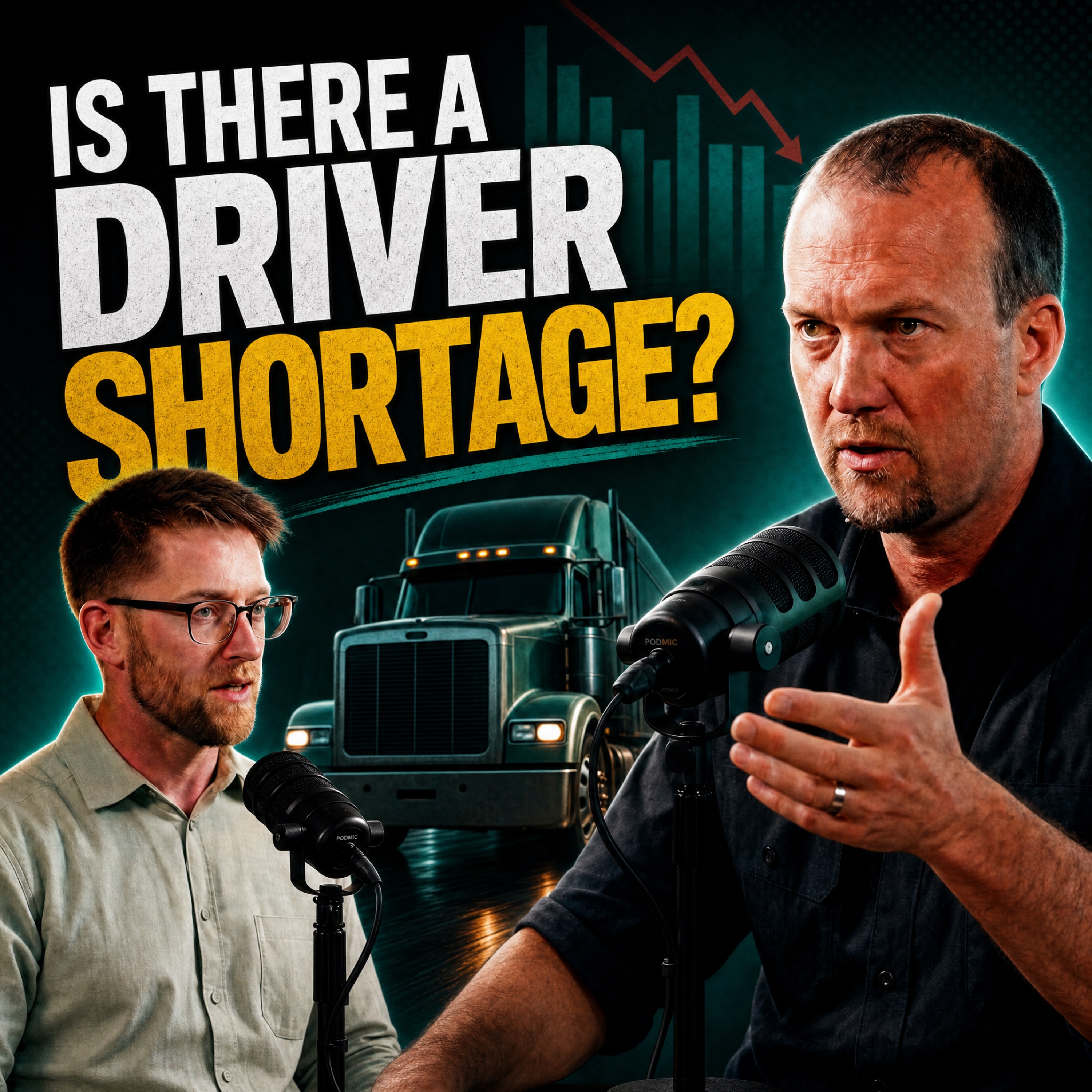
Thinking about a truck driving career? This is part two of our Q&A with Josh Barron, director at Midwest Truck Driving School. We cover what your first year on the road is like, how to choose a CDL school, and whether the driver shortage is real. RJ asks the questions. Josh answers.
We cover three things.
First, how to evaluate a CDL school. Josh explains what separates a solid truck driving program from a weak one.
Second, what the first year is really like at a mega carrier. We talk about turnover, training pay, and what most new drivers run into early on.
Third, the driver shortage. We get into whether it’s real, and what the nuance means for your career.
Josh also compares life on the road (OTR) with regional and local driving, and how to figure out which one fits. He’s honest about who this career isn’t right for.
RJ put together a free playbook of questions to work through before you decide on a CDL career. It’s linked below.
https://www.midwesttruckdrivingschool.com/before-the-wheel-future-drivers-playbook-opt-in/
🔗 LINKS
Listen wherever your get your podcasts: https://built-in-the-midwest.captivate.fm/listen
Midwest Truck Driving School: midwesttruckdrivingschool.com
North Country Heavy Equipment & Electrical Line School: https://ncheschool.com/
Submit your Questions: https://webforms.pipedrive.com/f/6WfGT9X1zlYC6WvssJqfWxOOkvVa1AjzqgnAIIHOq70WWiNo5czEWXpBMqxVTW7UST
💬 CONNECT
Email: marketing@midwesttruckdrivingschool.com
Facebook: https://www.facebook.com/CDLMidwest
Instagram: https://www.instagram.com/midwesttruckdrivingschool/
TikTok: https://www.tiktok.com/@midwesttruckdrivingskool
Transcript
This is part two of a two part Q& A session with Josh Barron, the school director at Midwest Truck Driving School.
Speaker A:And in this session we talk about the credibility of CDL schools and things that you should look out for to avoid going to a CDL mill.
Speaker A:The reality of working as a driver at a mega carrier and what most experience within the first year of starting their driving career.
Speaker A:And we talked about whether or not there actually is a driver shortage and the nuance around it.
Speaker A:So you have a better understanding of the industry.
Speaker A:Hope you enjoy the episode.
Speaker B:If you're thinking about a career in the trades and you want to know what employers actually look for, what the work is really like, and what nobody tells you before you get started, you're in the right place.
Speaker B:Built in the Midwest features conversations that'll help you figure out if this path is for you.
Speaker A:Got one big question that I kind of want to tackle.
Speaker C:Oh, you want to throw a curveball at me?
Speaker A:Yeah.
Speaker C:All right.
Speaker A:So there is kind of a pattern of what a lot of drivers were, you know, have kind of said their experience has been online.
Speaker A:Most agree that the first year out of school is kind of a gauntlet.
Speaker A:You got to just kind of get through it.
Speaker A:And it typically most people that really kind of.
Speaker A:When you look at these big mega carriers, it depends on where you look, but it's usually like 90% turnover rate.
Speaker A:There's a lot of factors that go on and usually you don't end up at one big major carrier and stay there.
Speaker A:I mean, you can, but most don't.
Speaker A:But then those that I didn't check for efficacy.
Speaker A:This was not a scientific study, but from what I saw, it seemed like those who had found roles that they were very happy with, they were satisfied.
Speaker A:They weren't like burned down the industry, they were far more positive than others.
Speaker A:In the same threads was that they had found kind of a sweet spot with either a local or a regional carrier.
Speaker A:Usually maybe not the tiny shop with like 20 trucks, but maybe they've got a few hundred.
Speaker A:They've.
Speaker A:And there's some room for advancement.
Speaker A:They're not tiny.
Speaker A:They're not huge.
Speaker A:Where have you kind of seen or I guess what.
Speaker A:What is your observation of the industry of like, for those that are looking at this as a career, not just a, you know, something to do for a few years to figure something else out, you know, for those that do well and live, you know, live a good life, can raise a family, you know, where.
Speaker A:Where do we.
Speaker A:The real opportunities?
Speaker C:Yeah, that's a good question.
Speaker C:Going back to your gauntlet comment, which is kind of interesting because you are, you are right in a sense, you know, your first year on the road.
Speaker C:What I like to tell all new students, all right, because some new students are, well, I want to make this much and I want to be home every night and I want to do as a. Whoa, you're getting awfully nitpicky for what you want to do.
Speaker C:I mean, doctors don't have a choice on where they want to work or how often they want to be home or anything else.
Speaker C:Their residency, it's whoever will pick them up.
Speaker C:That means they got to move across the country and they went to school for 10 years.
Speaker C:So I was like, you know, out of school.
Speaker C:The biggest thing is to get your experience and, you know, getting a year under your belt, right, is imperative to your long term success in trucking.
Speaker C:And what you don't want to do is be so picky that you wait six months to try to find a carrier and now a carrier's not going to pick you up because you've been off the road for so long or you've been out of school for so long.
Speaker C:And then.
Speaker C:And nobody likes a large gap in employment history, right?
Speaker C:If you got six months, a year or two years gap in employment history.
Speaker C:All right, I know if I'm looking to hire you, I'm gonna, I'm gonna ask you, rj, couple years here, I mean, you know, you got a little comfortable on the couch.
Speaker C:All right, I wanna know, all right?
Speaker C:And I think that's important is right outta school, don't be too picky, all right?
Speaker C:Get into a company and also ask about their training program, right?
Speaker C:Cause that's one thing I've seen hundreds of different companies and hundreds of different training programs.
Speaker C:And that training program is really important.
Speaker C:So for instance, when I came out of school, the carrier I went with, all right, I was in their, what we call a finishing program for four weeks, right?
Speaker C:So they knew I had a strong foundation in trucking.
Speaker C:I had my cdl, I had the appropriate endorsements that I needed, right?
Speaker C:And there it was, the finishing program.
Speaker C:So there it was, it was all sops, right?
Speaker C:It was all standard operating procedures within that company or what we were hauling inbound, outbound procedures at all the different mills.
Speaker C:The paperwork, the paper logs on how they want them to do them, the ELDs on how they wanted to do them and where to fuel up at.
Speaker C:Every company's different, what kind of fuel card they use.
Speaker C:I mean, there's so many.
Speaker C:There's hundreds of different things.
Speaker C:And what I like to tell students is, you know, when you graduate the program.
Speaker C:And they said, oh man, that was great.
Speaker C:And I was like, well, you're learning has just begun, right?
Speaker C:Because you have a strong foundation.
Speaker C:But think about a foundation of a house or anything, a foundation.
Speaker C:No one thinks about the foundation.
Speaker C:They just think about the house.
Speaker C:You just see the house, but you don't understand all the stuff that goes into it.
Speaker C:Right?
Speaker C:You look at like a 40 story building, has to have like 60ft of foundation underneath of it, right?
Speaker C:You don't see any of it, but that's the most important to be able to build on it.
Speaker C:And so those are the things that I would ask, number one is what type of training program do you have?
Speaker C:Finishing program do you have?
Speaker C:And what I'm gonna learn in that finishing program, how long can I expect it to be before I graduate out of that program and actually get my own truck?
Speaker C:And what does that look like?
Speaker C:And I would be weary if they said, oh no, we're just gonna put you in a truck and you're gonna go, because that's scary.
Speaker C:And some smaller companies will do that.
Speaker C:And you gotta tell them, no, I'm not ready for that.
Speaker C:I just came outta truck driving school.
Speaker C:I got a good foundation, but I'm not ready for that.
Speaker C:Right.
Speaker C:We've worked with a lot of local companies around here, smaller companies that wanted to hire students, and we've worked with them to develop a finishing program, training program out of truck driving school.
Speaker C:So they understand that these students have a strong foundation, but they need to have all this other stuff.
Speaker C:Right.
Speaker C:They're not a seasoned veteran that's been on the road for several years.
Speaker C:So those are the questions that I would ask.
Speaker C:And then, you know, really be a sponge, be, be a sponge and ask a ton of questions, all right?
Speaker C:And everything's gonna be new.
Speaker C:And that's the other thing about being in truck driving school.
Speaker C:Ask a ton of questions in truck driving school.
Speaker C:And what I always like to tell students, you know what, ask them now so that way you have the answers when you get to that company that you're looking for and make the mistakes now so that you don't make those mistakes later on.
Speaker C:Right.
Speaker C:And that school should set you up for success.
Speaker C:So, you know, ask the school all the questions that we talked about and then whatever company you decide to go with, ask them those questions as well.
Speaker C:So that would be my advice is one, one, make sure they have a finishing program and ask them what that looks like anywhere, it could be anywhere from two to eight weeks long, depending on the company.
Speaker C:And then you end up in your own truck.
Speaker C:And some people say, well, they're not really paying much for training pay.
Speaker C:I was like, I don't care.
Speaker C:They're taking a chance on you.
Speaker C:They're going to train you and finish you, and then you're gonna end up in your own truck and you'll be making great money.
Speaker C:So you know what?
Speaker C:Bite the bullet for, for the few weeks and then, you know, you can laugh your way to the bank after that, right?
Speaker A:Yeah.
Speaker C:As far as carriers go, I tell you what, you know, we have at the school, we've worked with hundreds of carriers over the last nearly 30 years, right?
Speaker C:And there's so many.
Speaker C:And nowadays a lot of your bad carriers, right, have gone out of business, right?
Speaker C:Because drivers won't work for bad carriers, right?
Speaker C:And so there's so many great carriers out there.
Speaker C:And I know people that are with Schneider and they're out for a couple weeks at a time, and they love it, right?
Speaker C:And there's other people I know that are with Rail or, you know, HBI or AmExpress or CRST or Warner Enterprises, and they love it, right?
Speaker C:So it's one of those things where it really is a different fit, right?
Speaker C:That glove doesn't fit everybody.
Speaker C:And I know me with a wife and four kids over the road's just not in the cards right now, right.
Speaker C:I would want something more local or low or more regional just so I can be home more with the family.
Speaker C:And so, you know, out of this class, there's several people that are going with your Schneiders of the road otr, they have a great training finishing program, and they're excited to be on the road.
Speaker C:They're excited to see the country.
Speaker C:I mean, there's things that I got to see on my travels that, that I've never got to see again because I literally just saw them when I was on the road.
Speaker C:And people want that.
Speaker C:They want to be able to go and see the Grand Canyon and get paid to do it.
Speaker C:Go through the badlands in the Dakotas, I was going to say on i80, going across Nebraska, but there's nothing there, Right?
Speaker C:No offense to the Nebraska people out there.
Speaker C:There's just nothing there.
Speaker C:All right.
Speaker C:Besides a really cool chrome shop.
Speaker C:All right, But.
Speaker C:Or, you know, going.
Speaker C:Going through the Rocky Mountains.
Speaker C:I mean, if you've never been to the Rocky Mountains, aesthetically, that might be the most, in my opinion, the most beautiful place in the country.
Speaker C:I Mean, aesthetically, it's, it blows you away.
Speaker C:It's, it's bigger than anything you've ever seen before.
Speaker C:And it is.
Speaker C:So it's such an awe feeling that you're like, wow.
Speaker C:And there's people out there that have never seen it, right?
Speaker C:There's people have never been to Florida or seen the Gulf of Mexico or the ocean, right?
Speaker C:Or gone across the Golden Gate Bridge in California and got to see the redwoods or Mount Rushmore.
Speaker C:So anyway, there's just some of the things that I've seen on my travels.
Speaker C:Just a couple of things that I get to talk about because I got to truck there and I got to drop my trailer and use PC to take my truck wherever I wanted.
Speaker C:And so it's one of those things that, that might not be a good fit for you, but maybe something more local or regional might be a good fit.
Speaker C:So I don't think there's a one size fits all there and that depending on your situation, there's a lot of great opportunities.
Speaker C:But get that year under your belt, get that year under your belt and then you can be more picky choosy, but don't be picky choosy right out of school.
Speaker A:So I think to expand on that and the reality is in any industry, and I think my hypothesis at this point is that there are a reasonably high number of people who enter CDL careers, driving careers as a non traditional student.
Speaker A:They're not necessarily 18, 19, it might not be their first thing.
Speaker A:So they're coming in and someone in their 30s, 40s, 50s, does not want to do the standard path of a student of going to school for four years and then doing internships for two years and starting entry level and then like working up.
Speaker A:So they have a compressed timeline of what their expectations are generally, again, like, you know, context.
Speaker A:And just what I've seen, oh yeah, of you wanting to kind of hit certain thresholds faster and then they get into the reality of the industry and they go with maybe a mega carrier with extremely high turnover rate, which again, looking at it from a, a business context, like if you're just approaching it as an employee and what you're experiencing, you don't see the whole picture.
Speaker A:And again, like I'm not in one of those companies, so I have my own biases here.
Speaker A:But speaking from a high level sort of macro observation, you have tons of supply of entry level drivers.
Speaker A:Even with, you know, half of all CDL schools going away, there's lots of people who can get a CDL like the barrier isn't that high.
Speaker A:Many of you know people can get them for free in paid school ed programs.
Speaker C:Okay, that's where I'm going to disagree with you just a little bit on the barrier.
Speaker A:Because comparatively to a master's or a bachelor's degree.
Speaker C:Oh, yeah, no, no.
Speaker C:Comparatively low.
Speaker A:For a few thousand dollars you can get started.
Speaker C:Yes.
Speaker C:But the barriers to get into this industry are.
Speaker C:And a lot of people find them out.
Speaker C:Like for instance, you know, you got to pass a drug test.
Speaker C:And it sounds dumb, but there's a lot of people that can't pass drug tests.
Speaker C:You gotta have a clean driving record.
Speaker C:If you have a lot of accidents and tickets on your record.
Speaker C:So you're not eligible to get a CDL until those either drop off or you give them, you get them dismissed from the court.
Speaker C:As well as the medical card requirements.
Speaker C:Right.
Speaker C:If you have like over an 18 inch neck.
Speaker C:Right.
Speaker C:They're gonna make you take a sleep apnea test.
Speaker C:You might not get a medical card.
Speaker C:If you don't have a medical card, you don't have a cdl.
Speaker A:Sure.
Speaker C:You don't have a medical card.
Speaker C:So you haven't meet those medical requirements.
Speaker C:So.
Speaker C:So, but, but yes, you're exactly right compared to like masters and everything else.
Speaker C:But it's one of those things.
Speaker A:There are some barriers, but you don't need massive capital.
Speaker A:You're not $50,000 in loans to make it happen.
Speaker A:You can.
Speaker C:And the average dentist is like 500.
Speaker A:Grand or something in the time.
Speaker A:The time demand is incredibly short.
Speaker A:Where you can go.
Speaker A:I didn't even think about it.
Speaker A:To zero months from now.
Speaker A:You can be working.
Speaker C:Yeah, absolutely.
Speaker A:So that's what I mean by low barrier.
Speaker A:Like there are, there are.
Speaker C:Sure.
Speaker C:But.
Speaker A:And not to.
Speaker C:But not massive like capital expenditures or.
Speaker C:Correct.
Speaker C:I want to get a master's degree and it's going to be, you know, I don't think there's a master's degree program under 100 grand, you know, so.
Speaker A:Right, yeah, yeah.
Speaker A:So looking at, you know, when I'm talking about the demand, lots of people do and can get an entry level.
Speaker C:Absolutely.
Speaker A:The requirements for an entry level driving position.
Speaker A:So these mega carriers don't pay great.
Speaker A:Like they, they offer very little compared to what most people would like to be earning.
Speaker C:Yep.
Speaker A:Because they can just.
Speaker A:If you quit, they can find someone else.
Speaker C:Yeah.
Speaker A:So.
Speaker A:And I understand that being in that scenario and feeling like a number in that game is demoralizing and it can be dehumanizing in some context because people don't care about you.
Speaker A:You are just there, you know, so when you go in, you need to know that that's kind of likely what you're going into.
Speaker C:And that could happen.
Speaker A:It could happen.
Speaker A:But while you're in that, the benefit of large companies like that is they have so much money and time spent into doing things efficiently for their bottom line.
Speaker A:So when you can just crank out the skills like network, don't put your head down and try to just exist your way through the hard year.
Speaker C:Exactly.
Speaker A:Like you said, be a sponge.
Speaker A:That is an active role that you need to take.
Speaker A:You gotta actively try to develop relationships.
Speaker C:And if you're with one of those companies, you have a great opportunity to learn.
Speaker C:And, you know, that's one thing that I think it was one of their podcasts we did that was talking about where you might absolutely hate a job.
Speaker C:And there's some jobs that I absolutely hated, and yet if I could go back, I would do them again.
Speaker C:Just because the education that I learned from it.
Speaker C:It's like that teacher that you just hated in high school or whatnot, that just pushed you and yet homework every weekend and just, man, she is just so strict and so hard.
Speaker C:And yet after the fact, you're like, probably learned more from that teacher than anyone else.
Speaker C:And so, you know, just because you might don't like it, take the opportunity to learn as much as you can.
Speaker C:And then when you feel confident enough, you can always move along.
Speaker A:Right.
Speaker A:Because when you have made yourself uncomfortable and you've put yourself into more opportunities to meet new people, to grow, to learn, to go beyond what you need for the role that you're in.
Speaker A:Because the goal isn't to stay there.
Speaker A:It's not to play under the ceiling that that company has.
Speaker A:It's to then go somewhere else where they're going to just.
Speaker A:They're going to grab you up because you're so good at what you do that they're not taking, you know, they're willing to take a bigger risk on you with more pay or with a better working arrangement, but someone who hasn't proven themselves, who has no credibility to them, it's an outsized risk.
Speaker C:Yeah.
Speaker A:And it just doesn't make sense from a business standpoint.
Speaker A:So when you can kind of have compassion for both sides and understand the game, it makes it much easier to move through it.
Speaker A:Because then you're not just like, this is it, you know, this is all I'm ever gonna amount to.
Speaker A:Think of every coworker you've ever had and like, yeah, there's a reason why some of them kind of stay in the same role for 20 years.
Speaker A:Like not everyone wants to.
Speaker C:No, not everyone wants to progress or look at promotions and different things.
Speaker C:And you know, that's the other thing that the ability to move up in the truck industry and is so much more extensive than I think most people think about.
Speaker C:I mean I think about like what I do now.
Speaker C:I was a graduate of the Midwest Truck Driving School.
Speaker C:I was a graduate and now I'm the school director and I instruct still as well.
Speaker C:And it's like wow, that's a big change.
Speaker C:If you look at almost a lot of your director of safety's in trucking companies were previous drivers.
Speaker C:A lot of your dispatchers were previous drivers.
Speaker C:A lot of your directors of maintenance or logistics were previous drivers.
Speaker C:So there's room to navigate vertically horizontally in the trucking industries that a lot of people don't realize.
Speaker A:Yeah.
Speaker A:So I think the.
Speaker A:I don't want to move on from it quite yet.
Speaker A:There's something else that comes up and I think that we have been I think somewhat complicit in something that I now I regret a little bit of.
Speaker A:There is you know, this sentiment online that you know, people will say that there is a driver shortage.
Speaker A:We've talked about this a few different times in different contexts.
Speaker A:But I want to kind of clarify position on this because it's less about that there is a direct shortage like a shortage of number of drivers for the roles available.
Speaker A:Like that is probably untrue and we see it just in the dynamic of the Medgar carry relationship that we just talked about.
Speaker A:Like the they have plenty of supply for entry level roles.
Speaker A:The problem is there is like people who have gone up the chain and kind of developed the skills and the experience over decades.
Speaker A:Those folks are leaving or will be soon, you know, whether they're not now but they eventually they're going to have to.
Speaker A:There is a shortage of those drivers and for people that do have an above average or even just like meeting expectations and doing the minimums, there's a shortage of those for the roles that are available.
Speaker A:So where does your head go there without.
Speaker A:I don't want to sell the clickbait of like ah, there's just a shortage.
Speaker A:Like there's not but like it's more nuanced than that.
Speaker C:Yeah.
Speaker C:And you know it's interesting because it is a complex situation because you know you have a lot of different factors in place right now.
Speaker C:Article I read in Transport Topics the other day, the average age of A driver right now is 55 years old.
Speaker C:55, Which means proportionally speaking, there's just as many people older than 55 as there's younger than 55.
Speaker C:And so the turnover, a part of the turnover problem is you got all these, all these baby boomers retiring, right?
Speaker C:You got all these babies, you got people 65, 75, 85, still trucking.
Speaker C:Like, you get out there and it's like, you see a younger guy like us trucking, it's like, oh, wow, like, look at you.
Speaker C:It's not common.
Speaker C:Right.
Speaker C:Average age is 55.
Speaker C:So, you know, you see that, you see that turnover and then you see people that in different situations, like, you know, back in the day, over the road was great for me.
Speaker C:I loved it.
Speaker C:I traveled the country, but now I got a wife and four kids.
Speaker C:My situation, my life has changed.
Speaker C:That just doesn't work for me anymore.
Speaker C:And so.
Speaker C:And you have other, other people that, you know, were in flatbed for numerous years.
Speaker C:Well, flatbed, you're throwing chains, you're throwing straps, tarps.
Speaker C:Tarps could be £150 a piece.
Speaker C:As you get older, you don't wanna do that anymore.
Speaker C:And so you might go from a flatbed carrier to a dry van carrier because you're backing up into docks, and that might work out better for you.
Speaker C:The other thing is, I've seen people actually from this neck of the woods that got sick and tired of driving in the snow.
Speaker C:They don't wanna drive in the snow anymore.
Speaker C:And the dangers associated with icy roads.
Speaker C:And so they switched carriers to a carrier down in Texas or Georgia so that they had more southern routes and that's what they preferred.
Speaker C:And so there's so many different aspects of it, you know, and that's the other thing where.
Speaker C:Yeah.
Speaker C:Do some people get burnt out from this industry or what they're doing, and then they find a local job maybe doing something completely different, and then they want to go back on the road.
Speaker C:You know, it's one of those things that.
Speaker C:What was that stat that I read that the average person today has like four or five different careers their lifetime compared to back in the day when it was only one or two.
Speaker A:So I would say that number is even higher.
Speaker C:Yeah, it's even higher.
Speaker A:Younger, you know, my, you know, early or late millennial to, like Gen Z.
Speaker C:So it's, it's, it's.
Speaker C:And that is.
Speaker C:And that's amongst all the different careers out there where people change their careers regularly.
Speaker C:So, yeah, it's just, it's one of those Things that.
Speaker C:Is there a driver shortage?
Speaker C:Well, there has to be.
Speaker C:Considering we have Schneider Rail, all these companies coming in to recruit, right?
Speaker C:If all their trucks were full, they wouldn't be coming into recruit.
Speaker C:So there is a shortage.
Speaker C:You know what I mean?
Speaker C:But what that shortage looks like is different.
Speaker C:And of course, of course, every company wants, wants to hire a 3, 4, 5 year guy that's been on the road, has a great safety record, a good CSA score, is healthy, meets the medical requirements, of course.
Speaker C:But, but those people are few and far between to find.
Speaker C:And so those companies need to hire students straight out of truck driving schools because that's how they keep their fleets full.
Speaker A:So, sure, I think there's kind of two components of it that I think kind of get brushed under the rug of the broader issue, which is like, oh, we call it a shortage.
Speaker A:I'm like, well, sort of.
Speaker A:There's one part of it is a retention problem of if you have the vast majority kind of siphon into these large carriers to get their start, which is admittedly some of the advice that we give, because it's gonna be a good opportunity.
Speaker A:They have high demand.
Speaker A:So you get in, you're getting paid lesson, likely you're gonna learn a lot.
Speaker A:And then a lot of those people leave, which again perpetuates the problem of did they leave because they found a better opportunity because they got the internship period done and they now can get hired by a different company with maybe it's a little bit more favorable, or did they leave because they realized I can't make this work, you know, or they quit or they find they just go do something else because they don't like it, whatever it might be.
Speaker A:And then there's, I think, the, the other aspect of people using those companies for that purpose of like, I'm not going to be here long term, like, you know, kind of treating it like a McDonald's of, you know, this is a stepping stone.
Speaker C:And some people do look at it like, I'm going with this company to learn to train and yes, I'm getting paid, but my end goal is this over here.
Speaker A:Correct.
Speaker A:So I think that as with anything, there are new sort of facets of some of these issues that I've come to observe and learning different perspectives.
Speaker A:But if you're just looking at the industry and you're thinking about getting into it, you're thinking about going to CDL school, or you're weighing your options, you go online and you get discouraged because you see there is no shortage.
Speaker A:It's all Locked up, you know, the hours suck or whatever.
Speaker A:It might be the thing that kind of like you read it and you're like, ooh, I don't know.
Speaker C:But could you look at every occupation and find those comments?
Speaker A:Of course.
Speaker C:I mean, I looked at.
Speaker C:Actually one of my wife's friends went to be a nurse, and all of a sudden she realized, like, it's nights, it's weekends, it's the middle of night, 12 hours, 12 hour shifts, hard on the body.
Speaker C:It's like, whoa, this sucks.
Speaker C:Now.
Speaker C:It's one of those things.
Speaker C:And you scour the Internet, you're gonna see, oh, yeah, nursing is terrible.
Speaker C:Like, yeah, do this or do that.
Speaker C:And there's other nurses that I know that love what they do.
Speaker C:And so I think you're gonna find that across every industry, every job, there's gonna be positive.
Speaker C:And there's other people, there's other nurses I know that have more of a scheduled shift.
Speaker C:And it's.
Speaker C:And they really like it and they like what they do, they like the people they work with.
Speaker C:And so, yeah, it is one of those things where I think you're gonna see that across a lot.
Speaker C:The positive and negatives of people's own experience.
Speaker A:Yes.
Speaker A:I mean, that's universal truth.
Speaker A:It's not a unique problem.
Speaker A:No matter what you look at, you can bounce from thing to thing to thing and experience the same thing.
Speaker A:But for truck driving specifically, I actually put together a.
Speaker A:We'll call it a playbook of compiled resources about 60 pages long.
Speaker A:It's not meant to be.
Speaker A:It's very skimmable.
Speaker A:I put it together so you can kind of skip through.
Speaker A:And the point of it is to ask yourself the questions that you need to be thinking about before you make a decision one way or another.
Speaker A:Because for some, it's not the right path.
Speaker A:You're gonna invite a lot of suffering that you could otherwise avoid.
Speaker A:Cause if you just can't be in.
Speaker A:If you can't be in a car for like two hours without getting really stir crazy, like, probably not a good career for you.
Speaker C:Exactly.
Speaker A:Like, I fall asleep after three hours.
Speaker C:You have to kind of like to drive to an extent.
Speaker C:You know what I mean?
Speaker C:You don't have to love the drive, but you got to like it a little bit.
Speaker C:I mean, if you're complaining about driving an hour somewhere.
Speaker A:Yes.
Speaker C:Maybe a little introspection there would be helpful.
Speaker A:Yes.
Speaker A:So I put together a bunch of different sections about the things that are required, some of the compliance side things to do to prepare, things that you can kind of self evaluate a little bit.
Speaker C:Absolutely.
Speaker A:So that will be available in the description, in the show notes, you know, wherever you're finding this.
Speaker A:So if you've got some questions and you're like, I don't really know where I fall on this, it'll give you something to kind of chew over.
Speaker A:Then if you read through that and you're still not sure or you're kind of leaning in one direction, give us a call, shoot us a message.
Speaker A:And we're always happy to just kind of talk through what we've seen, because sometimes you just, you gotta know people that have been in it.
Speaker A:And, you know, our promise to you is we're not here to try and convince you one way or another because it has to be the right fit for you.
Speaker C:Absolutely.
Speaker C:And, you know, it is one of those things, too, that maybe you decide maybe you're in.
Speaker C:I mean, we just had a student from Texas and North Carolina in the same thing.
Speaker C:And not that I'm encouraged people to come all the way up to the.
Speaker C:Up here to train, but feel free to give us a call.
Speaker C:Or maybe you decide that this is the place you want to train and you're coming from California or Texas or like I said, there's some from Texas, North Carolina in the same class.
Speaker C:Guess what?
Speaker C:We're happy to do that as well.
Speaker C:We train people from all 50 states and there's been a couple people from South Africa as well, so.
Speaker C:Yeah.
Speaker C:Yeah.
Speaker A:So not necessarily local.
Speaker C:Yeah.
Speaker A:But if you're in the Midwest, you.
Speaker C:Know, we can do that.
Speaker C:Absolutely.
Speaker A:And if you don't want to make the commute to come to school here, but you're just like, I need.
Speaker A:I like what they're saying.
Speaker A:I'd like to just ask them questions.
Speaker A:We're happy to do it.
Speaker C:Absolutely.
Speaker C:Absolutely.
Speaker C:That's what we do every day.
Speaker C:Exactly.
Speaker A:So thank you for listening.
Speaker A:Thank you, Josh, for some great questions.
Speaker C:You know, I was a little nervous.
Speaker C:I'm like, I don't know what curveballs you're going to throw at me, but no.
Speaker C:And I actually really enjoyed this.
Speaker C:And I think anyone else out there that has any of their questions or wants us to go deeper on different subjects or different things, put them in the chat box and we'll do this in another month or two and put them all together, and RJ will throw some more curveballs at me.
Speaker C:So I appreciate it.
Speaker A:All right, well, thank you for listening.
Speaker A:Thank you for watching, and we'll see you in the next one.