
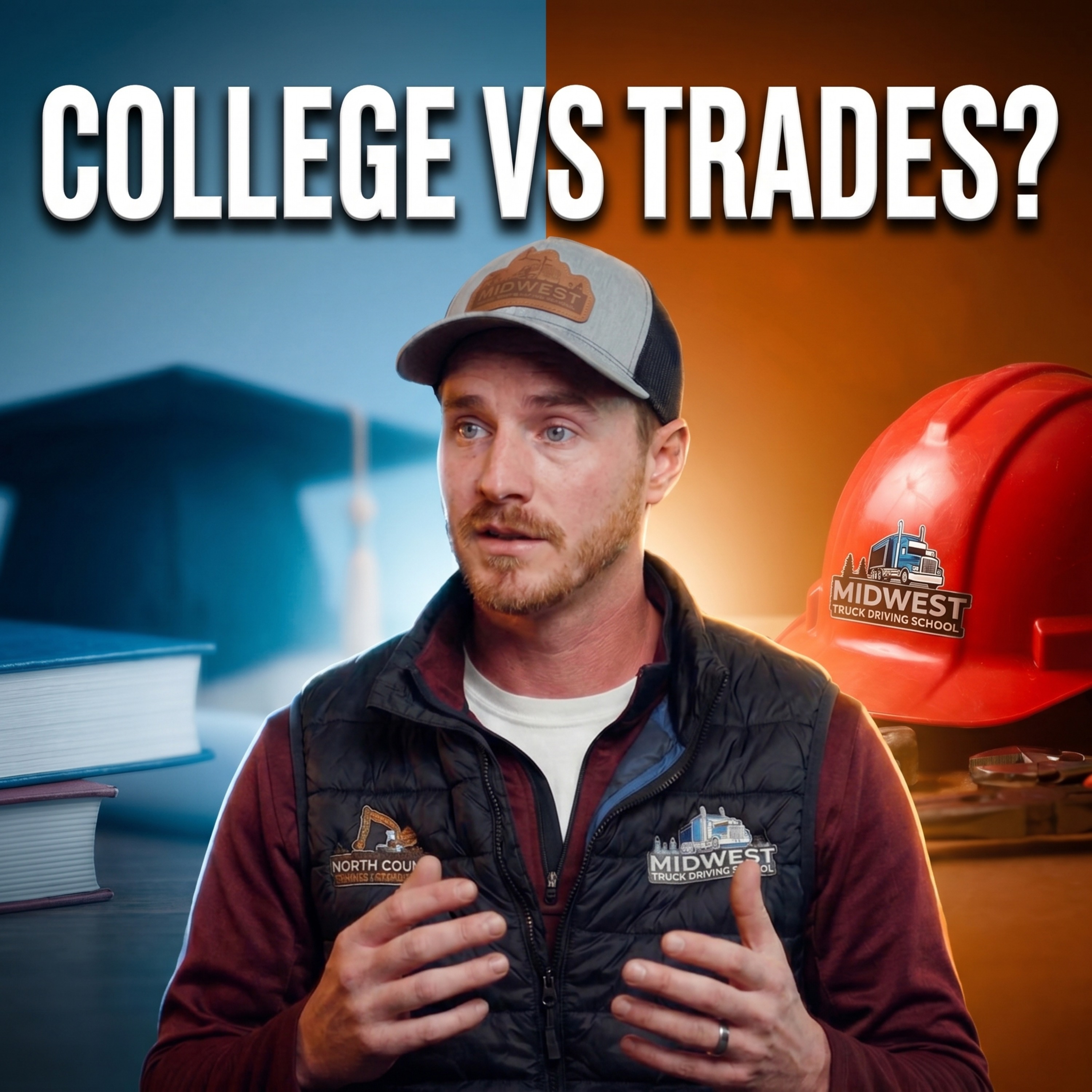
Nine years ago, the average truck driving school student was 50. Today, they’re 18-20. Why are high schoolers and career changers walking away from college and choosing skilled trades careers — truck driving, lineman work, heavy equipment operation — instead?
In Episode 11 of Built in the Midwest, we sit down with Kyle Barron, Director of Admissions at Midwest Truck Driving School and North Country Heavy Equipment and Electrical Line School.
After nearly a decade across the desk from prospective students, Kyle has watched the demographic shift firsthand — the rise of trade school enrollment among young adults, the parents calling about gap year plans, and the 4.0 high school graduate who can’t find a job. This is the skills gap conversation from someone who lives it every day.
We get into:
– Why a four-year college degree no longer guarantees employment
– The truth about underemployment among recent college graduates
– What kinesthetic learners need (and why traditional classrooms fail them)
– Why the trades are a viable career path for career changers in their 30s, 40s, and 50s
– The case against the couch-and-beach gap year — and what to do instead
– How to evaluate trade school programs in the Midwest
– The real ROI of starting a blue-collar career vs. taking on student loan debt
If you’re a high school student weighing college vs. trade school, a parent helping a teenager think through career options, a career changer considering a fresh start, or an employer trying to understand where the next generation of skilled workers is coming from — this conversation is for you.
🔗 LINKS
Listen wherever your get your podcasts: https://built-in-the-midwest.captivate.fm/listen
Midwest Truck Driving School: midwesttruckdrivingschool.com
North Country Heavy Equipment & Electrical Line School: https://ncheschool.com/
Submit your Questions: https://webforms.pipedrive.com/f/6WfGT9X1zlYC6WvssJqfWxOOkvVa1AjzqgnAIIHOq70WWiNo5czEWXpBMqxVTW7UST
💬 CONNECT
Email: marketing@midwesttruckdrivingschool.com
Facebook: https://www.facebook.com/CDLMidwest
Instagram: https://www.instagram.com/midwesttruckdrivingschool/
TikTok: https://www.tiktok.com/@midwesttruckdrivingskool
Transcript
It used to be like 45 to 55.
Speaker A:Used to be the average, average student that we had come in.
Speaker A:Now not as many people are gravitating towards college or universities.
Speaker A:So now we're seeing a ton of 18, 19, 20 year olds right out of high school.
Speaker B:There's a lot of, a lot of 4.0 students that are broke.
Speaker B:There's a lot of 2.5 students that are broke.
Speaker B:There's A LOT of 2.5 GPA students that are rich and doing really well.
Speaker A:People are waking up, Wall Street's waking up and they're realizing like there's more out there than working a desk job that might not be there in a couple years.
Speaker B:If you're thinking about a career in the trades and you want to know what employers actually look for, what the work is really like, and what nobody tells you before you get started, you're in the right place.
Speaker B:Built in the Midwest features conversations that'll help you figure out if this path is for you.
Speaker B:Well, it's an exciting day today.
Speaker B:We have Kyle, director of admissions of Midwest Truck Driving School in North Country Electrical Line Heavy equipment School.
Speaker B:Welcome to the Built in the Midwest podcast.
Speaker B:Thanks for being here today.
Speaker A:No, I'm happy to be here.
Speaker A:This is exciting.
Speaker A:You guys have done a really, really great podcast.
Speaker B:I think it's been great.
Speaker B:And you know, what we were kind of just talking about a little bit ago is being able to connect with people and all over the Midwest, but I'm hearing people all over the country and you know, something I want to talk about today is just talk about kind of the season that we're in and, and talk about we got graduation coming up and you know, there a lot of schools around here, a lot of students around here are graduating.
Speaker B:What would you have to say to somebody that's, that's looking at graduating here in the next four to six weeks on, on potentially their future plans?
Speaker A:Yeah, absolutely.
Speaker A:So I've been, I've been director of admissions now at Midwest for this will be the ninth year.
Speaker A:So I've seen a ton of changes throughout the years.
Speaker A:And what's, what's really interesting is 9 years ago I would not see a lot of these young kids come through these 18, 19, 20 year olds.
Speaker A:So just this evolution and this change of the, the age group that we come in, I mean it used to be like 45 to 55.
Speaker A:Used to be the average student that we had come in.
Speaker A:Now with these graduations coming up and the last few years, really it was kind of like this Covid push, I feel like not as many people are gravitating towards college or universities.
Speaker A:And so now we're seeing a ton of 18, 19, 20 year olds right out of high school.
Speaker A:I mean, guys literally turning 18 and being like, yeah, I should probably get in the trades.
Speaker A:I should probably do something that I know is going to be a viable career option in the next five, 10, 15 years.
Speaker A:Because let's be honest with where things are going with AI you just don't know.
Speaker A:I mean, you really don't know.
Speaker B:So right now there's a lot of kind of uncertainty with that.
Speaker B:But also something that's been on the Wall Street Journal and something that has been on all the news stations is this skills gap, this massive skills gap to maybe somebody out there that doesn't know what the skills gap is.
Speaker B:What are they talking about here?
Speaker A:They're talking about this gap of the baby boomers that are retiring, getting out of the trades.
Speaker A:And for so many years, the trades have been honestly neglected.
Speaker A:They just haven't been cared about.
Speaker A:They haven't been pushed.
Speaker A:I mean, I remember personally when I was in high school, I had many recruiters from colleges, universities, college, college, college, my parents, college, college, college.
Speaker A:Nobody ever talked about the trades.
Speaker A:I mean, who wants to get, who wants to get dirty?
Speaker A:Who wants to, you know, be a lineman or dig holes in an excavator or be a truck driver?
Speaker A:Like, that was, I mean, that was not even an option.
Speaker A:That was like, like, no, you need to go to college.
Speaker A:And now people are waking up, Wall Street's waking up and they're realizing, like, there's more out there than working a desk job that might not be there in a couple of years.
Speaker A:Like, like this gap in the trades is huge and it's ever growing and we have to fill it.
Speaker A:Because if we don't fill it, who's gonna maintain our country's infrastructure?
Speaker A:Who's gonna build our bridges, our roads?
Speaker A:Who's gonna maintain our electrical grid?
Speaker A:Like, everything in this room that I'm looking at today, this cup, this notepad, this mic, was.
Speaker A:How was it brought here?
Speaker B:On a semi truck.
Speaker A:On a semi truck.
Speaker B:Exactly.
Speaker A:So, like, who's gonna do that?
Speaker A:Like, who's gonna deliver your, you know, how are you gonna get your groceries?
Speaker A:We have to have this young generation step up to the plate and get into these trades.
Speaker A:And it's not like they're taking one for the team.
Speaker A:I mean, these trades are very lucrative.
Speaker A:I mean, for a relatively quick vocational training program, you can level up in Life very quickly.
Speaker A:I mean, from my personal experience, you know, out of high school, I was pushed college, college, college.
Speaker A:And I'd go to college for two, three hours a day for four years.
Speaker A:And then I get out of college, I don't really know what to do.
Speaker A:Like looking for jobs, applying for jobs, and then I'd have to move away.
Speaker A:I don't know if I want to do that.
Speaker A:That's what these kids are thinking.
Speaker B:And then what?
Speaker B:You know, and it's funny you say that because I've interviewed a lot of, a lot of people and a lot of people said the same thing, that in high school it was college ready, college ready, college ready.
Speaker B:And, and is that not like a one size fits all approach that I think people are recognizing is not the case?
Speaker B:And you're obviously a huge proponent of higher education with what you're doing, but at the same time, there's a lot of different paths to success.
Speaker B:And all these young people that I've interviewed, they say college ready, college ready.
Speaker B:And they took college ready courses in high school that everyone took because it was just assumed that you were going to college and that was the only way to be successful when in fact there's so many different paths.
Speaker B:And I'm thinking of other things as, you know, with the trades, with the military, with apprenticeship programs, and that one size fits all.
Speaker B:It just doesn't work anymore.
Speaker A:No, it doesn't work.
Speaker A:And the proof's in the pudding.
Speaker A:I mean, you look at, I mean, I just look at, from an admissions standpoint, how many individuals that we have come through our programs that literally have associate's degrees, that have bachelor's degrees and can't find work.
Speaker A:Like, they're like, what are we doing?
Speaker A:Like, like I have six figures in loans that, that you can't just write off.
Speaker A:You will die with them.
Speaker A:What are you doing?
Speaker B:Well, interesting statistic on that point.
Speaker B:33% Of college graduates do not have a job 18 months after graduation.
Speaker B:Right.
Speaker B:So.
Speaker A:So that's a shocking statistic.
Speaker B:It is.
Speaker A:That's crazy.
Speaker B:It is crazy.
Speaker B:But I think people are recog.
Speaker A:Payments don't stop.
Speaker A:No, they keep coming.
Speaker B:No, no.
Speaker B:So getting individuals career ready.
Speaker B:Right.
Speaker B:Career ready, not college ready, but just career ready and whatever that career may be.
Speaker B:And that's what this podcast is all about, is understanding that there's all these different careers.
Speaker B:And right now the skills gap is primarily in the trades and across all the trades.
Speaker B:We've talked about welding, we just had a guy on recently talking about diesel technician.
Speaker B:We've professional Drivers on, we've had linemen on.
Speaker B:But also things like H Vac and things like carpentry.
Speaker B:There's this massive skills gap.
Speaker A:Electricians, electricians.
Speaker A:I mean, there's a humongous gap there.
Speaker B:And it's going to take.
Speaker B:What would you say?
Speaker B:It's going to take years, Decades.
Speaker A:Oh, my gosh.
Speaker A:I mean, to become a master electrician.
Speaker A:I mean, what is that, like a five year apprenticeship?
Speaker B:Apprenticeship, yeah.
Speaker A:Five years.
Speaker A:I mean, you don't just snap your fingers and oh, we got all these electricians.
Speaker A:I mean, this gap is gonna take a lot of time to fill and it's not gonna happen overnight.
Speaker B:No, absolutely.
Speaker B:So, you know, on this point, in the middle of July, Middle of July, I believe July 15th, you having a career exploration day.
Speaker B:Talk about that day.
Speaker B:And I believe this is what, the third or fourth annual now.
Speaker A:Yeah, I think this is.
Speaker A:Yeah, I think this is the fourth annual Career exploration.
Speaker A:And what this is, is to essentially have this huge open house for all of our programs, all of our schools, and open the doors up for anybody, really, the general public.
Speaker A:Somebody might be interested in any one of these programs.
Speaker A:Like, what's it like to get behind the wheel of an 18 wheeler?
Speaker A:What's it like to get 60ft up in a bucket truck?
Speaker A:What's it like to climb a utility pole?
Speaker A:What's it like to run a log truck, an excavator, a bulldozer and open these doors up and maybe give these individuals and these possible students and parents and even young kids, what else is out there.
Speaker A:I mean, I had this individual from northern Wisconsin.
Speaker A:He had no idea that the lineman trade was like even a thing.
Speaker A:Just because he lives in this small community and he doesn't have much proximity around this trade.
Speaker B:He was never even exposed to that.
Speaker A:No.
Speaker A:But we reached out to a couple of these different school districts, really, all over the Midwest, and, And they're like, oh my gosh, I didn't even know this was a viable career option.
Speaker A:This is so cool.
Speaker B:Yeah, absolutely.
Speaker B:You know, it's interesting you say that because we just did a tour here with Horizons School up in the Keweenaw and give Barb a little shout out up there.
Speaker B:Yeah, absolutely.
Speaker B:And she was fantastic.
Speaker B:Always is.
Speaker B:And these young people had so much fun getting on the poles and they weren't really sure about these, these, these jobs or these careers.
Speaker B:And so to see them put on the lineman gear and get on a pole and a few of them, like, this was never even a viable career option for them.
Speaker B:They didn't Even know that this was something that they could do, let alone how to do it right.
Speaker B:And so we do tours from high schools from all over.
Speaker B:All over the place.
Speaker B:I want to give a shout out to Linus as well.
Speaker A:Yes.
Speaker A:I heard Linus is coming in.
Speaker A:I know.
Speaker A:Really excited.
Speaker B:Well, not only is he coming in, so he came up with this idea of, like a reverse job fair.
Speaker B:So we actually took not one, but two trucks and trailers to Newberry High School last week and put on a little presentation.
Speaker B:But it was more one on one.
Speaker B:Very conversational on telling the students that, hey, these are some students that are in the class.
Speaker B:This is what they're doing.
Speaker B:And we're here just to talk about the programs.
Speaker B:But we actually went to them and he kind of came up with this idea, and it was so receptive.
Speaker B:They loved it.
Speaker B:Everyone was taking pictures out the windows.
Speaker A:Literally.
Speaker A:Get in the driver's seat and see what it's like in the day of our life.
Speaker B:Exactly.
Speaker B:These trades aren't for everybody, which is fine, but it's.
Speaker B:But it's about maybe exposing these to the right people that say, actually, you know what?
Speaker B:That.
Speaker B:That does sound like something I'd be interested in and would be something that I want to look at a little bit further.
Speaker B:And speaking of, Lyons will be here next week.
Speaker B:He's bringing a massive class, a busload of students to the school.
Speaker B:And so I said, I go there, Linus, you come here now.
Speaker B:All right, so he's going to come.
Speaker A:It's kind of hard for them to get into bucket trucks and climb poles.
Speaker A:You know, we can't do it on site.
Speaker B:Exactly.
Speaker A:But if they come here.
Speaker A:Absolutely.
Speaker B:Well, and that's the first thing that I like to do.
Speaker B:Someone's interested in the lineman program.
Speaker B:Let's hop on the bucket truck.
Speaker B:Right.
Speaker B:I mean, you know, everyone's a little afraid of heights, but some people are definitely afraid of heights, right?
Speaker A:Yes.
Speaker B:And I.
Speaker A:And I, I, I personally, like, I. I am not.
Speaker B:I. I could never be alone.
Speaker B:No.
Speaker A:And that's okay, though.
Speaker A:But.
Speaker A:But that's why we do these career exploration days in these tours, because it's like, this isn't for everybody.
Speaker A:And that's okay.
Speaker A:There's a lot of options out there.
Speaker B:Exactly.
Speaker A:But you got to do something, though.
Speaker B:Yeah, Absolutely.
Speaker B:But it's about exploring these different careers where it's not just.
Speaker B:And I feel like a lot of teachers that I work with, and they're not just about college ready now.
Speaker B:Now, college is great for certain people.
Speaker B:It's not great for Other people, there's not a one size fits all here.
Speaker B:And so they're understanding there's a lot of different paths to success.
Speaker B:And you know, something I heard here recently was, was there's a lot of 4.0 students, right, that are broke.
Speaker B:There's a lot of 2.5 students that are broke.
Speaker B:There's a LOT of 2.5 GPA students that are rich and doing really well.
Speaker B:And there's a lot of 4.0 students that are rich.
Speaker B:So your GPA doesn't make a difference?
Speaker B:No, it doesn't.
Speaker A:Who you are?
Speaker B:No, it really doesn't.
Speaker B:And so something that I have recognized for years is a lot of people that I've trained, they're kinesthetic learners, right?
Speaker B:And when you're a kinesthetic learner, that means you like to touch it, you like to feel it, you like to get down and dirty, and that's how you learn best.
Speaker B:And I've seen a lot of young people that struggle with the book work and the tests and everything.
Speaker B:But all of a sudden when we start operating heavy equipment or we start driving or learning how to shift a non synchronized manual transmission, or actually doing the pre trip or we're pointing at the different components, that's when they excel.
Speaker B:Right.
Speaker B:And so part of this is not just exploring.
Speaker A:So you guys kind of do that, you bridge the gap, you'll do a theory section and then you actually go out and apply it and do it.
Speaker A:And all of a sudden now the two kind of mesh together and it makes things that much easier.
Speaker B:Absolutely.
Speaker B:Cause some people are really good at the book work and some people are not so good hands on.
Speaker A:I was never good at the book work, but I was good at the hands on.
Speaker B:But the hands on.
Speaker B:Exactly.
Speaker B:And everyone learns a little different.
Speaker B:And that's where these programs are kind of designed for both where yeah, we got plenty of book work, but we have a lot of hands on stuff to reiterate all that material and really drive it home.
Speaker B:And so for all the kinesthetic lear out there, that's when they excel.
Speaker B:And people that maybe struggle in the classroom, they're helping out people that were good in the classroom, that are struggling out in the yard.
Speaker B:And so it's one of those things with the trades where being exposing and exploring these different careers for young people, who knows?
Speaker B:I mean they might.
Speaker B:There's so often times where they get to touch it, they get to feel it, they have to climb that pole and they're like, you know what?
Speaker B:Yeah, this is what I've been looking for, this is what I've been interested in.
Speaker B:And I want to be alignment because of this or you know what, I don't want to drive the trucks, but man, I love how they work.
Speaker B:And I have like an engineering mind and I want to work on this stuff and I want to become a diesel tech.
Speaker B:And so being able to expose all these young people, these different careers and then they can figure out what they want and what they don't want.
Speaker B:And that's what it's all about.
Speaker B:So moving on to a new thing that is coming out and you're kind of ramroding.
Speaker B:This is the accelerated CDL program, right?
Speaker A:Yeah, absolutely.
Speaker A:We're actually really excited about this.
Speaker B:So talk to me about this.
Speaker A:So like I said, I've personally been at the schools now for nine years, but the school's been around much longer than that.
Speaker A:I mean it's pushing, I think over 28 years now.
Speaker A:And throughout that time frame a lot of things have changed.
Speaker A:I mean the industry's changed, the way people look at the industry has changed, the equipment's changed, the technology's changed.
Speaker A:And I know when the school first started there was one program and that was the four week class A CDL program.
Speaker A:And then you start getting all these calls from customers.
Speaker A:They want this and they want that.
Speaker A:And you need to listen to essentially what's your clients, what your customers want.
Speaker A:And that's when the school came out with the class B program.
Speaker A:And then there was customers that wanted the passenger school bus program, then that program came out and then there was customers that maybe had a class B but wanted the class A, but they didn't want to come for the four weeks.
Speaker A:So now there's a B to A upgrade program.
Speaker A:We have restriction removal programs, which is if somebody has a restriction on their license, that could be an automatic restriction, that could be a fifth wheel plate restriction, that could be an air brake restriction.
Speaker A:So we have that class to help them get that restriction taken off their cdl.
Speaker A:But this one was really interesting and it took a minute to put it together.
Speaker A:And one thing that I love to take pride in is going to different conferences and seminars and talking to these other schools literally from across the country, from California to Texas to Washington.
Speaker A:And one of the common denominators that we're kind of going back and forth on is these employers really want a quicker program.
Speaker A:They want a quicker program for the class A and it was a challenge because you know, we take a lot of pride in the quality of instruction.
Speaker A:That we put out for this four week, 160 hour program.
Speaker A:So how do we condense this class to better cater employers and maybe those individuals that have experience, maybe with that Uncle Bob in the back 40 because they're farm boys, you know, we do see that.
Speaker A:And so to condense this down and create this 80 hour accelerated class, a CDL program has been a fun project actually.
Speaker A:And so this actually rolls out here in, I want to say, another week and a half.
Speaker A:And what it's really meant for is that employer that has Jimmy lined up ready to go.
Speaker A:They vetted him, he's gonna be a great candidate.
Speaker A:He just needs to get that CDL.
Speaker A:So we get him into this 80 hour accelerated program and from there we get through all the entry level driver training, all the nuts and bolts of the program, we build this phenomenal foundation for him in this accelerated program and then he goes off to this employer and then that employer then builds upon that foundation.
Speaker A:Right.
Speaker A:So it's different than our four week class where, John?
Speaker A:Off the street?
Speaker A:Yeah.
Speaker A:I want to get my cdl.
Speaker A:Well, what do you want to do, John?
Speaker A:Well, I'm not really sure yet.
Speaker A:Okay, this four week option is for you.
Speaker A:Here's why.
Speaker A:We're going to go through in depth, in detail, what this program's all about, what a class a CDL is all about.
Speaker A:And we're going to help you get all your endorsements, your, your tanker, your doubles and triples, your hazmat, really open up all your doors.
Speaker A:That way when you do find that company you want to work for, whether it's a logging company, whether it's a flatbed, a tanker, hauling doubles for FedEx, whatever it is, you have the skills and competencies to be successful.
Speaker B:So that month long program, it's very comprehensive, it's focused on quality and people that want to do get into hauling propane or hauling gasoline or diesel fuel.
Speaker A:It's by far our highest value course for sure.
Speaker B:And they can get their hazmaterials endorsement.
Speaker B:They actually get the opportunity to haul doubles too, right?
Speaker B:I mean they actually get to hook up doubles, actually haul doubles, get their doubles triples endorsement, get their tanker endorsement, learn about surge and slosh and you.
Speaker A:Know, this, I mean, understand how to pull 28 foot trailers, 48 foot trailers, 53 foot trailers, sliding tandems, bridge law, roundabout training, cat scale training, the list goes on and on and on.
Speaker B:It'll blow your mind.
Speaker B:It's thorough.
Speaker B:It's thorough to say the least.
Speaker A:Beyond thorough.
Speaker A:I mean, I have never had a student that said, that wasn't that, you know, I thought I would have learned more.
Speaker A:I mean, honestly, it's never happened.
Speaker A:10 Times out of 10, it's.
Speaker A:That course blew me away.
Speaker A:Like, holy cow, I had no idea you could actually learn that much.
Speaker A:I had no idea there was that much that was actually entailed in this industry.
Speaker B:Well, there was a student recently and he made a comment about that where he had no idea he was gonna learn how to load and unload heavy equipment, how to chain it down.
Speaker B:Talk about chains.
Speaker B:Chain binders, grades of chains, attachment points on a bulldozer.
Speaker B:Right.
Speaker B:And how to chain it down properly.
Speaker B:He's like.
Speaker B:And that's what he wants to do.
Speaker B:He wants to be able to haul a lowboy and haul heavy equipment.
Speaker B:And he's like, man, this was such a foundation to be able to get out there.
Speaker B:And as well as the rules and regulations, because there's a whole rule book on load securement and loading and unloading heavy equipment, how to do it safely, how to chain it down properly.
Speaker B:And so that month on course has been the staple course at the school for 30 years.
Speaker A:Dang me.
Speaker A:And it still will be the staple course.
Speaker A:Right.
Speaker A:But we still, at the end of the day, we still have to listen to our customers, especially our employers.
Speaker A:These employers, time is money to them.
Speaker A:Right.
Speaker A:So that's where how can we condense this program without losing value?
Speaker A:And so what we do is, I mean, this course is really, really designed for more of a one on one type of scenario, which is good, but it's also one of those things too.
Speaker A:It's like we had to restructure a little bit because it's like we can't have every student one on one.
Speaker A:I mean, our typical structure right now is three to four students for one instructor for the duration of the program.
Speaker A:But this is different because now we need more instructors, more equipment, more one on one time, which is okay.
Speaker A:But we're doing it to cater to the employers that hired that gentleman that don't want to wait the four weeks to get them in.
Speaker A:Instead, we can get them in every two weeks.
Speaker A:Yeah.
Speaker B:And you know, talking to some employers myself, and they got a guy and boom, they got stuff that needs to happen right here, right now.
Speaker A:This guy's got his.
Speaker B:Gotta get an alert approval.
Speaker A:He's got his drug screen.
Speaker B:So they already have employment.
Speaker B:That employer sent them through.
Speaker B:This is what.
Speaker B:And so part of it is kind of what that employer wants them to get too, where that employer chooses.
Speaker B:All right.
Speaker B:Yeah, I need them to have this, this and this.
Speaker B:But I don't need them to have all these endorsements and I don't need to have roundabout training and sliding tamp.
Speaker B:Nope, this is what I need.
Speaker A:But in some cases, they don't want us to over train their guys.
Speaker A:Right.
Speaker A:Because.
Speaker A:Because if we overtrain a guy and get him their hazmat and get him their tanker, well, that also did what for?
Speaker A:That opens more doors.
Speaker A:It opens more doors.
Speaker A:And so these employers don't always want all these doors open for these guys.
Speaker A:Which is fine.
Speaker A:Right.
Speaker A:Because they're paying for the program to train these guys.
Speaker B:They're the ones paying for it.
Speaker A:They can choose what.
Speaker B:They can choose what they want.
Speaker B:Exactly.
Speaker A:So they have spoken, we have listened, and we're super excited to roll this out.
Speaker B:Excellent.
Speaker B:So people that want to get into this accelerated accelerate, a two week program now, they like the theory and the drug testing and all that.
Speaker B:When does that get done?
Speaker A:So they get that done ahead of time.
Speaker A:They get the commercial learning from it done.
Speaker A:They get their theory done, their DOT physical, all done ahead of time.
Speaker A:When these guys get here, we're not in a classroom.
Speaker A:We are literally boots on the ground.
Speaker A:We're in the trucks.
Speaker A:Day one, hour one.
Speaker A:We're going to.
Speaker A:I mean, and a lot of times we're shifting gears the first day as well.
Speaker A:We're not messing around.
Speaker A:This course is.
Speaker A:It's not for the guy that wants to kind of meander around and take it easy.
Speaker A:No, this is for the go getters.
Speaker A:This is for those guys that are highly motivated.
Speaker A:This is for the individuals that want to get in, want to get out, that have secured employment, that need to.
Speaker B:Get kind of a baseline of trucking knowledge or maybe trucking experience would be helpful too.
Speaker B:You were talking about that guy that's on a farm that, hey, he's shifted the farm.
Speaker A:Well, he's got.
Speaker A:He's got his f. Endorsement.
Speaker A:He's been driving with Uncle Bob.
Speaker A:I mean, he knows about this trade.
Speaker A:He knows about this.
Speaker A:He knows what a clutch is.
Speaker A:I mean, if you don't know what a clutch is, this class isn't for you.
Speaker A:You know what I mean?
Speaker A:If you don't know what a.
Speaker B:It's good to be able to articulate that on, okay, who's a good fit for this and who might not be a good fit.
Speaker B:You want to set.
Speaker A:Not everybody will be a good fit for this.
Speaker A:Not by any means.
Speaker A:I mean, we have students sometimes that want to go through our B day upgrade class, and in some cases that's One week.
Speaker A:In some cases that's two, three, four weeks.
Speaker A:Well, what's the difference?
Speaker A:Well, sometimes a student will come in that has a class B.
Speaker A:Well, that could be an automatic class B, maybe driving a passenger school bus, you know, do they have any experience with a clutch shifting gears while we can't take them and put them into one of our big rig 18 wheelers with a 10 speed, 18 speed, non synchronized transmission, they're gonna fall in their face.
Speaker A:And that one week is not gonna be enough for them, you know, so in that case we'd put them in, you know, to a longer program.
Speaker A:Because at the end of the day, this school, this school's success is our student success.
Speaker A:Right?
Speaker A:If they're not, if they're not getting this, if they're not winning, we're not winning.
Speaker A:And that is, that's our motto.
Speaker B:Yeah, no, I love that.
Speaker B:But being able to listen to a lot of the other trucking companies that you work with and these other businesses that say, hey, you know what, I need this guy in and out.
Speaker B:We have a finishing program to finish them.
Speaker B:We just need that CDL to make it happen.
Speaker B:But it really shows you, you have your ear to the industry, listening to them on what's needed and what's required here.
Speaker B:Well, kind of moving on to some of the, some of the big things going on.
Speaker B:What other advice would you give to some young people out there, you know?
Speaker B:Cause that's what this podcast is all about, talking to young people on what they should or shouldn't be doing or, you know, different things.
Speaker B:And the one thing I want to talk about with that tour that we just did is there was a lot of people that didn't have a job, right?
Speaker B:They were in high school, never had a job before.
Speaker B:What would you say to those young people that are still in high school?
Speaker A:I would say you need to do something, right?
Speaker A:I mean, regardless of what you do after high school, you gotta do something.
Speaker A:You can't sit in your parents couch in the basement the rest of your life.
Speaker B:Can't.
Speaker A:You can't.
Speaker A:I mean, at some point they're gonna stick a boot up your ass and say get out.
Speaker A:And we get those.
Speaker A:I get that call From mom and 35 year old Jimmy's on the couch in the basement.
Speaker A:It's time to go, time to leave the nest, you know, retired, I'm done subsidizing you, like time to move on with your life.
Speaker A:But no, I mean, you know, if you're fresh out of high school, do something, you know, whether that's get into a trade program, some type of form of higher education and college might be your career path too.
Speaker A:That's great.
Speaker A:Just know what you're getting into.
Speaker A:Do your research.
Speaker A:I mean, truly look at like, you know, if you're 18 years old, in five years you're gonna be 23.
Speaker A:Like, like actually make sure that's going to be a viable career option in five years.
Speaker A:Yeah, I mean, I know that seems like a short span, you know, because I think it's hard to look past even 15 years right now.
Speaker A:We don't know.
Speaker A:But what we do know is it's going to be very, very challenging to replicate AI driving a semi truck.
Speaker A:I mean, at the end of the day, airplanes have been driving them or have been flying themselves, excuse me for I think since the 80s.
Speaker A:Right.
Speaker A:On autopilot.
Speaker A:Yeah.
Speaker B:But yet they still have 95% autonomous,.
Speaker A:But they still have how many pilots?
Speaker B:Two commercial pilots.
Speaker A:Two commercial pilots every plane.
Speaker A:So this industry is not going anywhere anytime soon.
Speaker A:I mean, especially the heavy equipment side, the lineman side, it's not going anywhere.
Speaker A:You know, welders, pipe fitters, H vac, electricians, not going anywhere.
Speaker B:You're not going to get AI to do those jobs.
Speaker B:And it's one thing, you know, you see a lot of, a lot of young people.
Speaker B:And one thing I told the last school tour, I said, guys and gals, you know, you're in high school, you should have a job.
Speaker B:You know, there's different skill sets and different soft skills that you develop by having a job that you're not going to get anywhere else.
Speaker B:Literally nowhere else.
Speaker B:You're not going to get a work ethic from pretty much anything than having a job.
Speaker A:Right.
Speaker B:And the one student said, well, what about sports?
Speaker B:You know what I mean?
Speaker B:That's hard work.
Speaker B:I said, do you get paid to go to sports?
Speaker B:Right, right.
Speaker B:I play sports.
Speaker B:Right.
Speaker B:I like to play golf and stuff.
Speaker B:Right.
Speaker B:No, it's fun.
Speaker B:You enjoy it.
Speaker B:Right.
Speaker B:A job forces you to wake up, forces you to go there, forces you to punch a clock.
Speaker B:Forces you to work with people maybe that you don't want to work with.
Speaker B:And the other thing is it sets yourself up for success.
Speaker B:I talk to a lot of employers and a big thing that they talk about is they get these people that apply to go with them, but they've never had a job before.
Speaker B:Well, guess what?
Speaker B:If you don't, if you're 20 years old and you never had a job, you're behind the ball because you don't have any work Experience.
Speaker B:And who's gonna, you know, even if that might be McDonald's or Walmart or fast food or retail.
Speaker A:Something, something, something to show accountability, showing up on time.
Speaker B:I want to see a W2.
Speaker B:Show me a W2 that you've worked before.
Speaker B:And I think, And I think that's really important.
Speaker B:I think the.
Speaker B:Some of the younger generations lacking that, where you might not like your job, but you've proved that you know how to work, plain and simple.
Speaker B:And I think that's really important is do something.
Speaker B:And, you know, you were talking about, you know, maybe taking a year off and like, having a gap year seems to be like the new norm.
Speaker B:Everyone's doing it.
Speaker A:I don't know why everyone has the gap year.
Speaker B:Everyone's doing it.
Speaker A:Just do something.
Speaker B:But say, the thing is, and I think there's good things and bad things to the gap year.
Speaker B:You know what I mean?
Speaker B:If you want to have a gap year, to have a long summer vacation and sit on the beach and relax and take time for yourself and not do anything, probably a bad thing, because is it Newton's law?
Speaker B:You know what an object in motion tends to stay in motion.
Speaker B:An object at rest, if you rest too long, you might never be able to get movement.
Speaker A:You might not get going again.
Speaker A:Right.
Speaker B:And so.
Speaker B:Okay.
Speaker A:But I do have a question about this gap year.
Speaker A:Okay.
Speaker A:Okay.
Speaker A:You know, and I'm just speaking from how I was raised.
Speaker A:If I was ever to take a gap year, I mean, I think my parents would say, okay, do your gap year in your own apartment, not in my house.
Speaker A:I'm not flipping your bill anymore.
Speaker A:I mean, like, I feel like parents, and that's all.
Speaker B:How would you survive?
Speaker B:You wouldn't survive.
Speaker A:I mean, I mean, dad's still getting up at 7am and coming home at 6pm so that you can have your.
Speaker B:You can have a gap year.
Speaker A:Like, I don't.
Speaker A:I'm not gonna be that kind of parent.
Speaker B:No.
Speaker A:I mean, I'm really not.
Speaker A:But, you know, I think some of this comes down to the parents, too, on forcing their kids a little bit, like a nice encouragement, like, hey, a little tough love.
Speaker A:Exactly.
Speaker A:Get out there and do something.
Speaker A:You know, get.
Speaker A:Get a skill set, get a job, do anything.
Speaker A:Just don't sit on your ass.
Speaker A:Go do something.
Speaker B:Yeah.
Speaker A:You know what I mean?
Speaker B:Absolutely.
Speaker B:And so that's where you could take a gap year.
Speaker B:Right.
Speaker B:And there's a positive aspect to it and say you just.
Speaker B:You're not sure what you want to do, whether it's trades or college or whatever.
Speaker B:But you take that gap year and you work a couple full time jobs, you work in the gig economy, you're working on the weekends, you're building your resume.
Speaker B:And you know, the other thing that, that I've done before, right, when I was younger is say you're interested in an industry, right?
Speaker B:Interesting industry.
Speaker B:And say we'll say diesel tech just because we were talking to AJ here a little while back.
Speaker B:And if you go to AJ and say, you know what, I will for you for free.
Speaker B:For free.
Speaker B:Just to see if maybe this is something I want to do.
Speaker B:Guess what?
Speaker B:There's, I don't think there's an employer out there that would say no free labor.
Speaker B:Come on in.
Speaker A:Absolutely.
Speaker B:And guess what AJ's going to say?
Speaker B:He's going to say, you can work in my shop, you can clean the floors, you can watch some of the older guys doing engine rebuilds and clutch jobs and everything else.
Speaker B:And maybe it's for you, maybe it's not, but the experience you get will be invaluable.
Speaker B:And I think about the best experience I ever had was working at Burger King when I was, when I was 14 years old, right.
Speaker B:And people laugh when I say that.
Speaker B:But by far the best work experience I have, right?
Speaker B:Because I was 14 years old as my first job, one of my first jobs and first kind of full time job, I was working there nights, I was working there on weekends.
Speaker B:I'll take my moped back and forth to BK and, and, but I learned to work with people.
Speaker B:I learned to make change.
Speaker B:This was before credit cards.
Speaker B:If you, yeah, you know about digital.
Speaker A:Display that tells you to change?
Speaker B:No, no, you didn't.
Speaker B:You know that.
Speaker B:So it was before you had to count change.
Speaker A:You had to use your brain.
Speaker B:It was before credit cards.
Speaker B:So you didn't have credit cards.
Speaker B:It was all cash.
Speaker B:It was all cash.
Speaker B:And then, and then you had the headsets and you'd, you'd, you'd announce that whopper or, you know, large fry, you know what I mean?
Speaker B:Give me a big fish on the fly, you know, hot and ready.
Speaker B:I mean, you get all that stuff, right?
Speaker B:Sure.
Speaker B:But it was some of the best work experience.
Speaker B:And I remember my manager, I'll never forget Jen, if she's listening.
Speaker B:She was not a nice lady, all right?
Speaker B:You know that?
Speaker B:But she did what she had to.
Speaker B:And she was a manager, right?
Speaker B:And she pushed, she pushed, she pushed to the point where I didn't like her.
Speaker B:But guess what?
Speaker B:I like her now because I see what she was doing.
Speaker B:She was trying to be efficient, trying to be effective.
Speaker B:And you know what?
Speaker B:And it taught me how to work with people that maybe I'm not a huge fan of.
Speaker A:It was that little bit of experience on that one job when you were 14, that kind of, you know, you realize, like, okay, what's it like to work with people?
Speaker A:What's it like to have a boss, a manager?
Speaker A:You know, because if you're 20 years old and your boss talks to you in such a way that you don't, like, we're just gonna quit.
Speaker A:Well, you can't.
Speaker B:You shouldn't.
Speaker B:You know what I mean?
Speaker B:Yeah.
Speaker A:But that's what it taught me, too,.
Speaker B:Is after a year at Burger King, I'm like, man, yeah, I would like something different.
Speaker B:And then I go, so you learned what you want to do.
Speaker B:Yeah.
Speaker B:And then I applied around and.
Speaker B:And I knew, like, some advice I got a long time ago is don't.
Speaker B:Don't quit your job until you got something else lined up.
Speaker B:It's a lot easier to get a job when you have a job than to get a job when you're unemployed, right?
Speaker B:So.
Speaker B:So have that next job lined up before you quit your job that way, you know, because if we're in, like, a recession where there's no jobs available, then you might want to hold on to your job.
Speaker B:Right?
Speaker B:But it's one of those things with these young people.
Speaker B:It's like, you know, if you're a junior senior in high school and you never had a job, that blows me away, because I think I was on my fifth job by my junior year or senior year, you know, to a point where I was serving and bartending and hosting and busing in high school.
Speaker B:And so at restaurants, Right.
Speaker B:Which my Burger King experience really helped out with that and helped out with the communication side.
Speaker B:So it's one thing where I, you know, I like to really talk real to these young people because I want them to be successful.
Speaker B:I want them to be successful because I have four kids.
Speaker B:You have numerous kids.
Speaker A:I have four kids.
Speaker B:Exactly.
Speaker A:Yeah.
Speaker B:So.
Speaker B:So.
Speaker B:And you want your kids to be successful, and you want to push them and motivate them, because based on what I've seen, kids are like water.
Speaker B:They're going to take the path of least resistance.
Speaker B:And so someone's got to be there to push them and motivate them.
Speaker B:And I think as an instructor, as a teacher, as a parent, as a coach, right?
Speaker B:That's your job.
Speaker B:That's your job is to be that leader and to push them as a.
Speaker A:Parent, that's one of your most important jobs, right?
Speaker A:To push your kids to do hard things.
Speaker A:Right.
Speaker A:And if that hard thing is going to Burger King, well, guess what?
Speaker A:Life's gonna get a lot harder than that.
Speaker A:You know, the older you get, the more responsibilities you have.
Speaker B:Absolutely.
Speaker A:And you know, to gain that experience at a young age was probably great for you.
Speaker A:I mean, I remember the same thing.
Speaker A:I was a junior in high school and my dad made me pay for my phone bill, my car insurance, my gas, all of it.
Speaker A:Right.
Speaker A:And the only thing I didn't have to pay for was food and honestly, rent to live in the house, which was great, but at the time it was like, holy cow, these are a lot of bills.
Speaker A:I'm a junior in high school and so I literally roofed houses all summer long.
Speaker A:I mean, I'm talking getting on top of a house at 6am, not getting off until 9pm I mean, I give a lot of respect to those guys, but it taught me that summer, like, this probably isn't something I want to.
Speaker B:Do, but it was some great experience,.
Speaker A:But it was, it was phenomenal.
Speaker B:And you had great work ethic.
Speaker A:Absolutely.
Speaker A:And my boss actually at the time, like, and I worked really, really hard and if we got the job done in X amount of time, he'd throw me a little dog bone.
Speaker A:And hey, 20 bucks back then was, I mean, it was a tank of gas.
Speaker A:Things have changed now, but at the end of the day, it gave me that experience to, you know, understand work ethic, understand showing up on time, understanding what it's like, you know, for a boss to say, hey, if you fall off the roof, you're fired.
Speaker A:You're fired before you hit the ground.
Speaker A:I mean, come on.
Speaker A:Right?
Speaker B:You know, and luckily things have changed now.
Speaker B:Yeah.
Speaker A:No, seriously.
Speaker A:I mean, we weren't necessarily tied off or anything, but yeah, rules, rules change.
Speaker A:And thank God OSHA wasn't there.
Speaker B:Oh, yes, absolutely.
Speaker B:Absolutely.
Speaker A:And then, and then the next summer I worked at a maintenance shop.
Speaker A:I was like a shop hand, right.
Speaker A:I would literally change out, I mean, go figure, semi tires.
Speaker A:And let me tell you, it was 125 pounds.
Speaker A:You know, when you're, when you're taking off a 200, 225 pound semi tire off a semi truck and you're 125.
Speaker B:Pounds tire, the rim, everything.
Speaker B:Yeah, it's.
Speaker A:Oh my gosh.
Speaker A:And then they make me stack them in the trailer like eight high.
Speaker A:Like, how do you want me to do this?
Speaker A:Like this?
Speaker A:Is this impossible?
Speaker A:Figure it out.
Speaker A:Okay.
Speaker A:We'll figure it out.
Speaker A:But it gave me that experience, and it also gave me kind of what I didn't want to do in life as well, you know, which pushed me to pursue other things.
Speaker A:Higher education.
Speaker B:Absolutely.
Speaker B:And that's where part of it, where you get that work experience and you develop that work ethic, but also you find out what you want and you find out what you don't want.
Speaker B:So there's so many positive attributes to it that it's one of those things, and that's why I'm a pusher for it, because I know what it's done for me, and I see other people on what it's done for.
Speaker B:And the other thing with it, it builds your communication skills because you have to interview, and you're always dealing with customers, and life is working with customers.
Speaker B:Right.
Speaker B:And it's a huge part of it.
Speaker A:Especially when you're applying for a job, you're selling yourself, right?
Speaker A:You're selling yourself.
Speaker A:And those communication skills are honestly second to none.
Speaker A:And when you're a young guy, you're nervous, you're anxious, and you don't know what to expect.
Speaker A:But then after you get through that, remember, I mean, even if it's that basic interview with bk, right, you were probably uncomfortable, but once you got through it, you're like, holy cow, I can do hard things.
Speaker A:And at the time, that probably was hard, right?
Speaker A:But as soon as we go out of our comfort zone in life and do something challenging, that's when we grow as people, right?
Speaker B:Absolutely.
Speaker B:Absolutely.
Speaker B:And you know what?
Speaker B:That's a great way to.
Speaker B:Great way to kind of.
Speaker B:Kind of wrap this up is understanding that no growth happens in your comfort zone.
Speaker B:And if you want to grow or progress as a person, mentally, physically, spiritually, intellectually, right across the board, if you want to grow, you got to step out of your comfort zone, Right?
Speaker B:Because it's in the uncomfortable situations.
Speaker B:That's when we grow as people and as individuals.
Speaker B:And I think that's our advice to young people.
Speaker B:Get out of your comfort zone, all right?
Speaker B:And make it happen.
Speaker A:Get out of your comfort zone.
Speaker A:Fail faster.
Speaker B:Fail faster.
Speaker A:Then you know what you don't want to do, right?
Speaker A:Awesome.
Speaker B:I love it.
Speaker B:I love it.
Speaker B:Well, thank you, Kyle, for joining me today.
Speaker B:So much good stuff.
Speaker B:We're going to have you back on here sooner than later because I feel like we just scratched the surface of this iceberg, and there's a lot more to talk about.
Speaker A:All right.
Speaker A:I appreciate you having me.
Speaker A:Thank you.
Speaker B:Sat.