
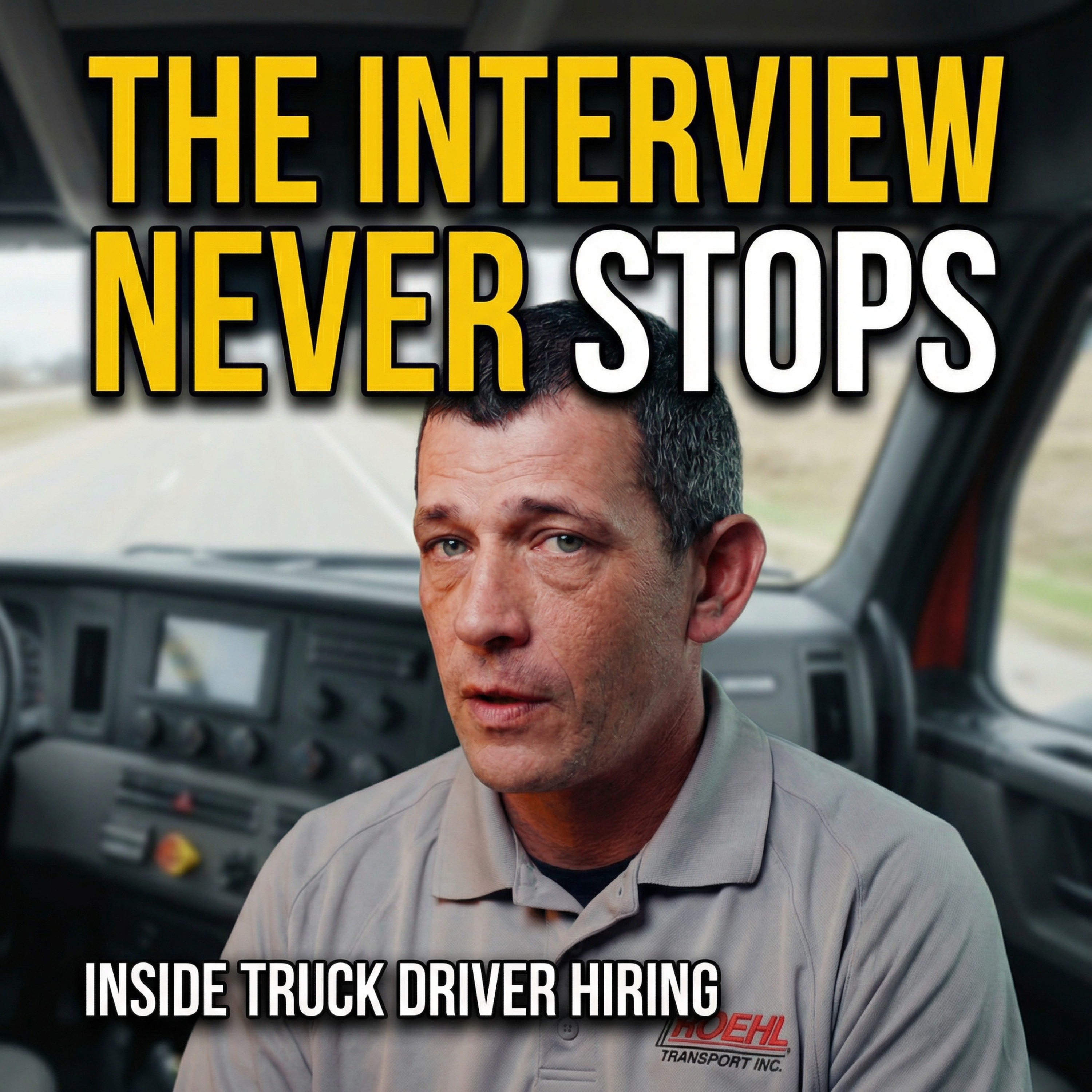
David spent ten years recruiting for the U.S. Army before he ever recruited a single truck driver. Now he travels the Midwest sitting down with CDL students and soldiers transitioning out — and he’s blunt about what most of them get wrong before they ever sign an application.
WHAT WE GET INTO
- The thing every new driver assumes about hiring that’s costing them offers
- Why Roehl swapped side mirrors for cameras on their 2026 trucks — and what it actually changes about the job
- The “reality check” that hits every new driver around day 19, and the small group who don’t make it past it
- What David tells students who’ve got a speeding ticket or a DUI in their past
- The question David says separates the drivers who succeed from the ones who wash out
- Why the worst thing a new driver can do is walk in thinking they already know
ABOUT DAVID
David spent five years with the 82nd Airborne — three deployments, two to Iraq, one to Afghanistan — before transitioning into Army recruiting for a decade. He retired from the military in 2017 and has been recruiting drivers ever since. Today he’s the military field recruiter for Roehl Transport, covering CDL schools and military bases across the Midwest. Roehl has been family-owned since 1962 and runs roughly 1,900 trucks across all 48 states.
🔗 LINKS
Listen wherever your get your podcasts: https://built-in-the-midwest.captivate.fm/listen
Midwest Truck Driving School: midwesttruckdrivingschool.com
North Country Heavy Equipment & Electrical Line School: https://ncheschool.com/
Submit your Questions: https://webforms.pipedrive.com/f/6WfGT9X1zlYC6WvssJqfWxOOkvVa1AjzqgnAIIHOq70WWiNo5czEWXpBMqxVTW7UST
💬 CONNECT
Email: marketing@midwesttruckdrivingschool.com
Facebook: https://www.facebook.com/CDLMidwest
Instagram: https://www.instagram.com/midwesttruckdrivingschool/
TikTok: https://www.tiktok.com/@midwesttruckdrivingskool
Transcript
This isn't just a 9 to 5 job.
Speaker A:This is a lifestyle.
Speaker A:It's going to be a little bit of a reality check when they get out there.
Speaker B:That's very, very serious.
Speaker B:I mean, that's a federal document.
Speaker B:Your logbook is super important.
Speaker A:That interview process never stops.
Speaker A:You're being interviewed from the time that you submit that application to the time that you get hired on.
Speaker A:If you have a good work ethic, then you're doing the right thing, being safe out there on the road.
Speaker A:You can make a very good living in this industry.
Speaker C:If you're thinking about a career in the trades and you want to know what employers actually look for, what the work is really like, and what nobody tells you before you get started, you're in the right place.
Speaker C:Built in the Midwest features conversations that'll help you figure out if this path is for you.
Speaker B:Well, hello and welcome, David, to the Built in the Midwest podcast.
Speaker B:Thanks for being on the show today.
Speaker A:Oh, you're welcome.
Speaker A:It's my honor to be here today.
Speaker A:Yeah, really, thank you for inviting me.
Speaker B:It really means a lot.
Speaker B:So let's kick right into it.
Speaker B:And I've got to know you pretty well over the last year or so.
Speaker B:Dave is with Roehl.
Speaker B:Why don't we start with rail?
Speaker B:If you want to give me a little bit of history about rail and the company and how you came into the organization.
Speaker B:Yep.
Speaker A:So rail's been around since 62.
Speaker A:arted by Everett Rail back in:Speaker A:His son Rick runs the company now.
Speaker A:So we've had two owners in the last 60 plus years, which is great.
Speaker A:Rick is hometown roots.
Speaker A:He holds a class A license.
Speaker A:He's out there picking up loads, periodically showing his drivers that, hey, I'm going to do this as well as, you know, he wants to know exactly what his drivers are doing.
Speaker D:Yeah, absolutely.
Speaker B:And you see, I see your trucks all over the place.
Speaker B:You know, I mean, I would say you're one of the biggest carriers in the upper Midwest.
Speaker A:Yeah, I mean, we're, we're, we're a large company and on average we got, like I said, we got about 19 to 2,000 drivers, trucks out there on the road at any given time.
Speaker A:And we cover entire 48 states.
Speaker B:All over the place.
Speaker A:All over the place.
Speaker A:Yes.
Speaker A:Wow.
Speaker B:No, that's, that's fantastic.
Speaker B:And, and so what is your role within the company?
Speaker A:Yep.
Speaker A:So I have been with Vail now for about 14 months and I was brought in as their military field recruiter.
Speaker A:So my job is to.
Speaker A:I come to, you know, attend.
Speaker A:Go to trucking schools and also to military bases and explain what rail has to offer for the CDL students that are currently in school.
Speaker A:And so that's.
Speaker A:So I come.
Speaker A:I cover the entire Midwest, and then I go out to military bases as well.
Speaker D:Awesome.
Speaker B:Awesome.
Speaker B:It seems like every time I'm talking to you, I'm on a.
Speaker B:On a flight going here.
Speaker B:I'm on a plane going here.
Speaker B:I mean, you're traveling all over the place.
Speaker A:I travel a lot, but in a good way, because this is something I am very passionate about and I like to do.
Speaker A:It goes back to my roots of growing, you know, a little bit about my background, so a little bit about myself, and I kind of jump into that, if that's okay.
Speaker B:Yeah, absolutely.
Speaker A:So, you know, right out of high school, joined the military.
Speaker A:I was.
Speaker A:Joined airborne infantry.
Speaker A:I was with the 82nd Airborne for five years.
Speaker C:Awesome.
Speaker A:Did three deployments overseas.
Speaker A:One in Afghanistan, two to Iraq.
Speaker B:Wow.
Speaker A:Then got detailed to become a recruiter.
Speaker A:Actually realized, you know, after about a year and a half in recruiting for the army, realized I liked it.
Speaker A:Realized it brought me more passion than being strictly infantry.
Speaker A:You know, being able to see a young man or a woman come in, be able to help them, get them, you know, onto a right path.
Speaker A:They go base training, job training.
Speaker A:They come back, hey, come in, shake their hand, saying thank you brought more satisfaction.
Speaker A:So I actually changed my job over from being infantry to a permanent recruiter.
Speaker A:Permanent recruiter for the army?
Speaker A:Yeah.
Speaker A:So I did recruiting for 10 years in the army, and so then I got out of the army.
Speaker A:I retired back in March of 17.
Speaker A:Awesome.
Speaker A:I went working for another trucking company.
Speaker A:In my previous life, I was their lead military recruiter.
Speaker A:I was with them for almost eight years.
Speaker B:So you kind of continued on in a similar role to what you're doing for.
Speaker B:And this is.
Speaker B:This is something.
Speaker B:I mean, clearly you can see your passion for what you do, so that's fantastic.
Speaker A:And then I was with them for up until November of 24.
Speaker A:And then, you know, they had some downsizing, some cuts.
Speaker A:I was part of it.
Speaker A:And that's okay.
Speaker A:I mean, it's life.
Speaker A:It happens.
Speaker B:One door closes, another one opens.
Speaker A:And be honest, I'm very glad.
Speaker A:And the opportunity that rail.
Speaker A:As you know, because they brought me in as their military field recruiter.
Speaker A:They've only had one other field recruiter for a while now.
Speaker A:So they brought me in, and now I cover the entire Midwest Area and some of the military bases.
Speaker B:Yeah.
Speaker B:Fantastic.
Speaker B:And who's, I mean, who's better to talk to other veterans than a veteran?
Speaker B:I mean, in all honesty.
Speaker B:And it's one thing, there's several veterans that are instructors at the school and they love being placed with other veterans because they can talk the lingo and they know each other.
Speaker B:They've been through similar experiences, so that's huge.
Speaker B:And it's one thing, it's probably a really good fit for you because there is a ton of veterans that are in this career as well.
Speaker A:Correct.
Speaker B:Could you talk about that on maybe why this is a good fit for a lot of veterans.
Speaker A:So truck driving as a whole, I would say is a good fit.
Speaker A:You know, veterans fit into it because you set yourself up with a rhythm on every day.
Speaker A:You know exactly what you're doing, where you're going, you know, all of that.
Speaker A:You set your own schedule.
Speaker A:A lot of companies, you know, if they're solo, company like rail is, you know, you're by yourself, you're not having to worry about team driving or another person in the truck.
Speaker A:And a lot of your veterans, they do kind of want to be.
Speaker A:They're a solo creature.
Speaker B:Yeah, they're a solo creature.
Speaker B:They don't want Big Brother putting their finger on them all the time.
Speaker B:And with trucking, would you say trucking gives you a lot of autonomy where you're able to kind of make your own schedule.
Speaker B:You're out there by yourself, you have the support, but at the end of the day, you're the one that's responsible.
Speaker A:Yes.
Speaker A:I would say you do have some autonomy to a point because you are going to get your load.
Speaker A:You are going to get your trip, you know, your trip planning in.
Speaker A:You are going to know, hey, okay, well, I have five days to make it from point A to point B, you know, and in what happened, you know, as long as you follow your trip planning and you're safe, you know, you're going to, you're going to, you're going to get there on time and what happens kind of in between there, that's kind of.
Speaker B:It's kind of up to you.
Speaker A:As long as you're following the rules and doing exactly what whichever company you're with, you know, puts out there.
Speaker A:Because every company is a little bit different.
Speaker D:Yeah, absolutely.
Speaker D:Absolutely.
Speaker B:Now you go to.
Speaker B:Okay, so military basis CDL schools.
Speaker B:What, if you don't mind me asking, what do you have better luck with as far as getting people to, you know, be a.
Speaker B:Be.
Speaker B:Be a part of Your organization.
Speaker A:So I would not say one's better than the other.
Speaker A:Okay.
Speaker A:Because honestly, they're not.
Speaker A:I mean, it's two completely different.
Speaker A:You're talking apples and oranges almost.
Speaker A:Because you have.
Speaker A:When I go to say, like, you know, when I go out to Fort Benning, for example, I was just out there last week.
Speaker A:Everyone out there, you know, they.
Speaker A:They get pulled into from different locations all across the United States.
Speaker A:And rail is very unique on, you know, we have rail jobs where they're able to go in, see, plug in their zip codes, see what jobs they have available.
Speaker B:Yep.
Speaker A:And so depending on where they live, there might be some things that are.
Speaker A:What's available, not what's not available.
Speaker D:That's awesome.
Speaker A:And so.
Speaker A:But then coming to trucking schools, it's a targeted area.
Speaker A:So when I pull up, when I'm talking to the students, it's.
Speaker A:This is what we have in your area, not what we have.
Speaker A:General area.
Speaker B:Yep, absolutely.
Speaker B:So I'm sure you.
Speaker B:You guys have customer freight all over the country.
Speaker B:Everything else.
Speaker B:But of course, you have different areas that are gonna be.
Speaker B:There's more opportunities in those areas.
Speaker A:Correct?
Speaker A:Per se, yes.
Speaker B:So when you go to these schools, on more of a general kind of standpoint, are you seeing more people getting into trucking, less people getting to trucking, and are you seeing more energy from students?
Speaker B:What are you seeing at these schools?
Speaker A:That's a good.
Speaker A:That's a very good question.
Speaker A:Because my experience is depending on where you live.
Speaker B:Yep.
Speaker A:You know, so if it's a bigger city.
Speaker A:So a lot.
Speaker A:I mean, I. I turned the.
Speaker A:Turn down.
Speaker A:The.
Speaker A:The enrollment is a lot of times down.
Speaker A:What I've.
Speaker A:What I've noticed personally is some.
Speaker A:If I'm in the big city, like, if I'm in, you know, if I'm in, you know, by Chicago area, if I'm.
Speaker A:Or if I'm in, like, Phoenix area for Pittsburgh, like a big city.
Speaker B:Yep.
Speaker A:They have more employment opportunities.
Speaker B:Sure.
Speaker A:But then you start coming out into the Midwest until this.
Speaker A:To some of the smaller towns are, like, up here, where there's employment opportunities, but there's not a ton.
Speaker B:Yep.
Speaker A:Do you start seeing enrollment up in CDL schools because people are wanting to get out there and, you know, find a job.
Speaker B:Yeah.
Speaker B:Interesting, Interesting.
Speaker B:So you're seeing.
Speaker B:So some of these schools in the bigger cities have lower enrollment, correct?
Speaker B:Yes, I'll be.
Speaker B:Darn.
Speaker B:And then more rural schools have higher.
Speaker A:Correct.
Speaker B:Have a little bit higher enrollment.
Speaker B:Now, as a whole, over the last maybe year or two, have you seen lesser Enrollment than normal or more enrollment than normal.
Speaker A:It comes in waves.
Speaker A:It comes.
Speaker A:It's kind of, you know, so when I first started last year, in the beginning it was.
Speaker A:There was, you know, almost every school had good enrollments.
Speaker A:And then it come a holiday season, it kind of dips down a little bit.
Speaker A:And then now we're starting to see more enrollments.
Speaker B:So things start to pick back up again.
Speaker B:Back up.
Speaker B:And there is something about the winter time.
Speaker B:Nobody wants to do anything in the winter time.
Speaker B:And.
Speaker B:And now that we have some sunshine again and some springs in the air and the snow's starting to melt, there is something about that.
Speaker B:I agree.
Speaker B:I've noticed that too.
Speaker B:Where all of a sudden I'm like, okay, well, maybe I can go outside and start picking up the sticks out of my lawn.
Speaker A:Until you get four feet of snow, right?
Speaker B:Yeah, exactly.
Speaker B:Oh, my God.
Speaker B:That storm a few weeks ago was the worst I've ever seen.
Speaker B:That's for sure.
Speaker B:They're still cleaning it up in some places.
Speaker B:You drive through town, there's still a lot of driveways that have not been cleaned up yet.
Speaker A:So.
Speaker A:Yeah, this really just depends on kind of the areas.
Speaker B:Yeah, no, absolutely.
Speaker B:So right now, looking at rail and say I'm talking to someone in their 20s or someone in their 30s that's thinking about trucking, what advice would you give to them on maybe an opportunity with you or just opportunity in trucking in general.
Speaker B:So.
Speaker A:So I will start that with any new person if they're just.
Speaker A:If they're thinking about this organization, number one, or thinking about getting into this industry, I should say is do their research.
Speaker A:Do your research.
Speaker A:Because this isn't just a 9 to 5 job.
Speaker A:This is a lifestyle.
Speaker A:You need to talk things over with family, spouses.
Speaker A:You, you know, expect to be out over the road for, you know, 11 to 14.
Speaker A:Like what kind of.
Speaker A:What we offer.
Speaker A:And, you know, we even offer some weekly home time for recent graduates, but have that expectation of being out over the road.
Speaker A:Also, don't expect to make, you know, being top pay your first year.
Speaker B:Yeah, absolutely.
Speaker B:You need that experience under your belt.
Speaker B:And, you know, and I appreciate you kind of, kind of saying that.
Speaker B:It's like, you know what, we're not going to paint this.
Speaker B:It's all roses and rainbows picture, because it's not.
Speaker B:And the fact of the matter is that trucking is hard work.
Speaker A:It is.
Speaker B:And like you said, you're out on the road 11 to 14 days.
Speaker B:That's trucking.
Speaker B:Right.
Speaker B:And when you have loads around the country, well, guess what?
Speaker B:It takes three days to get out to the west coast.
Speaker B:It's going to take time back and it's not like you're going to get a load right back home a lot of times.
Speaker A:Correct.
Speaker B:So.
Speaker B:So those things happen.
Speaker B:You know, what other.
Speaker B:Yeah.
Speaker B:What other expectations would you, you know, tell someone that's interested in it but say, you know what, maybe if you have this, this or this, this might not be a good fit for you.
Speaker A:So a good, I mean, I would say with, with that question is we send all our recent graduates and the GYCDL students, we put them out with a trainer, you know, for 19 to 26 days.
Speaker A:And regardless of where that person is going, if whatever company that they go to.
Speaker A:Yeah, it's going to be a little bit of a reality check when they get out there.
Speaker D:Yep, absolutely.
Speaker A:It's going to kind of hit them in the face.
Speaker A:They're going to say like, oh, wait a minute, is this actually for me or not?
Speaker A:If they can buy, if they can get over that hump, they're going to be successful.
Speaker B:But it's that initial hurdle, it's initial.
Speaker A:Hurdle of, hey, is this actually, for once they actually get out there and they actually see that, okay, hey, I'm a week in.
Speaker A:I don't know if I can keep going.
Speaker A:I don't know if this lifestyle is for me.
Speaker A:But if they could push through that hurdle, they're going to be very successful.
Speaker B:I'll be darn.
Speaker A:I'll be darn.
Speaker A:There's always a little bit of a hurdle.
Speaker B:It's a learning curve and it's not easy.
Speaker B:And there's a sacrifice there to be able to do this.
Speaker B:So.
Speaker B:And you brought up something there that I liked, is that 19 to 35 days, whatever it was, for the, for the, say the finishing program where people go through a truck driving school, get their class a cdl, they have the endorsements and they have as much training as they can, but you can only get through so much in a month.
Speaker B:So what does that next month look like at a company like yours?
Speaker A:So when we bring an individual on with rail, we will send them out with a trainer for 19 to 26 days.
Speaker A:It is our safety and job skills training program.
Speaker A:And this is where we, we are going to take their skills that they've learned in school, we're going to refine them, add to them and then we want them, we want to expose them to as many things as possible during this time because we are a solo company.
Speaker D:Yeah, absolutely.
Speaker A:And so, yeah, they're going to, you know, you train, they're going to be sitting in the, they're going to drive.
Speaker A:Trainer's going to be in the passenger seat and then that'll be.
Speaker A:The trainer might drive a little bit, but it's primarily going to be the student, the recent graduate driving the entire time.
Speaker A:But then at the end we do want that driver to do five loads for us.
Speaker D:Yeah, absolutely.
Speaker A:Trainer's sitting.
Speaker A:No, the trainer's sitting in the passenger seat the entire time and the student is doing everything.
Speaker A:And that's kind of the culmination of almost graduation from our safety job skills training program of them being able to, okay, do all your paperwork, do all your trip planning, do all your pre trips, you know, customers.
Speaker A:That's all on the student.
Speaker A:And maybe it takes more than five, but that's, but because we are a solo company, we want to make sure that they are proficient.
Speaker B:It's almost like your final exam.
Speaker B:Like, you know what, hey, yes, you went through truck drivers, got your cdl, you went through rails finishing program, but now there's a final exam.
Speaker B:You got.
Speaker B:The proof is in the pudding.
Speaker B:I want to see you deliver those loads.
Speaker B:I want to see you be on time.
Speaker B:Can you, can you trip plan?
Speaker B:Can you map read?
Speaker B:Can you navigate safely?
Speaker B:Can you work your eld?
Speaker B:What ELD are you guys on?
Speaker B:What are you on?
Speaker B:Sam, Sarah or motive or peoplenet or.
Speaker B:Yeah, no, no big deal.
Speaker B:There's.
Speaker A:I don't know.
Speaker B:There's so many of them and I see, I see companies change them daily sometimes.
Speaker B:There's, there's there's like hundreds of them out there.
Speaker B:But.
Speaker B:But that's possibly.
Speaker A:Okay, that's another one that's out there.
Speaker A:Yeah, I just, I, I just don't know personally which one that.
Speaker B:No, it is.
Speaker B:And the thing is so at the school there's a couple of them school uses to train drivers on because essentially they're all the same.
Speaker B:They all say that.
Speaker B:I mean they're all electronic logging device and they say the same information.
Speaker B:But I imagine that's part of that program too is learning that ELD to make sure.
Speaker B:Because especially with violations on your CSA score.
Speaker B:That's a big deal.
Speaker A:That's a big deal.
Speaker A:And any school, not just you guys, but any school across the country, they can't necessarily teach.
Speaker A:No, no eld.
Speaker B:It's hard because we're not driving six hours away where we can, you know, put them on the logbook and all right, now we're going off duty or now we're Doing our pre trip.
Speaker B:So now we're going on duty and, and then we're switching drivers all the time.
Speaker B:So it would be hard.
Speaker B:And so that, that is something that's just.
Speaker B:We cover it in a very kind of general, brief way, but not into the detail, you guys.
Speaker B:Yeah, but, but that's very, very serious.
Speaker B:I mean, that's a federal document.
Speaker B:Your logbook is super important.
Speaker B:So.
Speaker A:And we know, I mean, regardless of where somebody lands after they graduate, it's only a matter of time before they are stopped for an inspection.
Speaker B:Absolutely, absolutely.
Speaker A:And when you're in that, when they're stopped, they're going to ask for three things.
Speaker B:Yeah, let me see.
Speaker A:A license, your med card and your E logs.
Speaker B:And.
Speaker B:Exactly.
Speaker B:And they, and you better have them on you, you know, so that's, that's, that's important.
Speaker A:So be able to train that student, you know, recent graduate, you know, the proper way from day one.
Speaker B:Yep.
Speaker D:Is absolutely.
Speaker A:Sets them up for success for their entire career.
Speaker D:Absolutely, absolutely.
Speaker A:And that's what we here at Rail, that's what we pride ourselves on, is being able to teach them from day one the proper way of doing everything from trip planning to load planning to E logs to, you know, driving safe, you know, because we have something called the safe seven.
Speaker B:Yep.
Speaker A:We have the railway.
Speaker A:And within the railway, that's our, it's our safe seven.
Speaker B:Okay.
Speaker A:You know, that's, you know, slow down, stay back, you know, know what's happening, yield to others, expect the unexpected, prepare to drive, reduce the risk.
Speaker A:You know that stuff that we teach our students, you know, in orientation.
Speaker D:Yeah, absolutely.
Speaker A:You know, and that, that's a mindset that we instill into our drivers.
Speaker B:Yeah.
Speaker A:And they could take that with them wherever they know.
Speaker B:The safe seven.
Speaker B:I like it.
Speaker B:It's like, you know, see the different, different safety programs, but having that heuristic in the back of your mind and it's like, all right.
Speaker B:And it just reminds you to do those things.
Speaker B:It reminds me of like a lot of trucks will have the goal sticker.
Speaker B:Yeah.
Speaker B:Because it's one of those things.
Speaker B:Yeah.
Speaker B:You get into a place like, ah, this seems a little tight, but we're going to try it.
Speaker B:And it's like, no, take a second, put on your flashers, pop your brakes and take a walk around that truck and trailer to make sure there's no little mailboxes or those little concrete poles.
Speaker B:That'll be a really bad day trying to get around.
Speaker B:Right.
Speaker B:And especially now, it seems like they're not making docks bigger.
Speaker B:They're making them smaller.
Speaker B:It's like in tighter areas, I would.
Speaker A:Say they're making docks, they're making things smaller.
Speaker A:But the technology now that's inside, that's in the new trucks is, is better.
Speaker A:I mean, think about the technology, you know, with lane deviation automatic headlights sensor, rain sensor wipers that we have in, in, in the, in our personal vehicles.
Speaker A:Nowadays, if you go to a dealership, sit in a car, I mean, everything.
Speaker B:Is totally different than 10, even 10 years ago or 20 years ago.
Speaker B:Yeah, it's, it's crazy.
Speaker A:But they're taking all that and they're putting in those in the semis now, as they should.
Speaker B:And it makes things safer, right?
Speaker B:Yes.
Speaker B:So a lot of your trucks talk about that.
Speaker B:What safety systems do you have in your trucks?
Speaker B:Or like cameras or anything like that?
Speaker A:So we have a couple different things.
Speaker A:So one I would say is that we switch out our trucks about every three years.
Speaker A:Okay.
Speaker A:We switch them out for a brand new truck.
Speaker B:So you have a very new fleet that way.
Speaker A:And that's for a couple of reasons.
Speaker A:One, maintenance to, you know, everything stays up to date on, on the truck warranty is, you know, all of that, all that stuff.
Speaker A:Trailers are four years.
Speaker A:And so our trucks have, you know, lane deviation, automatic headlights, rain sensor wipers, passenger side sensors.
Speaker A:You know, we have 20, 26 Freightliners because all of our trucks, either Freightliners or internationals, we do run a automatic fleet.
Speaker B:Okay.
Speaker A:Yep.
Speaker A:And so like our:Speaker A:They have cameras.
Speaker A:They have cameras where the side mirrors.
Speaker B:Are and then there's screens.
Speaker A:So inside, when you're sitting, when you sit in the driver's seat over on the A pillar, they have two screens.
Speaker B:Really.
Speaker A:Yep.
Speaker B:A screen.
Speaker B:And, and that's, and that's your mirror.
Speaker B:But imagine that camera.
Speaker A:So the camera shoots down the tire side of the tractor and then at the tire, down the tire side of the trailer as well.
Speaker A:And even compasses, a little bit of the back of the trailer.
Speaker A:And when you're backing up, you have lines just like if you have in your car when you're backing up.
Speaker A:And it also has infrared at night to help you see when you're backing up at night as well.
Speaker B:No way.
Speaker B:So that visibility, you have so much better visibility.
Speaker A:Like, so you can see the corners now of the back of your trailer, behind the back of your trailer.
Speaker A:So the only, the only spot that really is a blind spot is directly right where the doors are right behind the trailer.
Speaker A:That's the only blind spot anymore.
Speaker B:Wow.
Speaker B:Wow.
Speaker B:So it literally takes those blind spots right out of the equation.
Speaker B:I. I remember a lot of times where there could be a car right next to you, and your regular west coast mirror, you couldn't see it, and you could kind of see it in your blind spot.
Speaker B:Fisheye mirror on your hood.
Speaker B:Right.
Speaker B:But a camera like that also, you got a wide angle lens.
Speaker B:You can see everything.
Speaker A:So it covers your lane.
Speaker A:The lane next to you has wide, like you said, wide camera.
Speaker A:And you're able to see more.
Speaker D:Absolutely.
Speaker B:But from a safety perspective, I mean, that's huge.
Speaker A:It's huge.
Speaker B:That's huge.
Speaker B:Absolutely.
Speaker A:Exactly.
Speaker A:And that's why safety is our cornerstone value here at Roehl.
Speaker A:And everything we do evolves around safety.
Speaker A:So we will never put one of our drivers in an unsafe situation.
Speaker D:That's awesome.
Speaker A:So if they're tired, they're fatigued, pull over, stop.
Speaker A:We want you to be safe.
Speaker B:But also giving them the tools that they need to be extremely safe.
Speaker A:I mean, you, you, you know, we all been there.
Speaker B:Oh, yeah.
Speaker A:Stuck in traffic.
Speaker A:It starts raining or it's snowing, it.
Speaker A:You're trying to figure out, okay, do I turn this to turn this on?
Speaker A:Do I turn this on?
Speaker A:You know, you're not paying attention to the road.
Speaker D:Yeah, absolutely.
Speaker A:And that's part of the Safe seven is, you know, is knowing what's happening and, you know, you want to stay aware.
Speaker D:Absolutely.
Speaker B:Because if you're distracted here or there, that's when something's going to happen.
Speaker B:Right.
Speaker B:And, you know, and I found that as well, if I'm talking on the phone, even via headset, and I'm in a lot of traffic, I'm like, okay, I got to call you back, because I just, I can't focus.
Speaker B:Right.
Speaker B:You know, on the highway is one thing, but, you know, you get into a busy city or something.
Speaker B:No, I got to be able to focus here.
Speaker B:I can't talk and drive and everything else, you know, and in those distractions, they're just.
Speaker B:They seem to be getting just worse and worse out on.
Speaker B:Out on the road, that's for sure.
Speaker B:So something I'm interested in is looking at.
Speaker B:So the truck industry, we get calls once in a while, and the students say, well, I have couple speeding tickets in my past, or I got a DUI from six years ago.
Speaker B:What kind of standards do you guys have as far as somebody that has maybe not the cleanest driving record in the world?
Speaker A:So I'll say This, and I don't want to.
Speaker A:I'll say we look at everyone on a case by case.
Speaker B:Sure, sure, absolutely.
Speaker A:And we look at the total person concept.
Speaker B:Okay.
Speaker A:So just because they had it and something in their past, that does not defy who they are.
Speaker D:Okay, excellent.
Speaker A:You know, could we, you know.
Speaker A:Yeah.
Speaker A:Motor vehicle reports are different than backgrounds and so on and so forth and.
Speaker A:Yeah.
Speaker A:Do we have some standards?
Speaker A:Yes.
Speaker A:And that's where our recruiters in Marshfield and across the country, that's where they step in and they're able to have that conversation.
Speaker A:But if I was to say anything to some of this, you know, anyone who's applying, I would say that when you're filling out an application, be honest.
Speaker B:Yeah.
Speaker A:Be upfront about everything.
Speaker A:Anything.
Speaker A:Even if you had a speed and ticket 20 years ago, do your best to put it on there because you.
Speaker B:Guys will find it.
Speaker A:Well, I mean, and it will be found eventually.
Speaker B:And so if you lie, it's like, okay, that's.
Speaker B:That's not a good look.
Speaker B:Nobody likes that.
Speaker B:Nobody.
Speaker A:So people don't realize is that in this industry is that it's not your normal.
Speaker A:All right, I'm going to, I, you know, I submitted for a job, I have an interview, and we bring my resume in.
Speaker A:I'm going to have a shirt and tie and all that.
Speaker A:Most of the time, you're interacting with your recruiters through phone, email, you know, text messages.
Speaker A:Very rarely will you, I mean, not very often will you actually meet the recruiter.
Speaker B:Yeah.
Speaker B:Talking to them on the, on the phone.
Speaker A:And so that interview process never stops.
Speaker A:Yeah.
Speaker A:You know, you're, you're being interviewed from the time that you submit that application to the time that you get hired.
Speaker A:On every.
Speaker A:Everything in between.
Speaker A:There is an interview process.
Speaker D:Yeah, absolutely.
Speaker A:You know, when they bring you in for orientation, that's still an interview process.
Speaker A:Because if you're doing something that's against rules, you could be dismissed.
Speaker D:Absolutely.
Speaker B:So they're going to be looking at all that from start.
Speaker B:From start to finish.
Speaker A:Yep.
Speaker B:So what are some attributes that would make a new student or a person more hireable?
Speaker A:So I would say with that is being a sponge, being open to learn, because.
Speaker A:Yes.
Speaker A:You know, they're going to have knowledge from their previous experiences and their life experiences.
Speaker A:Then they're going to, you know, they're going to have what the school taught them, but then we're going to teach them.
Speaker A:Every company is going to teach them a different way.
Speaker B:Absolutely.
Speaker B:Every company's a little bit different.
Speaker B:And you almost want someone that's able to be molded to your company because it's like, you know, everybody's got different sops and, and how they do things.
Speaker B:And I mean, I've even seen differences with how different companies drop trailers.
Speaker B:Some want you to leave it a half inch above the ground and then drop your airbags.
Speaker B:Some, some don't.
Speaker B:Some want make firm contact with the ground.
Speaker B:It just, every company's a little bit different.
Speaker B:So I, I love that advice to new students, like be a sponge and that there's more than, maybe there's more than one way to do something successfully.
Speaker A:And don't, don't think you are right because, you know, especially as a new student, you know, you're learning.
Speaker A:Yeah.
Speaker A:You're still new to the industry.
Speaker A:I mean, talk to people, ask questions.
Speaker A:You know what they say that the, the worst question is the question you never ask.
Speaker D:Yeah, absolutely.
Speaker A:You don't understand.
Speaker A:Ask the questions.
Speaker A:You know, I don't know a single company that's going to set a driver up to fail, especially in the beginning or period.
Speaker A:Set them up for failure, period.
Speaker A:But, you know, it's the ones, what I see is where in my experience has been the ones that don't necessarily ask the questions or they think that they know everything, then they get out there and like, I don't know it, those are the ones that kind of struggle or fail.
Speaker D:Sure.
Speaker B:So being willing to ask questions and just from my own experience, some of my, my biggest insights were from talking to some of the older guys that have been there, done that.
Speaker B:And I remember trying to get into places in Milwaukee or Chicago and you know, I call a guy that lived down there and trucked down there for a long time.
Speaker B:Oh, yeah, that's, that's easy.
Speaker B:Just do this, do that.
Speaker B:I'm like, easy for you, you know.
Speaker B:But yeah, talk to someone that's done it before.
Speaker B:Yeah, talk to someone that's done it before.
Speaker B:And you don't need to, it's still not going to be easy for you, but it's going to make it a lot easier.
Speaker A:And that's where, you know, we take, you know, with that safety and job skills training program with, where we have that trainer with, with our student.
Speaker A:It's, that's why we want to expose them to as many things so that way they can kind of get some of that knowledge.
Speaker D:Yeah, absolutely.
Speaker D:Absolutely.
Speaker B:No, I, I, I love that.
Speaker B:You know, you know, something I'm thinking about is, you know, we talk to a lot of people that are on the fence about getting a cdl yeah.
Speaker B:Where they're like, I don't know and I don't know what I want to do and they're just kind of going back and forth.
Speaker B:But I'm stuck in this de job and I'm working at, you know, not to make fun of McDonald's or Walmart, you know what I mean?
Speaker B:But I'm stuck making minimum wage over here and I'm working weekends and, and in the middle of the night and blah, blah, blah.
Speaker B:What would be your advice to that, that person?
Speaker A:So now.
Speaker A:And I would go back, I would go back to kind of what we were talking about earlier is do your research because this is a lifestyle, okay.
Speaker A:It's not, it's not the nine to five.
Speaker A:It's not, it's not the, you know, hey, I'm home every weekend or I sleep in my own bed every night.
Speaker A:It's not.
Speaker A:No.
Speaker A:But if you're, if they have the work ethic and they're willing to put in the work in the beginning, it will pay off for them in the future.
Speaker A:Because, you know, truck driver, I mean, if you're, if you have a good work ethic and you do that and you're doing the right thing being safe out there on the road, you can make a very good living in this industry.
Speaker D:Absolutely, absolutely.
Speaker B:So I think that's important for them to realize is like, yeah, I mean you can make a great living and great benefits and everything else, but it's.
Speaker A:Not going to be handed to you.
Speaker B:No.
Speaker A:And it's not going to, it's.
Speaker A:You're not, it's not going to come immediately.
Speaker A:No, it's it.
Speaker A:And if you look at any other type of apprentice or any other, some of the other jobs, hey, you got to, you know, you, you gotta work up to certain pay, you gotta work up to certain things.
Speaker B:Absolutely.
Speaker B:What job don't you.
Speaker B:Right.
Speaker B:I mean, I think that's a part of it and kind of those realistic expectations that you're gonna have to sacrifice a little bit.
Speaker B:This isn't easy, but the reward is there.
Speaker B:And so you know what, the more effort you put in, the chances are the more money you're end up making because of it.
Speaker A:I mean, it's after six months, a year in, you know, if you're, if you've been following everything that, that your company or rail, you know, has put out there and you're driving safe and you're going to make and you're pick up and delivering on time because that's, you know, a lot of people don't realize that that's kind of a key indicator for, you know, a lot of companies.
Speaker B:Super important.
Speaker D:Absolutely.
Speaker A:And I mean, unfortunately, I mean, if you keep delivering loads late or picking up loads late, is that necessarily is your fleet manager going to keep giving you loads if they know that, or if they're going to keep giving you loads that have lots of miles or things like that?
Speaker B:Absolutely.
Speaker B:Because wouldn't that be the same as showing up to work late or sleeping in a couple hours?
Speaker B:Right.
Speaker B:Let's be honest.
Speaker B:It's like we all have a time we got to come to work and be to work.
Speaker B:And when it comes to those deliveries, if that Delivery appointment is 9am on Friday, well, guess what time we got to be there?
Speaker B:8:15, 8:30 Exactly on Friday.
Speaker B:Right.
Speaker B:If we show up at 11, 11am and some of those appointments, some of them can be flexible, but some of them are extremely strict.
Speaker A:And that's one thing we want our drivers is constant communication.
Speaker A:Constant communication with your fleet manager or your fleet training manager of okay, if you are going to be late, we understand life.
Speaker B:Sure.
Speaker A:Things happen.
Speaker A:Because, I mean, let's be honest, you know, in this industry there are really three things that you can't control.
Speaker A:Weather, people and maintenance.
Speaker B:Yep.
Speaker A:But anything else is those other things are in your control.
Speaker A:So if you're going to be late for something, you know, if you go to late period communication, let your fleet manager know as soon as possible.
Speaker A:That way they could coordinate with the customer and maybe move that appointment time or things like that.
Speaker A:You know, depending on the customer, maybe we get docked for being late, you know, things like that.
Speaker B:Yeah, but if that communication is there beforehand, it goes such a long way.
Speaker B:You can't just say at your appointment time, oh, I'm going to be two hours late because I got stuck in traffic.
Speaker B:Well, no, we should have known that an hour ago or days ago or whatever.
Speaker A:How long have you been stuck in traffic for exactly?
Speaker A:Oh, you've been for three hours.
Speaker A:Why didn't you call me three hours ago?
Speaker B:Exactly.
Speaker B:It's no different than detention.
Speaker B:I've heard guys getting mad before different companies.
Speaker B:Well, I didn't get paid detention for that.
Speaker B:Well, did you let your company know after the.
Speaker B:Typically, it's the first hour that, hey, I'm sitting at the dock, it's been an hour, just so you know.
Speaker B:And then three hours later you got to let your company know because they got to bill for that too.
Speaker B:And you know, but that communication across the board has to be there.
Speaker A:And that's something I think that a lot of people take for granted is they think that it's all rainbows and unicorns.
Speaker A:I mean they don't think that, hey, I need to communicate.
Speaker A:Okay.
Speaker A:You know, it'll get there when I, when it gets there type thing.
Speaker A:And it's, we want you to be safe while communicating.
Speaker A:We don't want you to use hand.
Speaker A:Everything has to be hands free devices while you're driving.
Speaker A:Can't pick up your cell phone, you know, things of that nature.
Speaker D:Absolutely.
Speaker A:You know, but constant communication.
Speaker D:Yeah, absolutely.
Speaker B:No, super, super important, you know, something back on the kind of the school side of things.
Speaker A:Yeah.
Speaker B:And maybe that's a, that's a, that's a good part of, is that communication.
Speaker B:But what is something that you would like to see schools do more of to set these guys and gals up for success into the workforce?
Speaker A:Realistic expectations.
Speaker A:Oh yeah, you know, this just having that conversation with them of saying, okay, you're not going to come out and be in a millionaire after your first year.
Speaker A:You're not going to, you know, it's going to be tough.
Speaker A:It's going to be hard.
Speaker A:You know, you're going to, there's going to be some sacrifices that you're going to make.
Speaker A:You know, it's, you're not going to make nearly as much money.
Speaker B:Yeah.
Speaker A:You know, but I've, I've come into schools where they think they're gonna, you know, get everything handed to them on.
Speaker B:A silver plate and, and they're gonna be, it ain't gonna work.
Speaker B:You know, they're gonna be very disappointed.
Speaker A:They're gonna get a reality.
Speaker B:Yeah, exactly.
Speaker A:So that I think that would be the biggest thing is just is setting them up or at least having that initial conversation.
Speaker A:Maybe it takes a couple conversations.
Speaker B:Yeah.
Speaker A:Maybe one in the beginning, maybe one at the end, you know, of just, hey, this is.
Speaker D:Yeah, absolutely.
Speaker B:You know, and that's where, you know, the people listening here is.
Speaker B:I think that's great advice for them as well.
Speaker B:If they're thinking about it, where, if they have somebody's expectations, well, I want to make up 150 grand a year and be home every night and do all this.
Speaker B:And it's like, I'm sorry that, you know, that's roses and rainbows and that ain't this industry, plain and simple.
Speaker B:And so I just think it's important to understand that, that.
Speaker B:Well, and the other thing, especially right out of school, I always tell all the students, sometimes you got to take what you can get because you don't have any experience.
Speaker B:Correct.
Speaker A:And what I like to do when I'm talking in my class, when I, when I'm doing my class presentations is I mentioned long term goals.
Speaker A:Yep.
Speaker A:Because everyone has short term goals and long term goals of what they want to do.
Speaker A:And I, it's like I mentioned to them, like, regardless of what your plans are with, get with your cdl, what your long term goals are with this, you have to get experience.
Speaker D:Absolutely.
Speaker A:Experience is key in this industry.
Speaker A:And also when it comes to.
Speaker A:Is doing your research of, okay, if this is what my long, long term goal is, how can I get there?
Speaker A:What, what steps do I need to do if, if I want to become a heavy haul, you know, flatbed driver?
Speaker A:Because that's what my uncle did many years ago.
Speaker A:He's making lots of money, whatever the case may be.
Speaker A:What do I need to do to get there, to get to that point?
Speaker A:To get to that point.
Speaker A:Okay.
Speaker A:You know, is it smart, hey.
Speaker A:To go in the van?
Speaker A:Probably not.
Speaker A:You know, flatbed will be, you know, get experience in flatbed and things like that.
Speaker A:You know, career progression, career growth.
Speaker A:And that's where it goes back to looking at, when a student's looking at companies is what can I do to get to where I want to go?
Speaker D:Yeah, absolutely.
Speaker B:You know, and it's interesting because you talked about kind of some of those different divisions of trucking.
Speaker B:And it is funny how some students, they have, they kind of jive or connect more with one division or the other.
Speaker B:Where some guys I know, they love the flatbed, they love tarpon and getting up there and, and they don't need to worry about backing up into docks with flatbed.
Speaker B:They just pull in and off road forklifts come on out.
Speaker B:And other guys are like, no, I ain't throwing straps and tarps and everything else.
Speaker B:I just want to back up into a dock and no touch freight and other guys.
Speaker B:One guy know, he loves to haul heavy equipment and he said he Rarely goes above 55 miles an hour because he's hauling oversized loads, he's slow and he's got the placards on the front, oversized flags and everything else.
Speaker B:And so, you know, and that's something that's cool that, you know people out there that are interested in this industry that you know what this division might not be for you, but maybe a different division is.
Speaker B:And getting that experience kind of shows you maybe what you like, what you don't like.
Speaker B:And the other thing, and I'm curious if you've seen this at rail a little bit as well.
Speaker B:But you were talking about kind of the owner having a CDL as well.
Speaker B:And you know, I've seen a handful of students go from drivers into to say dispatcher roles or safety roles or.
Speaker B:Have you seen that a little bit as well?
Speaker A:Yes.
Speaker A:And that's one thing that we do have those opportunities.
Speaker A:So we have rail odd jobs on there they can plug in not only for driving jobs, but it's for non driving jobs as well.
Speaker A:So if you have maybe somebody who they went through school, got their license.
Speaker A:But you know what?
Speaker A:Maybe life happens.
Speaker A:Yeah, absolutely, life happens, you know, and maybe they, but they like the company, they can always go in and look and see if there's other different types of positions within that company.
Speaker A:That way they could still be part of the industry.
Speaker D:Yeah, absolutely.
Speaker D:Absolutely.
Speaker B:No, I, I absolutely love that.
Speaker B:And I want to be respectful of your time to.
Speaker B:David.
Speaker B:Oh, yeah.
Speaker B:So I'll give you the last word, my friend.
Speaker A:I would, I would just say this.
Speaker A:I appreciate you guys, you know, having me come in and kind of give my little bit of insight and for all, for all the new students and new drivers out there is do your research and just take it one day at a time.
Speaker A:Don't, you know, even though you maybe you didn't, you know, get it the backing on today, but tomorrow's a new day.
Speaker D:Yeah.
Speaker A:You know, just listen to your instructors and go from there.
Speaker B:I love that.
Speaker B:I love that.
Speaker B:Well, well, it just means a lot that you're here and I want to thank you for everything that you continue to do for the industry and just being an advocate for, for the industry, but also for veterans and for people wanting to change their lives in this great career path.
Speaker B:So once again, David, with Rail Transport.
Speaker B:Thanks for being on the show today.