


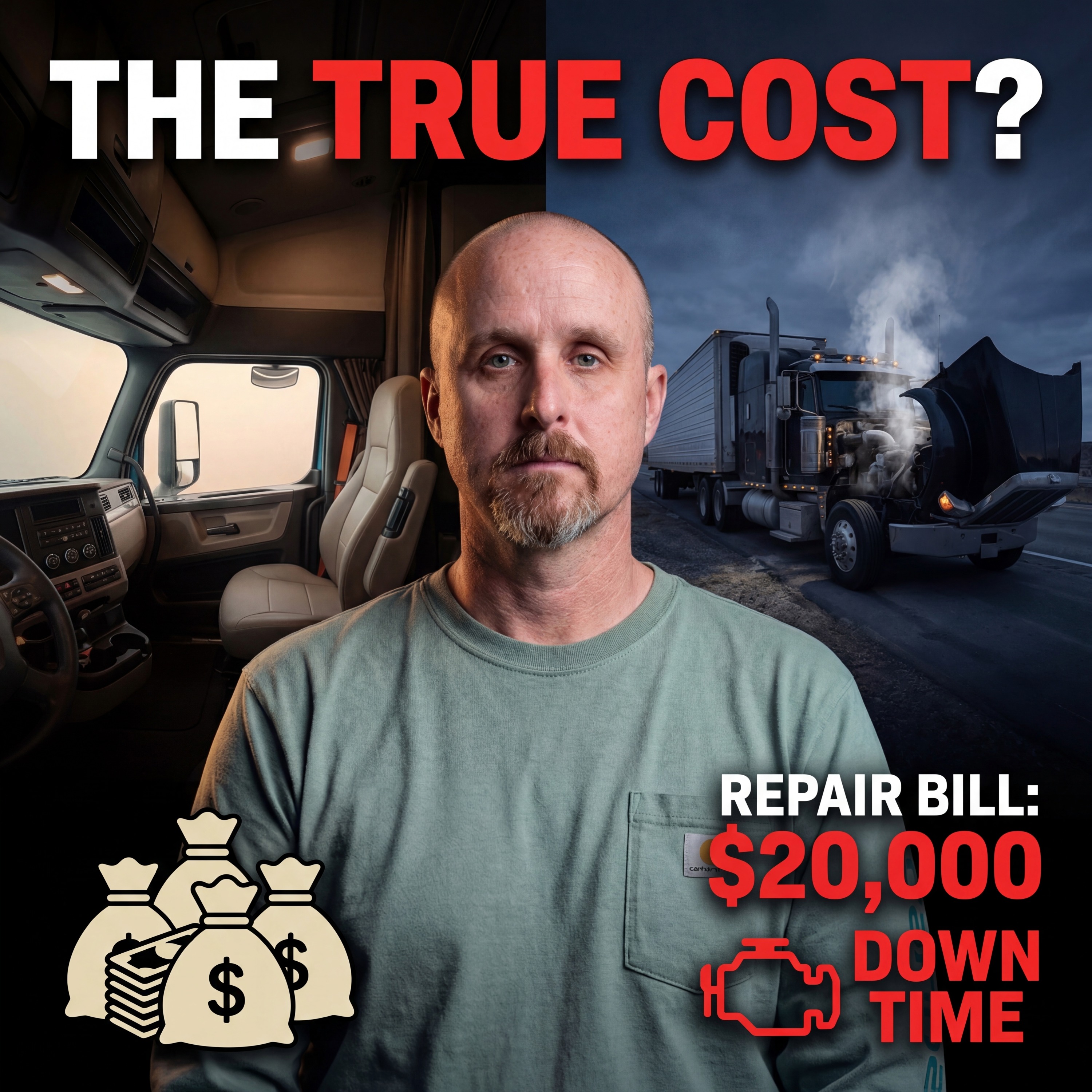
Andrew Krueger got his start hauling freight in box trucks around Chicago in his early twenties. A decade and a half later, he’s running his own trucks, hiring his own drivers, and filing for his own motor carrier authority — and he’s doing it from the Upper Peninsula.
Then the company he’d been leased to for years pulled the plug. Right before Christmas. Instead of walking away, he went all in.
This week, his first truck rolls out under his own name.
WHAT WE GET INTO
- What it actually costs to become an owner-operator — and the $4,000 bet that started everything
- The stuff CDL schools don’t teach you — blown airlines, brake adjustments, and the road etiquette nobody mentions
- Why most owner-operators will tell you not to do it — and why Andrew did it anyway
- The real numbers: what a motivated reefer driver can earn, what it costs per mile to survive, and why your business checkbook and personal checkbook can never be the same account
- Electric trucks, autonomous semis, and where Andrew thinks the industry is headed in five years
ABOUT ANDREW KRUEGER
Andrew got into trucking in his early twenties after working sandblasting and painting jobs around Chicago. He’s driven over the road, worked the repair side, and built a multi-truck operation hauling reefer freight to California. After relocating to Michigan’s Upper Peninsula, he grew from a single leased truck to running his own drivers.
🔗 LINKS
Listen wherever your get your podcasts: Listen to Built in the Midwest
Midwest Truck Driving School: midwesttruckdrivingschool.com
North Country Heavy Equipment & Electrical Line School: https://ncheschool.com/
Submit your Questions: https://webforms.pipedrive.com/f/6WfGT9X1zlYC6WvssJqfWxOOkvVa1AjzqgnAIIHOq70WWiNo5czEWXpBMqxVTW7UST
💬 CONNECT
Email: marketing@midwesttruckdrivingschool.com
Facebook: https://www.facebook.com/CDLMidwest
Instagram: https://www.instagram.com/midwesttruckdrivingschool/
TikTok: https://www.tiktok.com/@midwesttruckdrivingskool
Transcript
If you're going to go owner operator, you got to have money in the bank.
Speaker A:You got to be breakdowns, repairs.
Speaker A:You go out, you break down.
Speaker A:It could be a $20,000 repair bill on a used truck.
Speaker B:You just have so much more that you're responsible for.
Speaker A:You can do over 100,000 real easy.
Speaker A:My start as an owner operator, I think my all in out of my pocket was about $4,000.
Speaker A:They'll probably tell you don't do it.
Speaker A:You know, the way the last two years have been, it'd be don't do it.
Speaker B:But what would you say for someone who's considering getting into the industry as just a, I guess, a word of encour.
Speaker B:If you're thinking about a career in the trades and you want to know what employers actually look for, what the work is really like, and what nobody tells you before you get started, you're in the right place.
Speaker B:Built in the Midwest features conversations that'll help you figure out if this path is for you.
Speaker B:I'm very curious to hear, first of all, to just give people some context of how long have you been in this industry and kind of where did that start and where has that brought you to today?
Speaker A:So I got in the industry in my early 20s.
Speaker A:I was in sandblasting and painting before that working on the heavy equipment, moving it around.
Speaker A:I got pushed out of the industry where we were at location.
Speaker A:I just needed to move on.
Speaker A:So I started in, oh, I was probably about 21.
Speaker A:Started driving a non CDL box truck for a while in and out of Chicago every day and that kind of started going downhill and I needed to move on and find a better career.
Speaker A:Went and got my CDL working with a sewer and water company.
Speaker A:Went and took my permit test a week later, went got my cdl, you know, wasn't a big deal for me at that time.
Speaker A:That did that for a little bit.
Speaker A:And then I started driving over the road for a company and that's all in the Chicago area.
Speaker A:So Chicago companies get a little weird.
Speaker A:They like to do strange stuff and try to find creative ways to pay you and not pay you what you're supposed to.
Speaker A:It's a big game down there.
Speaker A:So I did that for a while.
Speaker A:After that I got an opportunity from the same guy that I was working with.
Speaker A:Said, hey, I got local work for you.
Speaker A:Yeah, I want to be home.
Speaker A:This is great.
Speaker A:Biggest mistake I ever made.
Speaker A:It was 18 hours a day running doing deliveries around Chicagoland area.
Speaker A:A lot of time just sitting in a truck waiting to get unloaded.
Speaker A:I did that for a while.
Speaker A:Then I stepped back out of the industry, got back into the repair industry.
Speaker A:Started working on the medium heavy duty trucks.
Speaker A:Did that up till 10 years ago when I moved up to the UP and got back into trucking full time.
Speaker B:Okay, still doing, did you move to carrying freight up here?
Speaker B:Are you still doing loads down in Chicago?
Speaker A:No.
Speaker A:So I moved up here.
Speaker A:I started with a local company up special delivery.
Speaker A:I worked for them for a little bit.
Speaker A:Didn't really like how it was working out.
Speaker A:45 minute drive back and forth to work every day working, you know, 14, 16 hour days.
Speaker A:I was like, not home, not seeing the kids enough.
Speaker A:So hey, over the road I'm going to be home more.
Speaker A:Which in fact it worked out for me.
Speaker A:Found a company out of Green Bay.
Speaker A:Father, daughter, own company, five trucks, they run California.
Speaker A:So I went out, did the first trip, ran California, no forced dispatch.
Speaker A:So when I get back, they're like, hey, tell us when you want to go out again.
Speaker A:So I'd be home for a week, two days, whatever I wanted.
Speaker A:So my home time with the kids was great.
Speaker A:And about a year into that, the owner came to me and was asking if I was interested in becoming an owner operator.
Speaker A:He was thinking about putting on some owner operators and he gave me my first shot, leased me a truck, simple lease agreement, not like the mega carriers that are out to make money.
Speaker A:It was straightforward.
Speaker A:It's two years, this is what I want for the truck, this is what you're going to pay me for maintenance.
Speaker A:And at the end of the two years, it's yours.
Speaker A:I had to go rent a trailer and we were hauling reefer at the time, so running California, hauling reefer.
Speaker A:So I think my start as an owner operator, I think my all in out of my pocket was about $4,000.
Speaker A:And if it didn't work, I didn't lose anything.
Speaker A:Yeah, return the trailer, return the truck, walk away.
Speaker A:And it worked.
Speaker A:I said I had the truck paid off in about a year.
Speaker A:It was a two year lease agreement.
Speaker A:Truck paid off in a year.
Speaker A:I'd hired, right before COVID started, I hired my first driver and he started driving full time.
Speaker A:And I was looking for a truck while he was driving, found another truck, I think I drove another two months and had a guy come looking for a job, put him in a truck and I just, I stayed home at that point for a while and just ran my two trucks and running my other business, taking care of some stuff there.
Speaker A:And then I put a third truck on and then that was probably about 22, 23.
Speaker A:Things started slowing down and freight was getting harder.
Speaker A:So I pulled the truck off because I went to three trucks, didn't make any more money at that point.
Speaker A:It was more headaches.
Speaker A:We downsized a little bit and the last year and a half has been pretty rough.
Speaker A:Just hanging in there with the way the freight markets have been.
Speaker A:And then up to recently in December, the company that I'd been leased onto that whole time, they decided to pull the plug.
Speaker A:They said they were done the end of January and that was right before Christmas.
Speaker A:I just, I'm done, I'm not going to do this anymore.
Speaker A:And then I was like, oh, I got a driver, the other driver had left.
Speaker A:So I had two trucks, one driver.
Speaker A:I talked to the driver, I'm like, I can't leave him hanging.
Speaker A:So I started filling out all my paperwork, fed the mc.
Speaker A:All that went through smooth.
Speaker A:The state of Michigan.
Speaker A:I just finally got my irp, my plates, my IFTA last week and I started at the beginning of January.
Speaker A:That's, you know, when you look at all the companies.
Speaker A:Like I did a lot of my own paperwork.
Speaker A:I did my mc, my dot, my urc.
Speaker A:I did a lot of it.
Speaker A:And then I hired out to my BOC3 carrier.
Speaker A:They do a lot of other stuff.
Speaker A:And I said, I'm not doing my irp, I'm not doing this.
Speaker A:You need to handle my driver qualifications.
Speaker A:So it's a lot of paperwork and it, it's kind of weird because there's these companies that, well, we can get your dot and your MC in 24 hours for an extra fee.
Speaker A:That's great.
Speaker A:But you can't get plates or IFTA because it's going to take the state.
Speaker B:Yeah.
Speaker A:You know, you got a 21 day waiting period on your MC, which that was fine, but now here I am.
Speaker A:Then we have this big snowstorm come through.
Speaker A:I supposed to get a truck out on Monday and then we had to cancel that.
Speaker A:But you know, this week I'll be running my own authority.
Speaker A:My first truck's going out, you know, brand new to me.
Speaker A:All on me now.
Speaker A:Yeah.
Speaker A:So it's an experience.
Speaker B:Yeah.
Speaker B:I mean what I'm hearing there is you're taking on a lot more bureaucracy which you have little control over and then just a tremendous amount of logistics that you are responsible for.
Speaker B:For someone who maybe they are in the industry, they're thinking about getting into it.
Speaker B:They maybe see the owner operator term thrown around.
Speaker B:They're like, I'm a little bit More entrepreneurial.
Speaker B:Maybe they've done their own business before and they think that could be a good market for them or a good opportunity.
Speaker B:What do they need to understand?
Speaker A:So the owner operator, you do it two ways.
Speaker A:You can lease onto another company, which is how I started.
Speaker A:It takes away a lot of the risk if you have your own truck.
Speaker A:If you're going to lease a truck from the mega carriers, their goal is to keep you in payments and keep you paying money.
Speaker A:And you look at the pay stubs from some of those guys and they make no more money than a company driver.
Speaker A:But they have their own truck.
Speaker A:So if you have the means, you're better off buying your own equipment, financing your own equipment and leasing it on to another company.
Speaker A:That way they're not controlling all your maintenance and what you do and when you do it.
Speaker A:But it's a lot involved.
Speaker A:If you're going to go out on your own, that's even harder because right now I am, oh, I'm probably 45 days into my new MC and there's a handful of carriers, make big carriers that'll work with me.
Speaker B:Sure.
Speaker A:There's, you know, after 180 days, I'll see a whole lot of other carriers that I've used to work with that'll work with me.
Speaker A:And then some of the other ones are still a year out before they'll touch me.
Speaker A:So it really limits what I can do, where I can go.
Speaker A:You know, that first beginning I, luckily for me, since working as an owner operator, leased on, I have a lot of local contacts and a lot of local smaller companies that I've hauled for and hauled with and I've called them and they're glad to work with me.
Speaker A:They're, you know, they were happy to hear from me and they'll take me on if they got freight, they'll help me out.
Speaker A:But it's not an easy, you know, I'm just going to do it, you know, if you're going to go owner operator, you got to have money in the bank.
Speaker A:You got to be breakdowns, repairs, you know that first you go out, you break down.
Speaker A:It could be a $20,000 repair bill on a used truck.
Speaker A:Yeah.
Speaker B:So for some of those timelines that you shared, is that from a compliance standpoint, they just won't touch a new carrier because of just the risk and the credibility of the risk.
Speaker A:Because yeah, you get a lot of risk, you get a lot of carriers, you get a lot of shady carriers run, they get a dirty MC and a lot of accidents.
Speaker A:So then they turn over and start a new one.
Speaker A:But they're smart about that.
Speaker A:They start a new MC knowing that they're going to need it.
Speaker A:So they age, let it age over there until they need it.
Speaker A:So it's already got like 6 months age before they pull it back into play.
Speaker B:Yeah.
Speaker B:And if someone has no idea what you said, what you mean when you
Speaker A:say mc, Motor Carrier Authority, your DOT number, your mc, which is what they look at to check your insurance, they look on safer web to see your inspections and all that, to see you're safe.
Speaker A:How many accidents, how many out of service, how many fatal accidents and all that.
Speaker B:Got it.
Speaker B:So that is your, the record that you carry.
Speaker B:Does that stuff ever expire or is that just for.
Speaker A:No, it stays on the record.
Speaker A:It shows you can go through it.
Speaker A:It'll show total inspections passed, percentage out of service.
Speaker A:It breaks it down pretty good accidents to away accidents and it just keeps adding up.
Speaker A:But they, you know, you have a percentage and you're just looking at the percentage number in the long run.
Speaker B:Yeah.
Speaker B:So you've got your MC and they're kind of being mindful of that for different stretches of time until they feel, I imagine it depends on the size of the company where they may have different thresholds of risk, where they will only accept carriers of a certain credibility than others who maybe they are a little bit more free with that or
Speaker A:they're looking at that, they're looking for you.
Speaker A:Because typically I would probably guarantee my driver's first trip out, he's going to get an inspection that's standard and they're looking, the new carriers, they're looking for that.
Speaker A:You got to clean inspection.
Speaker A:So now we know his truck's good to go.
Speaker A:That's a big thing because they don't know what equipment I'm running, what the condition is.
Speaker A:But we put it on the road.
Speaker A:Your new authority, you're going to get an inspection, they're going to look at it.
Speaker A:Then that tells them that hey, he passed an inspection, he's got to have some decent equipment, you know, maybe we'll work with them.
Speaker B:Yeah.
Speaker B:So something that came up in a recent conversation in our last episode actually was sort of the understanding the dynamic as a driver for a company that you are there to help facilitate their business.
Speaker B:And when someone's an employee of a company, especially large corporations, they can sometimes have the sort of almost adversarial outlook of they have all the money in control and they're not paying me what I'm worth, which that can be true.
Speaker B:But the reality is that they have decisions to make as a business that they are there to be profitable.
Speaker B:They're taking on tremendous risk to send people out with freight and trucks and equipment and training and payroll and all the things that they have to worry about.
Speaker B:You as an owner operator, I imagine, sit in a spot where you're even more aware of that because you have to manage the relationship and get them to hire you in each individual instance and eventually you'll have the reputation where you won't have to work quite so hard with individual carriers.
Speaker B:But I'm curious to see what your take is.
Speaker A:It's a hard subject to cover.
Speaker A:I mean, it's different for everybody in what part of the industry you're in.
Speaker A:You know, it changes a lot.
Speaker A:It really does.
Speaker A:I mean, and they look at everything and it just, it's hard to get that relationship started.
Speaker A:It's a really hard, hard road to
Speaker B:cross, to shift over a little bit.
Speaker B:You mentioned some grievance with just the nature of what CDL schools prepare you for as people actually get into the industry.
Speaker B:And I think there is a thread here of on the understanding what the industry is actually like and how to be a good participant in it.
Speaker B:But from your point of view, having gone through and gotten your class A in the past and now having just recently completed your class B to get some endorsements.
Speaker A:Yeah.
Speaker B:So now you're fresh out of a program and some of that might be a little bit more top of mind.
Speaker B:Where do CDL schools fall short in terms of actual preparation for on the road?
Speaker A:There's a lot.
Speaker A:I mean, yeah, you can drive and you know, I've seen CDL schools all over the nation and you see them running around with a day cab and a pup trailer.
Speaker A:That's not teaching you anything.
Speaker A:Yes, that might be what you're driving, but if you're using that to help facilitate somebody get a class A easier, you know, that's not going to get you there.
Speaker A:I mean, it's sleeper berth.
Speaker A:A sleeper truck, 53 foot trailer.
Speaker A:You know, pulling an empty trailer versus a loaded trailer is two completely different things.
Speaker A:You need a combination of both.
Speaker A:Pulling an empty trailer in the rain is a lot different than pulling a loaded trailer in the rain.
Speaker A:You know, we got hydroplaning, stopping distances.
Speaker A:That all changes.
Speaker A:Load shifting, you know, even backing up a loaded trailer, you know, when you start getting 90 degrees trying to back up, it's a completely different feel.
Speaker A:It acts completely different.
Speaker A:You know, so they're missing a lot of that.
Speaker A:There's just a lot of common sense that I see out there that isn't being taught.
Speaker A:You know, you go to the truck stop, you get fuel, you get fuel.
Speaker A:You pull up, you get out of the fuel island.
Speaker A:These guys are sitting there taking a 30 minute break in the fuel island.
Speaker A:And you're sitting there waiting and you gotta buy, you gotta buy fuel.
Speaker A:There's nothing you can do about it.
Speaker A:You're stuck there.
Speaker A:You know, just the custom, the courtesies, you know, move over, change lanes, but give me more than a truck length before you dive right back in front of me.
Speaker A:And it's all those things that I think, you know, I think they get ingrained so much of.
Speaker A:I gotta get to the right lane.
Speaker A:So they get in the left lane and they right back to the right lane.
Speaker A:The big, the big carriers like Swift and Warner and all those, if you're on a expressway and it's three lanes, they want those guys in the center lane now, which makes it a total nightmare.
Speaker A:You know, trucks use two right lanes now.
Speaker A:You're stuck behind Swift doing 55 and a 65 and you pass them on the right.
Speaker A:Sure.
Speaker A:You know, what's the right answer there?
Speaker A:There's a lot of just overall, I mean, there's more than just driving the truck.
Speaker A:It's knowing, you know, how to, how to cage a brake, how to fix, you know, you blow an airline, how do you clamp off the airline and cage the brakes so you can limp it off the road so you're not stuck on the side of the road creating a hazard, how to plug a tire, none of that's taught, you know, and these drivers get out there and they're, they're stuck and it makes it a horrible experience on the driver's side.
Speaker A:If you can't fix those little things to get your butt out of trouble and get you back on the road, it's going to make your driving career miserable.
Speaker A:You know, there's a lot, yeah, and
Speaker B:there's, I think there will always be.
Speaker B:Because no amount of schooling in a controlled environment will compare to real world circumstances where you have no control.
Speaker B:There's no human dynamic of something happens.
Speaker B:And now you've got traffic behind you that's pissed off at you or that if you're in a collision or something happens.
Speaker B:There's stuff that, nothing in a school environment that won't prepare you for.
Speaker B:But I, I do hear what you're saying.
Speaker A:You know, it's almost like coming out of the school environment, they should almost be required to Go work with a team driver for a little bit just to get the rest of the experience.
Speaker A:How to.
Speaker A:What to do at a shipper, how to do this just to take, you know, you got a lot of people.
Speaker A:I mean, you'll have some people that be like, this is ridiculous.
Speaker A:I can drive and they can.
Speaker A:But you'll get the other ones that are going to be totally nervous about pulling into the shipper for the first time and what do I do?
Speaker A:And just to help alleviate that, because when they start worrying about everything else, they start making mistakes, you know, cutting the corner, running over a stop sign, you know, just to try to alleviate that.
Speaker A:Just like an apprenticeship program.
Speaker B:Yeah.
Speaker B:I think the.
Speaker B:I mean, in an ideal world, everyone would go through that.
Speaker B:And many.
Speaker B:I know many of our graduates do tend to go through companies, you know, like Schneider I know has got, I believe, a three week sort of.
Speaker A:They don't announce the job that's in front of them.
Speaker B:Right.
Speaker B:And other companies have different.
Speaker B:Varying degrees of something similar.
Speaker B:But there isn't really a standard in that regard where everyone kind of approaches.
Speaker B:All right, you're going to learn.
Speaker A:All right.
Speaker B:We're going to spend a week or two on the maintenance stuff of.
Speaker B:All right, you blew an airline.
Speaker B:Now what?
Speaker B:That would be incredibly helpful.
Speaker B:Even just the step up from having range driving with.
Speaker B:Wait.
Speaker A:How to adjust brakes.
Speaker B:Sure.
Speaker A:How to adjust your brakes.
Speaker A:I mean, everybody should know how to do that.
Speaker A:Yeah.
Speaker A:You know, you can't rely on taking your truck to the shop and oh, they did my annual.
Speaker A:I'm good.
Speaker A:No, that doesn't.
Speaker A:Your brakes out of adjustment.
Speaker A:You know, teach them how to adjust the brakes quick and how they're properly.
Speaker B:When you first got in.
Speaker B:Now that you've been doing it for a long time, you've picked up that you now know the things you didn't know.
Speaker B:But I think that's the.
Speaker B:The root of the problem of new drivers who get in and they don't know those things.
Speaker B:Don't know.
Speaker B:They don't know them yet.
Speaker A:Well, when I got in, I was still very mechanically inclined and already messing around with all that stuff.
Speaker A:So it didn't.
Speaker A:But I could see where a new driver getting in.
Speaker A:That's a hard thing to come across and learn and overcome.
Speaker B:Yeah.
Speaker B:Yeah.
Speaker B:You're like, I just don't want to stall it out.
Speaker B:Just like keep it rolling, park it where I need it to go.
Speaker A:Right, right.
Speaker A:You know, that's a lot to learn.
Speaker A:You know, I mean, most of the trucks out there are automatics.
Speaker A:I run automatic Trucks.
Speaker A:I chase fuel mileage and efficiency.
Speaker A:There's less wear and tear on the trucks.
Speaker A:And I'll get guys that'll call me like, oh, I won't drive a Volvo.
Speaker A:Fine.
Speaker A:I don't want you then.
Speaker A:You know, it.
Speaker A:It's what I drive.
Speaker A:It's, you know, it's efficiency and making money and making profits.
Speaker B:Yeah, yeah.
Speaker B:And a lot of companies do, you know, ride, ride automatics.
Speaker B:But there is.
Speaker B:There are those that when you're only taught the automatic and that's the only option you've got then.
Speaker A:Well, we're on that path right now.
Speaker B:Right.
Speaker A:I mean, it's the efficiency.
Speaker A:I mean, everybody's chasing the efficiency.
Speaker A:You got.
Speaker A:Got the old timers out there that, oh, no, you got to have a stick.
Speaker A:You got to shift.
Speaker A:You got to do this.
Speaker A:Yeah, I like to make money.
Speaker A:I like to pay my guys more because we're saving money.
Speaker A:The maintenance is less.
Speaker A:So that's what we run.
Speaker A:Yeah.
Speaker B:Do you.
Speaker B:I'd be curious to see where you see different sort of advancements in just the truck technology that will become more commonplace.
Speaker A:Autonomous trucking.
Speaker B:Yeah.
Speaker A:I mean, autonomous come out with California.
Speaker A:They're pushing that.
Speaker A:They're working on it.
Speaker B:Yeah.
Speaker A:The electric trucks.
Speaker A:I mean, I do a lot of California, and that's been very controversial out there.
Speaker A:Even the yard trucks, the yard dogs and stuff, they're running electrics.
Speaker A:And I was at a couple places, and they had a whole bunch of them.
Speaker A:I was talking to one of the drivers that drives them.
Speaker A:He goes, it's great.
Speaker A:We got these electric trucks.
Speaker A:We got like six of them here.
Speaker A:We can't charge more than two at a time.
Speaker A:We don't have the electric.
Speaker A:We don't have the grid capabilities to charge more than two of our trucks at a time.
Speaker A:Like, so how does that work out?
Speaker A:I mean, they've pushed electric trucks.
Speaker A:They're pushing it so hard, even the electric vehicles, but we don't have the grid to support it yet.
Speaker A:Yeah, yes, it's coming.
Speaker A:It's fine to have their place, but we have to have everything else in place first for that to work.
Speaker A:You know, we're struggling.
Speaker A:Just have enough truck stops for trucks to park and get fuel, you know, now you got to throw the electric charging in and the rest of that.
Speaker A:Then you start talking autonomous trucks.
Speaker A:That's a whole other scary category because you see it all the time.
Speaker A:Even with the Waymo cars in California getting stuck or pulling into an accident scene.
Speaker A:And how's that going to work out?
Speaker B:Right?
Speaker B:Yeah.
Speaker B:The stance We've kind of seen like there should be autonomous features.
Speaker B:There are things that from a safety aspect that if you're on an 800 mile stretch of road that's, you know, straight as can be and you've been in the truck for 10 hours, having the option to look away and have a pretty high degree of confidence that it's not just going to veer off or if you fall asleep at the wheel that there's something that's gonna.
Speaker A:It's getting there.
Speaker A:They got the most of a lot of the newer stuff.
Speaker A:I know the Freightliners and Volvos and like the Peterbilts, they have the lane assist just like the cars do.
Speaker A:You go off if it's turned on or if you have it.
Speaker A:You know, the side collision, the side radar, the front radar.
Speaker A:Those are the front radar.
Speaker A:That's.
Speaker A:They're.
Speaker A:You can't turn them off.
Speaker A:They're very touchy.
Speaker A:I've driven rental trucks with it and I don't like it.
Speaker A:Somebody cuts you off, it's all over the brakes.
Speaker A:You know, on the highway, even if they cut you off on the highway, it's slowing you down.
Speaker A:You know, you get drivers, if you're not paying attention, there's somebody going slower in front of you.
Speaker A:You may have had the Cruise set at 65 and then you, oh, I'm doing 55 now.
Speaker A:Yeah.
Speaker A:You know, even how long have I been behind this guy doing 55, you know, so it's still.
Speaker A:You have to pay attention.
Speaker A:So I mean, it's coming.
Speaker A:I mean, there's no way to avoid it.
Speaker A:It's technology is going to keep advancing.
Speaker A:It's going to keep coming.
Speaker B:Yeah.
Speaker B:You know, I think the.
Speaker B:But we are quite a ways off from dispatchers having the confidence to just let a truck drive itself without anyone in the cab.
Speaker A:I don't know about that.
Speaker A:They're really.
Speaker A:That's a lot of savings on their side.
Speaker A:That truck.
Speaker A:You throw an autonomous truck, if it doesn't have a driver, doesn't have to stop going across the country.
Speaker B:Right.
Speaker A:You don't have to follow the rule.
Speaker A:Hours of service autonomous.
Speaker A:So you can send a truck straight across country and you're not having a team set of team drivers anymore.
Speaker A:It's just stopping for fuel and it's going.
Speaker B:Yeah.
Speaker A:So they're looking at bottom line.
Speaker B:Right.
Speaker B:Does it ultimately boil down to insurance of if 1 out of 20 dispatches has an accident or something goes wrong, then does it play out of like if we saved all that money on.
Speaker A:Yeah.
Speaker A:How does that work?
Speaker A:When the autonomous truck gets in an accident and kills somebody, who's responsible?
Speaker B:Right.
Speaker A:You know, there's no driver that's responding.
Speaker A:You know, how does that work?
Speaker B:I'm not.
Speaker A:What's that gonna.
Speaker A:What's that gonna look like in the future?
Speaker A:Yeah.
Speaker A:You know.
Speaker B:Yeah, those are.
Speaker B:We'll undoubtedly see it's gonna happen.
Speaker B:Some Supreme Court case is going to decide what happens because it's going to happen eventually.
Speaker A:Yeah.
Speaker B:And we're going to have to figure it out because it's happening in aircraft, it's happening on ground vehicles more and more.
Speaker B:I think civilian vehicles are going to go that route of.
Speaker A:Yeah.
Speaker A:Nothing but a fleet of autonomous cars in California.
Speaker B:Who's to say?
Speaker A:No.
Speaker A:But it's kind of scary sending 80,000 down, £80,000 down the road without a driver in the seat.
Speaker A:I mean, they're still doing pilot programs, they're testing with a driver in them still and they're still running them.
Speaker A:But that's kind of some scary territory we're entering into.
Speaker A:Yeah.
Speaker B:Yeah.
Speaker B:I mean, who's.
Speaker B:Who can say at this point, but if you were to put chips down on a bed of how far out we are of seeing that reliably.
Speaker B:If you pull into a quick trip, I guess when are they ever gonna charge?
Speaker B:There's just gonna be docs.
Speaker B:They pull in and I mean, how far out are we from this?
Speaker A:In the next five years, I think we'll see some more changes.
Speaker A:The technology's pretty close.
Speaker A:The research is there.
Speaker A:You know, the only thing holding back electric semis at this point is battery range.
Speaker B:Yeah.
Speaker B:Which get better every day.
Speaker A:They make gobs of power.
Speaker A:We just need the battery technology to last and.
Speaker B:Yeah.
Speaker A:You're there.
Speaker B:Yeah.
Speaker B:So someone comes up with a new cell format for a battery that is 10 times more efficient.
Speaker B:And then if you can get.
Speaker A:You can get it over the road truck to be able to have 700 mile range so they can run a full day.
Speaker B:Right.
Speaker A:That's going to be a huge difference.
Speaker A:Yeah.
Speaker B:Are they putting wireless chargers in the highways or something?
Speaker A:Yeah, yeah.
Speaker A:What's the charging rate look like to charge a semi versus buying fuel?
Speaker A:What's the cost?
Speaker A:What's the return on investment there?
Speaker B:Yeah, I'm sure there are some.
Speaker B:I don't know if this is optimistic or pessimistic, but to think like for the oil industry to be most likely to try and block that up, but once we see those guys start, suddenly they're all casting investments into lithium ion or some of these autonomous companies.
Speaker A:I feel like stop the oil industry, because they still need all the oil and everything's going to be plastic and all that.
Speaker A:So they're still using all those petroleum products.
Speaker A:Look at the carbon footprint that goes into building an electric car.
Speaker A:It's pretty big.
Speaker A:Yeah.
Speaker B:All right, so two.
Speaker B:So we don't just go down the
Speaker A:rabbit hole of conspiracies.
Speaker B:For those who are.
Speaker B:You've got, I think, a different experience than most.
Speaker B:Where you've come in, you've done a couple different verticals, you've got a different point of view on things.
Speaker B:For someone who's looking at trucking, despite everything we just said, is it a career worth going after and if so, who's it really for?
Speaker A:You got to be motivated to make money in trucking.
Speaker A:If you're not going to be motivated and you don't want to drive 11 hours a day, take your 10 off, drive 11.
Speaker A:If you're not out there hustling, you're not going to make the money.
Speaker A:If you're out there hustling and you're with a company, they're going to move you up, you know, so you're going to start new, you're going to start with one of the mega carriers.
Speaker A:It might be enough, it might be enough for you.
Speaker A:But you know, you get that year, two years of experience with mega carrier.
Speaker A:You move into somebody smaller that now, you're not a number, you have a name again, they're going to respect that.
Speaker A:And you know, even hauling refrigerator, dry, van, a driver if he wants, or he or she wants to run hard, you can do over 100,000 real easy.
Speaker A:You know, you just, you got to work hard, you got to put your nose down and grind and do it.
Speaker A:It's there.
Speaker A:But motivation is everything.
Speaker A:Work ethic, you know, be safe at what you do.
Speaker A:Do your job right.
Speaker A:You know, I mean, look at, if you get the experience, look at Walmart.
Speaker A:Walmart.
Speaker A:Walmart is probably one of the best paying major companies out there.
Speaker A:Problem is your home time is dictated by them.
Speaker A:You work when you know your schedule.
Speaker A:It's a hard, it's a hard gig to do.
Speaker A:If you have family, trucking over the road is a hard gig to do.
Speaker A:With family, it takes you away, you miss a lot.
Speaker A:It's a big adjustment.
Speaker B:So having very realistic expectations of what you're getting in for.
Speaker B:And it seems like as you're saying, it's hard to do, but simple to do in that you don't have to do a lot of things, you just have to do a few of them.
Speaker B:Really well, and a lot of it.
Speaker A:Trucking has the highest turnover rate and the grass is always greener on the other side.
Speaker A:For every truck driver, well, you know, they're paying me 50 cents here, they're going to give me 70 cents a mile here.
Speaker A:But they don't look any farther than the first two numbers.
Speaker A:I'm getting this or this.
Speaker A:How many miles you get?
Speaker B:Sure.
Speaker A:You know, what's the rest of the benefits, what's your stop, what's this?
Speaker A:So when you're looking, you have to really look at how many miles are you guaranteeing me X number of miles every week?
Speaker A:How much my deadhead am I getting paid?
Speaker A:The deadhead?
Speaker A:There's.
Speaker A:You have to ask all those questions when you're going to look for that job.
Speaker B:Is there anything that you wish someone had told you when you were first getting your cdl that you wish you'd known before you gotten in?
Speaker A:For somebody like, I like to travel, I like to see things.
Speaker A:And for a lot of people, trucking just.
Speaker A:It just sinks the hooks into you.
Speaker A:And you enjoy being out and seeing everything.
Speaker A:The country, the road.
Speaker A:You may not necessarily enjoy driving in the cities, but the rest of it.
Speaker A:But I thoroughly enjoy being out on the road and seeing the country.
Speaker A:You know, I haven't been on the road since January.
Speaker A:Kind of miss it.
Speaker A:You know, you get to see a lot of places, you meet people, you know, different food from all over the country.
Speaker A:Consistently.
Speaker A:We were hauling a lot of wine out of California, so go to a lot of vineyards.
Speaker A:So doing that for eight or nine years, you make a lot of friends up there that, well, I'm not gonna see them anymore.
Speaker A:So that kind of went down the drain.
Speaker A:So, yeah, I mean, if it gets into you and you want to try to have a family and the rest of it and you just can't get out of that trucking thing, it makes life difficult.
Speaker A:You know, that takes away from home time with the kids.
Speaker A:And I've gotten to a point that I don't plan on stepping back into semi over the road again.
Speaker A:You know, I'm going to keep my drivers on it.
Speaker A:I'll keep myself occupied at home.
Speaker A:I need to be home with the kids and enjoy my life.
Speaker A:Now.
Speaker B:Now you see that in the industry where you kind of put your time and you get your experience, you go out and then maybe you get the opportunity to lease a vehicle and you start building up your own fleet for those that think maybe someone's coming through, they're 20, 24, they're young, they're not quite there yet.
Speaker B:They don't have the house and kids yet.
Speaker B:But they know that someday that may be on the horizon as they grow in their career.
Speaker B:And they were to make, they consider going the owner operator route.
Speaker B:Would you mind just sharing even just kind of ranges of what that can look like for people?
Speaker B:I know there's tremendous variability here.
Speaker B:There's a lot, but it's a different type of earning than just the pay per mile.
Speaker A:Going owner operator, just one truck, or if you're going to start putting multiple trucks on, that changes it a lot.
Speaker A:One truck, it all falls on you.
Speaker A:You can make as much or as little money as you want.
Speaker A:You know, you have to put a budget together.
Speaker A:You have to know what your fixed operating costs are.
Speaker A:You know, what's my insurance, what's my work comp.
Speaker A:What's my.
Speaker A:You need to know what you have to make.
Speaker A:That makes a big difference.
Speaker A:If you know what you have to make, what the minimum is per mile, then you can survive.
Speaker A:You know, you can book loads a lot easier.
Speaker A:You start looking, all right, I gotta make minimum 250amile, otherwise I'm losing money.
Speaker A:You know, you can.
Speaker A:So are 354 bucks a mile.
Speaker A:Hey, I'm good.
Speaker A:And you know, it's a hard game to play.
Speaker A:You start adding multiple trucks, your phone doesn't stop ringing.
Speaker A:It's 24 7.
Speaker A:That phone is on.
Speaker A:Doesn't matter.
Speaker A:Somebody's calling you middle of the night.
Speaker A:Trucks don't break down Monday through Friday.
Speaker A:They break down Friday night through Sunday.
Speaker A:That's just the way it is.
Speaker A:It's emergency roadside repairs, emergency shop repairs.
Speaker A:You know, I run reefers, so it's.
Speaker A:Oh, it's like a three hour minimum to show up, you know, and all the extra charges.
Speaker A:And it's always on a weekend.
Speaker A:It's just the way it works.
Speaker A:So you have to, you have to be prepared that your life is going to revolve around it.
Speaker A:You know, the phone might not ring all the time, but you have to be.
Speaker A:Phone's got to be in your pocket, ready to go.
Speaker A:You know, the other driver is going to call you, hey, I got a flat tire.
Speaker A:What do you want me to do?
Speaker A:Can't leave them sitting on the road.
Speaker A:You got to be on top of it.
Speaker A:You know, you have to be good with money.
Speaker A:You know, you have your business checkbook and your personal check.
Speaker A:I had a great mentor when I was leased on, you know, he was very.
Speaker A:Here's the numbers.
Speaker A:You know, these are numbers is what you're going to make, you know, work.
Speaker A:These are my operating costs.
Speaker A:This is what you need to look at.
Speaker A:And, you know, I was always good with that side of it.
Speaker A:But he's like, everybody makes the error company checkbook.
Speaker A:They open it up and they spend out of it like it's their own.
Speaker A:And you can't do that.
Speaker A:You have to pay yourself.
Speaker A:You know, a lot of guys just do an LLC and you know, they run it all on their one account.
Speaker A:I right away, right out of the gate, I was a W2 employee for myself on my own company.
Speaker A:I paid myself no different than I would pay my drivers.
Speaker A:So same rate per mile stops and that's what I pay myself.
Speaker A:The only difference as an owner, operator, you can't pay yourself per diem.
Speaker A:Big deal there, you know, you have.
Speaker A:It doesn't matter at that point when you're owning because your cell phone's a business.
Speaker A:You know, all your business expenses, they wipe out.
Speaker A:But you have to, you have to do it that way because you need to show a profit because you're going to have to buy trucks.
Speaker A:So you can't just show a loss every year.
Speaker A:You have to be profitable.
Speaker A:And it's hard.
Speaker A:It's accounting.
Speaker A:You know, how to have a good accountant, somebody that's going to walk you through getting that stuff set up.
Speaker A:And I had a full service accounting in town by me that I would do my check register and I would hand them all my receipts every month and they would enter it all in.
Speaker A:They would put everything in the categories where it needed to be.
Speaker A:If it was right down to if my payroll wasn't right, if they needed to adjust my deductions on my payroll.
Speaker A:So I was a net zero when I did taxes at the end of the year.
Speaker A:I mean, those things all help out.
Speaker A:You know, what you can buy under the business, what you can't.
Speaker A:You need to take advantage of that because part of owning a business is not spending all your money on taxes.
Speaker B:Yeah, that becomes the game quite quickly.
Speaker B:You learn quickly.
Speaker A:I mean, you learn what the tax loopholes are for a business owner because you need to use those.
Speaker A:You need to use everything to your advantage.
Speaker A:You know, the government programs as far as getting loans and stuff like that.
Speaker B:Something we have talked about quite a bit are those who look at the profession as something that they are coming in to be a professional at, or those who are just, it's just a job and neither one is right.
Speaker B:You choose what's right for you.
Speaker B:And if you're just coming in to have something to put food on the table for a couple years, fine.
Speaker B:That's all good for those who want to make a career out of it and be a professional.
Speaker B:If becoming an owner operator is something you're eyeing down the road even more, to a far greater extent, that is true, because you just have so much more that you're responsible for.
Speaker B:And for those who, if you are getting into trucking because you don't want to deal with people, you just kind of want to mind your own business and, you know, have your things that you need to take care of and not worry about anyone else.
Speaker A:Yep.
Speaker B:I feel like I can guess the answer here, but probably not the right path for them.
Speaker B:Right, right, right.
Speaker A:It's.
Speaker A:You're, you're, you.
Speaker A:If you're going to be in trucking and over the road, you got to be used to being alone.
Speaker A:That's the hardest thing to overcome, is you're just alone in that truck for days, weeks.
Speaker A:You know, I don't know how these guys can live in a truck for a month at a time.
Speaker A:I do a trip, turn to California and back, and I am ready to be out of that truck for a week.
Speaker A:You know, it's like, I'm done.
Speaker A:Get me out.
Speaker A:I don't want to.
Speaker A:It's not for me.
Speaker A:But you have guys that'll live in a truck, go out for months on end, you know, you have to be okay with being alone.
Speaker A:And if you can't do that, it'll eat you alive.
Speaker A:You know, it'll just.
Speaker A:It'll totally destroy your mental health out there.
Speaker A:I mean, I've seen it at truck stops.
Speaker A:You can tell when you know somebody that's just not built for this industry, you know, but they're doing it, you know, driving over the road a lot of times in a lot of areas, It's a stepping stone to get you into a local job, to get you the experience, you know, owner.
Speaker A:To be an owner operator, you really.
Speaker A:You really have to sit down and look at numbers and put numbers to paper.
Speaker A:You know, if you're driving for a smaller company, like I did as a company driver, and you're interested and you've got somebody good that's running it, they will not be afraid to share all those numbers, you know, yes, they have to make a profit, you know, you have to understand that they have to make a profit, and it's not all going in your pocket.
Speaker A:So you have to make that clear with them.
Speaker A:You know, that, hey, I need to see these numbers.
Speaker A:I need to see if I really, if this is for me, you know, and the right people will help guide you down that path.
Speaker B:Yeah.
Speaker B:So for anyone who's considering going, find someone that you can sit down, buy them a coffee, have them run through it with you.
Speaker A:Yeah.
Speaker A:Find somebody that's been doing it, that's, you know, got their name on the side of the truck or something, and just buy them dinner and sit down and pick their brain.
Speaker A:You know, they'll probably tell you, don't do it.
Speaker A:You know, the way the last two years have been, it don't do it.
Speaker A:But, you know, the market's starting to come around, the capacity, the truck capacity starting to drop.
Speaker A:They're starting to clean up the drivers that are on the road.
Speaker A:And that has made a huge impact at the end of last year, coming into this year, up till this month, with our overseas involvement, it's kind of slowed things down.
Speaker A:The fuel, the rates have kind of stayed there, the fuel prices.
Speaker A:But I see it coming around this year, at least on the reefer side of things, and drive in, you know, the rates are looking better than they have in the last couple years, which is promising.
Speaker B:Yeah.
Speaker B:And at any point you look at any given industry, there's always cycles.
Speaker B:So there's.
Speaker B:There will be.
Speaker B:If things look really dismal, nothing lasts forever.
Speaker B:It will correct.
Speaker A:It's always up and down.
Speaker A:We've been on the down for a couple years now, so if everything starts straightening out, we can start coming around.
Speaker A:I mean, Covid, we put in so many trucks on the road during COVID to cover the shortage.
Speaker A:And then we've been dealing with just the over capacity, which has just annihilated the rates.
Speaker B:But eventually it will correct.
Speaker A:Things have to correct.
Speaker A:Yes.
Speaker A:You know, you can't haul freight at a loss.
Speaker B:So for.
Speaker B:Just to wrap things up for someone who, they hear this, they think, okay, I'm going to, I'm going to look into this, see if it's for me, feel things out.
Speaker B:What would you say for someone who's considering getting into the industry as just a, I guess, a word of encouragement,
Speaker A:Stick with it.
Speaker A:I mean, pay attention to what you're taught.
Speaker A:It's.
Speaker A:It's a good industry to get into.
Speaker A:If you're a hard worker, if you're dedicated, you know, if you, if you're good with numbers, you keep the accounting side, you can make a lot of money.
Speaker A:Especially, I mean, where we live.
Speaker A:Up here we got logging and the rest of it.
Speaker A:Those guys make good money up here as well.
Speaker A:It's there.
Speaker A:But you have to you.
Speaker A:You got to work for.
Speaker A:It's not going to get handed down if you work for it.
Speaker A:Possibilities, they just keep going.
Speaker A:You can keep climbing up the ladder.
Speaker A:You can start.
Speaker A:You can start driving.
Speaker A:Then you get into Flatbed, and Flatbed pays more.
Speaker A:You can get into over dimensional, oversized.
Speaker A:You know, it keeps going.
Speaker A:You can keep as long as you're ready to drive, willing to put in the work, you can climb to the top and start making a lot of money.
Speaker A:But you got to start at the bottom.
Speaker A:As much as you just want to be right here at the top right now, you got to start at the bottom and work your way up, stick with it and do it.
Speaker B:Fantastic.
Speaker B:Andrew, thank you so much for coming on.
Speaker A:Yeah.
Speaker A:Thank you.