
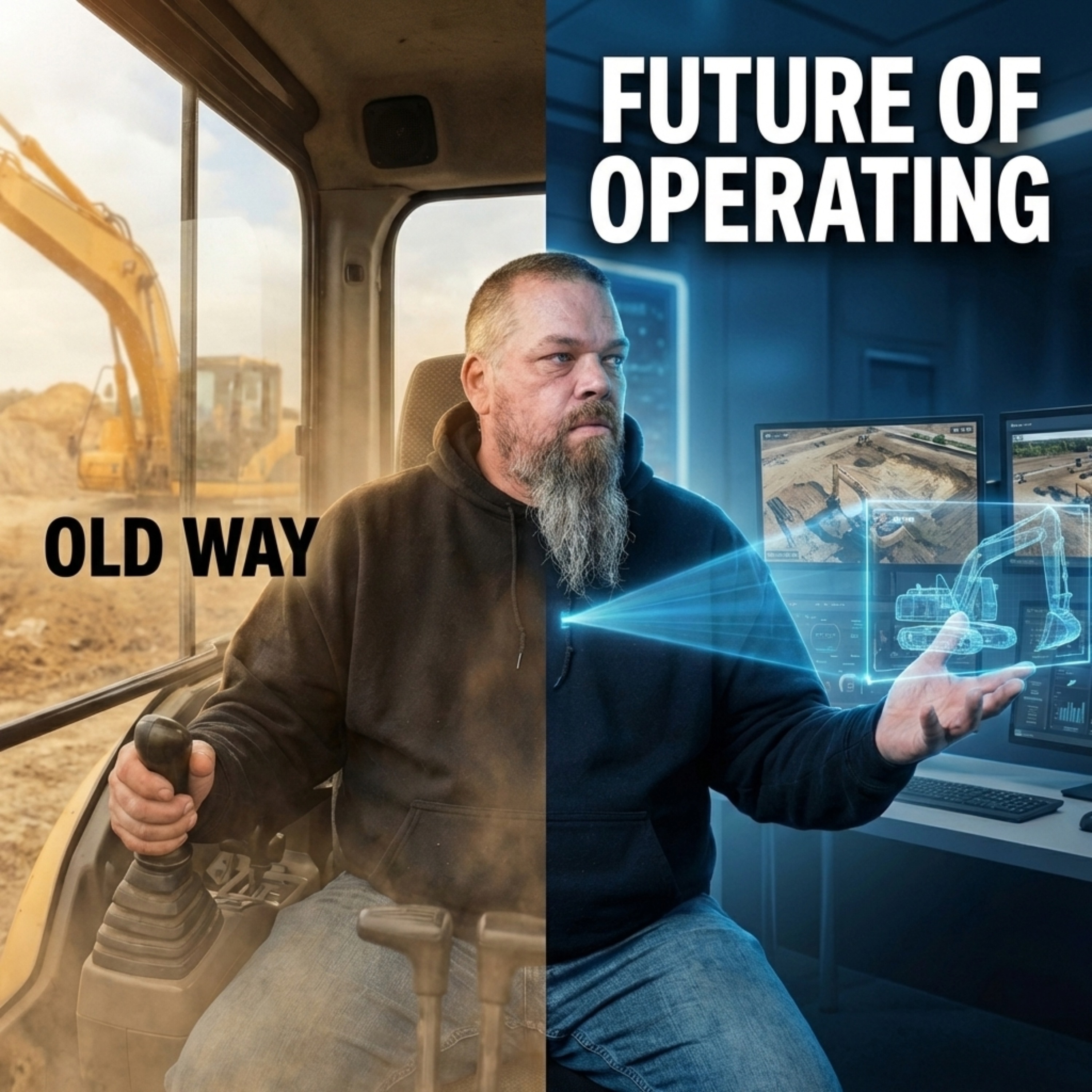
Donnie walked into the largest heavy equipment show in North America and watched someone operate a real excavator in Germany — from a console in Las Vegas. That moment changed how he thinks about what’s coming for the industry. And what he’s bringing back to his students.
WHAT WE GET INTO
- The ConExpo experience — 2,200 vendors, five buildings, four parking lots, and technology Donnie didn’t know existed
- Proximity software that locks machine controls when a person gets within eight feet — even in the operator’s blind spot
- Why the “five years of experience” hire is a unicorn now — and what employers are asking for instead
- The NCCER credentials that are putting graduates a year ahead in apprenticeship programs before they even start
- Why having a CDL as an operator makes you a one-person crew — and why employers are starting to require it
- Donnie’s take on women in heavy equipment: “Some of the best operators I’ve ever seen are women”
- The student age range that proves it’s never too late — from 16 to 66
ABOUT DONNIE
Donnie is the lead heavy equipment instructor at Midwest Truck Driving School. He just came back from ConExpo 2026 — the largest heavy equipment show in North America — and what he saw is changing how he trains the next generation of operators.
We get into the technology that’s coming, the credentials that are giving graduates a head start, why women are some of the best operators he’s ever trained, and why the “five years of experience” hire is officially a mythical creature.
🔗 LINKS
Listen wherever your get your podcasts: Listen to Built in the Midwest
Midwest Truck Driving School: midwesttruckdrivingschool.com
North Country Heavy Equipment & Electrical Line School: https://ncheschool.com/
Submit your Questions: https://webforms.pipedrive.com/f/6WfGT9X1zlYC6WvssJqfWxOOkvVa1AjzqgnAIIHOq70WWiNo5czEWXpBMqxVTW7UST
💬 CONNECT
Email: marketing@midwesttruckdrivingschool.com
Facebook: https://www.facebook.com/CDLMidwest
Instagram: https://www.instagram.com/midwesttruckdrivingschool/
TikTok: https://www.tiktok.com/@midwesttruckdrivingskool
Transcript
It's like you're playing a video game and you're controlling an excavator in Germany, a physical excavator in Germany, and you're sitting at a console in Las Vegas, Nevada.
Speaker A:If they're within eight feet of my vehicle, it stops.
Speaker A:It won't let me do a thing.
Speaker A:It automatically locks the controls.
Speaker A:So now I can't potentially kill or hurt somebody, even if they're in my blind spot where I can't see anybody that ever says a woman can't do what a man can do.
Speaker A:Throw that idea out of your head right now.
Speaker A:Some of the best operators, some of the best mechanics, some of the best truck drivers I've ever seen are women.
Speaker A:Watching these guys be successful, that's what I take out of this course.
Speaker A:It's not my success is their success.
Speaker A:So if I do good enough job and they go out there and they get a job and they're successful, that is my legacy.
Speaker B:If you're thinking about a career in the trades and you want to know what employers actually look for, what the work is really like, and what nobody tells you before you get started, you're in the right place.
Speaker B:Built in the Midwest features conversations that'll help you figure out if this path is for you.
Speaker B:Welcome, Donnie.
Speaker A:All right.
Speaker B:To the Built in the Midwest podcast.
Speaker B:Thanks for joining us this morning.
Speaker B:Now, let's start with your role at the school.
Speaker B:But our listeners are people from around the world that are looking into these different trades that want to know more information about the trades.
Speaker B:But tell me about your role and what you do at the school.
Speaker A:So I'm the lead heavy equipment instructor for North Country Heavy Equipment School.
Speaker A:I have taken over.
Speaker A:I took over that lead position probably about a year ago, I think, and I kind of lead the day to day operations, making sure that the students are where they need to be, making sure that the instructors are where they need to be, making sure that they have all the tools and material and equipment and everything that they need ready to go so that we can.
Speaker B:Yeah, absolutely.
Speaker B:So you gotta ramrod the whole program kind of from start to finish.
Speaker B:Now, there's some, some big changes going on in the industry.
Speaker B:There's some big changes going on in the.
Speaker B:I kind of want to dive into the Conant Expo because you got to go to it and I didn't.
Speaker A:All right, you went three years ago.
Speaker B:I did.
Speaker B:I know you're still, you're not going to let me live that down either.
Speaker B:So I'm a little jealous.
Speaker B:You know, I ended up having A baby, you know, so that's why.
Speaker B:But talk to me about the Expo and for people that don't know what the Conig Expo is, talk about the enormous size of this thing.
Speaker A:So Conag Expo.
Speaker A:I don't think I really fully understood the scope of the size of that event until I got there.
Speaker A:It's held in Las Vegas every three years.
Speaker A:It is the largest heavy equipment show in North America, second largest in the world.
Speaker A:This year they had 2,200 vendors.
Speaker A:It covered, I want to say, five different buildings that were part of their convention center and four outlying parking lots.
Speaker A:Every manufacturer you could ever think of had equipment there from the smallest skid steer you've ever seen through the largest construction equipment you could probably imagine.
Speaker A:You know, they had the dump trucks where the tires are taller than a semi truck.
Speaker A:And they had, you know, concrete equipment and crushers and skid steers and excavators and dozers.
Speaker A:I mean, you name it, they had it.
Speaker A:They had demonstrations and they also, you know, they also had a whole bunch of different vendors that cover not only just the equipment themselves, but the technology that is in and is coming to that equipment.
Speaker A:And I think that was probably one of the most exciting things for me was seeing some of the technology that's coming.
Speaker A:Smart grade systems on dozers where a lot of times the operator doesn't have to make those small, minor adjustments anymore.
Speaker A:The machine makes it for them.
Speaker A:Proximity software, part of our program.
Speaker A:We read OSHA incidents where people were hurt or killed on the job due to inattention or not paying attention to what's going on.
Speaker A:Well, now there's software that, where they can set it as a proximity where, let's say I don't want anybody within 8 foot of my machine where now it recognizes people on the ground in areas where I can't see them.
Speaker A:And if they're within eight feet of my vehicle, it stops.
Speaker A:It won't let me do a thing.
Speaker A:It automatically locks the controls.
Speaker A:So now I can't potentially kill or hurt somebody, even if they're in my blind spot where I can't see.
Speaker A:You know, and I'm sure people understand what blind spots are.
Speaker A:Everybody's driven a car or most people have equipment has blind spots, and some of them are worse than others.
Speaker A:And then there's people with disabilities that have additional blind spots.
Speaker A:We've trained students before with that, had cochlear implants.
Speaker A:We had a fully deaf student.
Speaker A:We've had students blind in one eye or the other.
Speaker A:We even trained a functioning quadriplegic student and he couldn't turn like a normal person.
Speaker A:So everything that he had was in this view here, anything behind that he couldn't see.
Speaker A:So this type of software that they're coming out with on not only but new equipment, but you can outfit old equipment with it.
Speaker A:So now we could take an excavator that's been out in service for 15, 20 years and outfit that excavator with that same software.
Speaker A:So it's amazing the amount of things that are being done.
Speaker A:I mean they had stations where you could literally sit down at a console use.
Speaker A:It's like you're playing a video game and you're controlling an excavator in Germany, a physical excavator in Germany and you're sitting at a console in Las Vegas, Nevada.
Speaker B:But, but that excavator is in there.
Speaker A:And it's actually, actually operating.
Speaker A:It's.
Speaker A:It's like drone, like the same drone technology where you know, military is flying drones all over the world from a trailer in the middle of nowhere.
Speaker B:So this technology in the last 10 years have, has just gone to the nth degree.
Speaker B:But this, the safety stuff is, is something that's interesting because we see that in, in vehicles where the automatic braking where a person, it just senses a person in front of you is going to automatic brake for a lot of newer cars or the blind spot detection where you try it won't let you get over if there's a car in your lane and the light will come on.
Speaker B:And they got cameras and mirrors now.
Speaker B:So this is all for safety.
Speaker B:It's going to help all these future operators just to be more safe utilizing technology in a much more kind of positive manner.
Speaker A:And they have the GPS equipment out now where as long as you have satellite access, which most job sites do, they can set it to where the machine will make the cuts and grades and everything that they needed to make without the operator having to do it.
Speaker A:Literally they're the steering wheel.
Speaker B:Well and I've heard of that with some newer equipment where it's almost dummy proof, where you can't mess it up, where it'll only go down so far.
Speaker B:And if that trench needs to be 36 inches plus or minus a half inch, it'll hold it right there the entire time.
Speaker B:So no, just amazing.
Speaker B:Now this place is huge.
Speaker B:So it's every three years.
Speaker B:So it takes three years to put this event on.
Speaker B:So we're not talking about a little trade show here.
Speaker B:Expo.
Speaker B:This is absolutely gigantic.
Speaker A:I sat on buses to go from the different areas.
Speaker A:Let's see.
Speaker A:I sat with a group from Italy, another group from Switzerland, one from Germany, Korea, Japan.
Speaker A:And I'm talking to these guys like.
Speaker A:Like all over the world.
Speaker A:They're from all over the world.
Speaker A:But it's.
Speaker A:We shared, like, interest, and we share interest in the industry and what we do, and it's.
Speaker A:It's.
Speaker A:You're talking to these people like you've known them for years.
Speaker A:You know, you have that.
Speaker A:You instantly have this connection.
Speaker A:Some of them were vendors, and some of them were just coming to see the show.
Speaker A:And it's just.
Speaker A:It's.
Speaker A:It's such a broad spectrum.
Speaker A:I mean, I was there for almost four and a half days, and I didn't see everything.
Speaker A:I missed.
Speaker A:I missed half of one full building and one full parking lot.
Speaker A:I needed at least two four and a half days.
Speaker B:Four and a half days going through this stuff.
Speaker A:I probably still didn't see it all.
Speaker B:No.
Speaker A:And I think I came back with eight bags of swag.
Speaker A:You know, a couple things on the display over here.
Speaker A:But, I mean, it's amazing to even some of the places that some people I talked to, I hadn't even really thought of, because when you sign up to go to Ag Expo and you get your ticket, they have a thing called my show planner, to where you can go in and pick different people or different companies that you want to go visit.
Speaker A:It puts it into an app, and then you pull up that app while you're at the show, and it shows you exactly where those vendors are located in what building.
Speaker B:So while you kind of plan your.
Speaker A:Route, so you can plan your route.
Speaker A:So I made sure that I hit all the ones that I wanted to hit.
Speaker A:But then while I'm walking around going, hey, I'll look at that.
Speaker A:That looks really cool.
Speaker B:That looks cool.
Speaker A:I want to look at that.
Speaker A:And then I start talking to those people like, okay, I see the benefit in that.
Speaker A:When what I'm doing now, you know, some simulator software and, you know, safety systems.
Speaker A:We talked about spill kits and stuff like that.
Speaker A:And there's.
Speaker A:There was a one.
Speaker A:One Pig is the name of the name of the vendor.
Speaker B:Yep.
Speaker A:They're one of the foremost safety companies for spill kits.
Speaker B:That's for.
Speaker B:Has Whopper.
Speaker A:Has Whopper.
Speaker B:I've heard of them.
Speaker A:And they can build any kind of kit, so.
Speaker A:know they were there because:Speaker A:Try to go through:Speaker B:You can that out.
Speaker B:You can't.
Speaker A:So you Just literally walk through these buildings, go, oh, hey, I want to go look at that.
Speaker A:Oh, hey, I want to go look at that.
Speaker A:It's like that, that whole thing with, you know, you're on something squirrel.
Speaker A:That's what it is.
Speaker A:You're zeroing in on.
Speaker A:I get to get to that booth.
Speaker B:Yeah.
Speaker A:All the way over there, and I.
Speaker B:Hit, you know what you want to check out.
Speaker B:But all of a sudden you're like, oh, yeah, I want to check out all this.
Speaker B:It's like going through a grocery store and you.
Speaker B:I need to get these three items.
Speaker A:And you come up with a grocery store hungry.
Speaker B:Yeah.
Speaker B:Oh, exactly.
Speaker B:Don't do it.
Speaker B:Don't do it.
Speaker B:Cause you're gonna come out with 30 items when you wanted to get three.
Speaker A:Yeah.
Speaker B:So that's, that's.
Speaker B:It's so interesting.
Speaker B:And so something I'm interested in is, is why do you think that's important to go to stuff like this in relation to kind of, kind of what you do in relation to maybe other people that are interested in the trades and, and how an event like this kind of maybe changed your look on.
Speaker B:On heavy.
Speaker A:So I think, you know, I've been doing this for a while, and I've.
Speaker A:I've always been on older gear.
Speaker A:And it's fun.
Speaker A:I mean, we're big kids with big toys, right?
Speaker A:You know, big toys that are hurt in a matter of seconds, but pretty quick.
Speaker A:But to be able to get.
Speaker A:Get.
Speaker A:Get out there and see the technology that's coming and stuff that I didn't even.
Speaker A:Wasn't even aware was even being thought of.
Speaker A:The younger generation we have now, they want to see that stuff.
Speaker A:So even if I don't have that stuff here, I can say, okay, this is what I'm training you on.
Speaker A:Okay, now let me show you a video.
Speaker A:Let me show you a website for some information on some information of stuff that's coming, stuff that's going to be on, in.
Speaker A:For.
Speaker A:On equipment that you may come into contact with when you hit the industry.
Speaker A:And now they get a chance to see, okay, this is what I learned on.
Speaker A:I know the concepts of how to run this well.
Speaker A:Now all I have to learn is that new piece of gear, that new tilt rotator head, that.
Speaker A:That new GPS system that whatever.
Speaker A:So they're expanding on what they've learned here.
Speaker A:So now I take the knowledge of.
Speaker A:Yeah, trust me, if I had millions and millions of dollars, I would have come home with a lot more things.
Speaker B:Take one of this, one of that.
Speaker A:Right?
Speaker A:But what I did come Back with was a wealth of knowledge of things that are going to be industry standard down the road and I can train on those.
Speaker A:Now I can say, okay, this is what we're on now, but this is what you're probably going to see in addition to this.
Speaker A:So it opens that, that window of okay, now I can connect some of the younger students to stuff that they're going to really want to see that it's going to be a whole lot of fun when they get out there.
Speaker A:Like these tilt rotator heads for excavators.
Speaker B:Oh, they're amazing.
Speaker B:They're amazing.
Speaker B:And the quick attachments that you and you have all these different things and literally you never need to get outside the cab.
Speaker B:So it just changes the way you excavate.
Speaker B:And yeah, no, those tilt rotating systems and those are very common over in Europe from what I've heard.
Speaker B:And so they're slowly making their way to the United States but they're coming more and more common around here.
Speaker B:But now being able to teach that and articulate that to students that are interested because they're going to see that stuff in reels and videos and different things and, and so being able to talk about it is going to be huge.
Speaker B:Now did you see anything on NCCR when you were out there?
Speaker A:I didn't see anything on NCCR at the show, but I did talk to a lot of individuals that are fully aware of nccr.
Speaker A:Okay.
Speaker A:And they, for one reason or another didn't go that route.
Speaker A:But they are, when somebody comes in with those credentials, they already recognize that they're coming in from a program that trains them to a higher standard and trains them to a higher level.
Speaker A:And we're finding even companies that of individuals that have gone to, applied for a job somewhere, they call me the next day, okay, talk to me about their NCCR credentials.
Speaker A:You know, we don't train nccr, but I see their NCCR certified.
Speaker A:Yeah.
Speaker A:What's their NCCR number?
Speaker A:So I can look them up and I can, having the access that I have as an instructor, I can look in there and say, yes, they have this, this and this.
Speaker A:We weren't able to certify them on this, this and this, but their module is done for this.
Speaker A:So all they need is the on the job stuff.
Speaker A:Oh, easy.
Speaker A:Okay, I can do that.
Speaker A:Right.
Speaker A:And it's, I think it's probably going to open up some more doors for NCCR down the road too.
Speaker A:But we've, we've been partnered now with, with a major company that does NCCR apprenticeships Yeah, so.
Speaker A:And they even said when they came out to talk to us, if they're coming from you guys and you're training nccr, instead of starting off at the lowest level like all these other people are coming into the apprenticeships, they're already going to start off at a higher level.
Speaker A:Some of the individuals may only be here for a month and a half, but they're almost a year into the apprenticeship from what they've learned here.
Speaker B:Just because they have such a strong.
Speaker A:Foundation, because they have a strong foundation coming from here that they can build off of there.
Speaker A:And it's seamless transition.
Speaker A:We're getting them signed up, we're getting their NCCR number, we're getting them as far as we can get them with what we have capabilities of, then all they have to do is carry on when they get to that new location.
Speaker A:And I'm showing the, our individuals how to bring up that information.
Speaker A:There's Builder, Builder Fax is another program now through nccr.
Speaker A:It's an online app that the person can bring up.
Speaker A:So if somebody doesn't know how to use a QR code, which most people should.
Speaker B:Yes.
Speaker A:But if they don't know how to use a QR code, these people, the individual can send them their credentialing right off of Builder Fax and it comes with all the information that they need to know about that individual.
Speaker B:That's another resource that they can utilize there.
Speaker B:So let's back up just a little bit.
Speaker B:For people that don't understand.
Speaker B:We keep talking about nccer.
Speaker B:All right, so that's the national center for Construction Education and Research.
Speaker B:What, what is that?
Speaker B:And, and what credentials are you talking about in layman's terms so people can understand what we're talking about?
Speaker A:So NCCER is a nationally recognized construction education program.
Speaker A:They're.
Speaker A:I mean, they train not only here in the United States, but they all do some, they do some training overseas as well.
Speaker A:What they've done is they've taken industry experts and they got together.
Speaker A:I wanted to say, I want to say it was early 90s.
Speaker A:They got together and they came up with an industry standard.
Speaker A:Okay, so industry standard basically is saying the industry recognizes these terms, industry recognizes these skills as being important.
Speaker A:And they came together, subject matter experts come together and say, okay, I think they, if it's a skid steer, they should know how to do this.
Speaker A:If it's a front end loader, they should know how to do this.
Speaker A:If it's an excavator, they should know how to do this.
Speaker A:So what NCCR has done is they've taken that information from the, the subject matter experts, they've made a program now that we can train off of using PowerPoints module, online module testing, performance profiles so that we can take the information that we're already teaching, add to it from the NCCR program.
Speaker A:And now they're coming out of here with better credentialing than they, than they ever have in the past.
Speaker A:So in the past they came out of here with a safe to operate, which is great.
Speaker A:You want to make sure that we're safe, right?
Speaker B:Absolutely.
Speaker A:But now they're coming out with not only a safe to operate, but they're coming out with specific skills they've gained on skid steers, specific skills they've gained on loaders on everything that we train here.
Speaker A:We're also taking them a little bit further.
Speaker A:We're going working with level one and level to their level one, level two programs.
Speaker A:And we're kind of branching into their level three because we teach motor graders as well.
Speaker B:Yeah, absolutely.
Speaker A:And that's actually under their Level 3 program.
Speaker A:So we're going to work towards getting the core program involved too.
Speaker A:So with level one, level two and level three, they have to have core, then they have to have a certain type of certain modules done with online module testing and performance profiles.
Speaker A:Those all come together, make them a craft and a craft person for that level.
Speaker B:For that level.
Speaker A:Right.
Speaker B:And so from tying this back to employers, from an employer's standpoint, somebody comes in with a level one and level two heavy equipment operator NCCR credentials, what does that mean to the employer?
Speaker A:It means the employer that not only are they safe in that piece of gear, they have a better working knowledge of that gear than somebody that either hasn't run one before or has basic knowledge.
Speaker A:They're being specifically trained in certain areas.
Speaker A:We even dig into construction math, we dig into interpreting civil drawings, which is, I mean everything we do is on a civil drawing, Right, Absolutely.
Speaker A:So there's other aspects of it that they're trained on, not only the generalized industry standard stuff, but specifics to those individual pieces of gear.
Speaker A:So now that that employer can say, okay, I don't need to teach this guy basics, I can take this guy and or girl and train them on what I need them to know specifically for my employment here, so I don't have to go back to the basics with these individuals.
Speaker A:So if they're coming out here with NCCR certifications for a skid steer, okay, this is what we use, a skid steer for these are the attachments we use.
Speaker A:Now, all they have to learn is that part of it, everything else is already done.
Speaker A:That knowledge is already there, and they've gotten the confidence.
Speaker A:We've had individuals that have left here that were hired as a dozer operator, or actually one guy was hired as a backhoe operator.
Speaker A:Six months in, his employer came to him and said, look, I know you.
Speaker A:I hired you as a backhoe operator.
Speaker A:My dozer guy is out sick today.
Speaker A:I need dozer work done today.
Speaker A:Hand me the keys.
Speaker A:Let's go.
Speaker A:The employer already knows that he's not going to be great at it.
Speaker A:But if he gets a half a day's work done, that's a half a day's work that he would have not gotten done otherwise.
Speaker A:And for that individual, it shows the employer that they're not afraid to get out there and do it.
Speaker A:Yeah, okay.
Speaker A:So they're gaining the confidence out of that.
Speaker A:And the NCCR reinforces that confidence.
Speaker A:It takes them, we teach them the basics.
Speaker A:The NCCR reinforces that, gives them that extra knowledge and builds that confidence quicker.
Speaker A:And that's what I'm seeing the most out of it, is the confidence in the students has skyrocketed.
Speaker A:You know, we've got individuals that come in, have never seen a piece of heavy equipment, let alone sit in one before.
Speaker B:You've said that before where they don't even know what a grease cert is.
Speaker A:But now they know.
Speaker A:They know the importance of maintenance.
Speaker A:They know the safety behind it.
Speaker A:And employers love that.
Speaker A:We've had simple things like teaching people how to climb on and off equipment.
Speaker A:Three points of contact, always facing the equipment.
Speaker A:I've had employers want to partner with us because we teach that alone.
Speaker A:They don't care about anything else.
Speaker A:Just because.
Speaker B:Just the safety.
Speaker A:Just the safety side of it.
Speaker A:Because the one employer that partnered with us and is now has hired eight of our students.
Speaker A:He, literally, two weeks before we had that conversation, had to send three people to the hospital because they jumped off of a track of a dozer and either twisted a knee or twisted an ankle.
Speaker A:So that one, something as simple as climbing on the equipment, three points of contact facing the equipment.
Speaker A:That's a cornerstone.
Speaker B:Cornerstone.
Speaker A:That's a big corner stone of big deal.
Speaker A:Yeah.
Speaker A:But it's amazing what the employers now are recognizing.
Speaker A:And this nccr, it takes it to a whole new level.
Speaker A:It brings us into a new world.
Speaker A:It's been tough getting it up and running, but I can see the benefit in I've learned and I've been Doing this a long time, and my mind's always open to learn.
Speaker A:And I've learned from this program.
Speaker A:And I know if I'm learning, the students are learning.
Speaker B:Absolutely.
Speaker A:And I can tell you the excitement level from day one to end a program is huge.
Speaker A:And they're excited about the credentials and they're showing them off.
Speaker A:And the fact that they're walking out of here with that stuff in hand is even better.
Speaker B:It's huge.
Speaker B:So something I think about and I always tell students, getting your CDL is really the ticket to getting into the trucking industry, the transportation industry.
Speaker B:And it doesn't mean you're a professional driver once you go through truck driving school and get a cdl, but it means you have a foundation to build off of.
Speaker B:And then from there there's always gonna be on the job training, no matter what it is.
Speaker B:I have a buddy that's going for, he wants to be like a surgeon or something.
Speaker B:But anyway, he's in his residency now, which is on the job training for doctors.
Speaker B:And that's like a few years.
Speaker A:I would say he'll be doing that for five more years.
Speaker B:Exactly.
Speaker B:But it's, it's, you know, he went through all the schooling, got a foundation, and he said, now it's literally on the job training for becoming a doctor, the residency.
Speaker B:But, but would I be accurate in saying, like this?
Speaker B:These NCCR credentials are similar to like a cdl.
Speaker B:CDL is the ticket to get you into the industry.
Speaker B:These NCR credentials, it doesn't make you a professional operator, but it gives you a foundation to build off of and to work off of.
Speaker A:Which is, which is, that's exactly what it is.
Speaker A:It's a stronger foundation.
Speaker B:Yeah.
Speaker A:You know, we've already been giving them the foundation, but we're making that foundation stronger.
Speaker A:So, so when these, when they, these individuals go out to an employer, the employer, even if they don't know what NCCR is, we, the person that is coming in, applying, they put, I'm NCCR certified.
Speaker A:They put in their NCCR number and they, and these employers are going, what's, what's nccr?
Speaker B:What's this?
Speaker B:Yeah.
Speaker A:And our guys know enough to train them on that.
Speaker A:And then they go to their website and they look at it like, wow, okay, that, that, that's amazing.
Speaker A:It's a big deal.
Speaker A:It shows here, they've got skits here, and you can look even just on the website, it'll show you what you're learning.
Speaker A:You know, it doesn't give you all the capability of taking the tests and everything without being, you know, paying for the system.
Speaker A:But it gives you an idea of what they're learning so that you as an employer can look at this and go, okay, this person's coming in way better off than anybody I've hired before.
Speaker B:Why is that?
Speaker A:Why is that?
Speaker A:What's different about this program and what they're learning?
Speaker A:And then they see, you know, they look, they see and then they do.
Speaker A:Right.
Speaker A:So they look at the individual that they're hiring, they see what they're being given, and then they watch the individual go do it.
Speaker A:And they like, wow, okay.
Speaker A:They're, they're light years ahead of the last guy I hired that barely, you know, he worked on his mom and dad's farm for six months.
Speaker A:Right.
Speaker A:So having that stronger foundation.
Speaker A:It is not just a foundation, it's a stronger foundation.
Speaker A:It's taking what we've already been teaching and strengthening it even more.
Speaker A:And our hire rate out of school right now is going way up.
Speaker A:And it's been exciting, really exciting.
Speaker B:Yeah.
Speaker B:These people are becoming more and more successful right out of school, which is the goal.
Speaker B:The goal is to get them employable and give them the skills and core competencies to be able to enter this industry, you know, as an entry level professional operator.
Speaker B:So talk to me about the.
Speaker B:So North Country High Commitment School is an NCCR accredited school.
Speaker B:Now, are there a lot of schools like that across the country?
Speaker B:If somebody's in California and they're looking at wanting to be a heavy equipment operator.
Speaker B:Right.
Speaker B:Would you say that, that going with an NCCR accredited school is a, is a big decision and that would be a big part of it to know that you're getting the training that you need, that they need in order to be able to get into this industry.
Speaker A:Yeah.
Speaker A:So I, me personally, if I was looking for schools and I knew what NCCR was, I would look for the schools with NCCR because I know that I'm.
Speaker A:For the money that I'm paying, I'm coming out with more on the end.
Speaker A:Not only am I just getting time in the seat, but I'm getting that time in the seat and I'm going to have a lot more to prove and to show for it at the end in a national accreditation and a.
Speaker B:National accreditation that you can take anywhere,.
Speaker A:That I can take anywhere across.
Speaker A:And the accreditation follows the individual.
Speaker A:It doesn't follow the like.
Speaker A:Like, because we are NCCR certified or certified accredited, we are able to train those individuals in the NCCR programs.
Speaker A:We've gone through the Whole vetting process.
Speaker A:We've gone through the certification process and I'm going through.
Speaker A:I've been through the certification process for an instructor, for test proctor, for performance profiles.
Speaker B:And maybe you should talk about that because that, that has been probably one of the most arduous things, you know, amongst everything.
Speaker B:It's just, it's just getting.
Speaker B:Once the school is accredited, then getting all the instructors certified is, it is a massive process.
Speaker B:It's taken months.
Speaker A:And it's not just a massive process.
Speaker A:It is a process where the instructor is taking ownership.
Speaker A:So when I sign something, I am not only, you know, like when I'm doing a performance profile, I click on it, I say, yes, this person certified in this.
Speaker A:We've gone out, we've done the testing, but at the very, the last thing that I have to click on is a box.
Speaker A:And it's on every time, every time I click on every one of them, it's saying that I'm putting my name out there as a certified instructor through nccr, that I have met all the criteria in the NCCR program, that this individual is certified in that thing, that's, that's my butt on the line.
Speaker A:So if that, and if I just go out there and pencil whip it and say, hey, yeah, this guy's good to go, and then he gets out there and doesn't perform, then the employers go, what the heck?
Speaker A:Then they call NCCR who certified you, and I can actually lose my certification.
Speaker A:Right.
Speaker A:And so that's.
Speaker B:It's a big deal.
Speaker A:It's a big deal.
Speaker A:It's, it's, it's.
Speaker A:You're.
Speaker A:I'm taking ownership in not only training the students, but training them under this new program with NCCR saying, yes, this person has met the criteria that NCCR wants and needs, and that's a big thing.
Speaker B:Absolutely.
Speaker A:And people that deal with NCCR or the credentials behind that, they understand what it takes to get these craft qualifications.
Speaker B:Absolutely.
Speaker A:So when somebody has said, and this is an industry for industry, professional says, yes, this person knows they can trust that.
Speaker A:And nccr, they do spot checks, they do audits, they do everything else like a normal education program like this should do.
Speaker A:And, and every time we've done one has been great.
Speaker A:And, and I take a lot of pride in that.
Speaker A:I know my fellow instructors take a lot of pride in that, knowing that not only am I bettering myself and bettering the program, but we're bettering our students on the long end.
Speaker A:On the end of it.
Speaker A:So when I send these guys out to the Industry, not only are they going to be successful, but we're going to get calls from those companies saying, okay, you get any more like this guy?
Speaker A:And we're getting those calls.
Speaker B:Absolutely.
Speaker A:You know, and, and with the industry, one thing that I think is really exciting about the industry right now is for a lot of years, the federal and state governments pushed college.
Speaker A:Yep.
Speaker A:Right.
Speaker A:Got to go to college, be successful.
Speaker A:Right.
Speaker A:You can have a very, very, very smart kid, but they're not college kid.
Speaker A:Okay.
Speaker A:I'm not saying they're not smart enough to go to college, but a lot of those kids for a lot of years are pushed into these college programs and they get in there and they don't know what they want to do.
Speaker A:Okay, I'm going to minor in this and I'm going to major in this.
Speaker A:A year into it, I don't think I'm thinking, I think I like that.
Speaker A:I'm going to go do this.
Speaker A:And then now they're six years into a college degree, they get out, they can't find work in that degree, and they've got 40 or $50,000 in federal student loans or more to pay off.
Speaker B:And now what?
Speaker A:And no job.
Speaker B:And no job and no degree.
Speaker A:But yet we can take a person from high school and put them into a trades program for a heck of a lot less money.
Speaker A:And now they walk out the door, they're making money day one.
Speaker A:And employers, for a lot of years, they wanted those guys that have five, six, seven years experience.
Speaker A:Well, my going joke.
Speaker A:And the girls in the office give me crap about this all the time.
Speaker A:Those individuals are unicorns.
Speaker A:They're mythical creatures.
Speaker A:They don't exist.
Speaker A:They don't exist anymore because they're already retired.
Speaker A:They're getting ready to retire or they're already working somewhere.
Speaker A:They're not going to leave.
Speaker A:Yeah.
Speaker A:So the school are.
Speaker A:The employers now are looking for people coming out of school.
Speaker A:And every employer I talked to us, I think about it this way.
Speaker A:If I hand you in, an individual that has the basic knowledge on that piece of gear, is safe, knows what he's doing, all you have to do is train that person on what you need them to do for your employment.
Speaker A:You don't have to teach them the basics.
Speaker A:They already know that.
Speaker A:I've already taken care of that for you.
Speaker A:Right, exactly.
Speaker A:Now they look at that and go, huh, Okay, I can mold them the way I want them.
Speaker A:Yeah.
Speaker A:So most of these guys that are getting hired, they're going to be there for the long haul because now they've Taken an individual that already has the knowledge and they're bettering that and they're giving them specifics for what they need.
Speaker A:So more and more employers now, and I've seen this over the last couple of years because I've.
Speaker A:We do our best with job placement and stuff like that too.
Speaker A:I'm on indeed, just about every day, every few weeks I teach a resume writing class to try to help the students write resumes.
Speaker A:So I'm seeing more and more employers calling me and saying, hey, I know I used to ask for that person with four or five years experience, but I'm gonna put preferred on there now or I'm not gonna put anything on there at all because I realize I'm not gonna get that unicorn, that mid creature.
Speaker A:Yeah, exactly.
Speaker A:I'm not gonna find that individual anymore.
Speaker A:I need what you have.
Speaker A:Yep.
Speaker A:And we're seeing more and more of that and more and more employers are calling us.
Speaker A:Individual from here will graduate, go get a job somewhere.
Speaker A:Six months later that person is calling me.
Speaker A:Hey, my boss said to get in contact with you.
Speaker A:I need five more people.
Speaker A:Wow.
Speaker B:Wow.
Speaker B:Unions.
Speaker A:And we're getting more recognized with, with the unions.
Speaker A:One of our wintertime instructors is actually a union member with local 324 and he's gotten some information and some ins for us with them.
Speaker A:We've got some coming out of union.
Speaker B:And there's been numerous students that have gone to, I'm thinking of, you know, Baco or Payne and Dolan or Mortensen that are, that are huge union operators and they've been extremely successful.
Speaker B:Which is, which is huge.
Speaker B:So that's, that's something I'm interested is kind of some of the companies, some of the companies.
Speaker B:Because I think, I think there is this notion that, okay, heavy equipment operator is going to be maybe in a pit all day or it's going to be in a mine.
Speaker B:But, but talk about all the different opportunities that you've seen students get into in the operator industry and I think a lot of people would be surprised.
Speaker A:So, so I've had individuals leave here and you know, they may, may be hired as a.
Speaker A:Give you an example, a dozer operator.
Speaker A:And he called me the first week and said, don, they're putting me in a loader in a pit.
Speaker A:Okay, that's acceptable.
Speaker A:Are they changing your pay at all?
Speaker A:Well, no, I'm still getting paid.
Speaker A:Paid as a dozer operator.
Speaker A:Well, guess what, you're going to be the most pricey and well paid loader operator on the planet that you can exactly right.
Speaker A:So what they're doing is, it's just like any other job.
Speaker A:You know, you've got a period where the company wants to understand you, they want to know you, they want to know is this person going to be successful for us or do I want to take them and put them in a $900,000 piece of equipment?
Speaker A:Day one?
Speaker A:Probably not.
Speaker A:So they're going to put you in a piece of equipment that may be 100,000.
Speaker A:Right.
Speaker A:Once they get that feel for you, you're going to get to where you, where you meant to be.
Speaker A:Okay.
Speaker A:And another industry stigma, if you will, is I'm not going to work in a trench ever again.
Speaker A:Well, I'm going to tell you right now, you're going to spend some time in a trench.
Speaker B:Absolutely.
Speaker A:You're going to spend less time in a trench the closer you get with the heavy equipment.
Speaker A:But there's always going to be fine tune work.
Speaker A:If you're putting a pipe in the ground, you have to get that 1 inch per 10 foot of drop on a pipe so that you have a quarter bubble level on a quarter bubble on a four foot level.
Speaker A:So there's going to be some fine tune work.
Speaker A:And that's where we teach that as well.
Speaker A:We teach how to properly set a pipe, how to compact your areas.
Speaker A:Compaction is huge when it comes to construction.
Speaker A:Okay.
Speaker A:So you will spend some time in the trench, but you'll spend a lot less time.
Speaker A:Right.
Speaker A:And the better and better you get, the more and more time you're going to spend in that equipment.
Speaker A:So there's going to be that learning phase.
Speaker A:There's going to be that.
Speaker A:Okay, you're the new guy, right?
Speaker B:Absolutely.
Speaker A:So it's just part of anything, anywhere you go.
Speaker B:And I think that's important is, is to, you know, not pictured at all.
Speaker B:It's not all roses and rainbows, that.
Speaker B:Yeah, guess what?
Speaker B:You're not going to be in that piece of equipment all the time.
Speaker B:Now you might get a job that, that's it.
Speaker B:But you might, you might not.
Speaker B:You know, and you might be in that trench, you might be in that pit, you might be working a shovel a lot, but that's, that's a part of it.
Speaker B:But you, like you said, as you get better at the equipment, you get more and more in that piece of heavy equipment.
Speaker A:Now I had one individual that left here went to a construction company and they put him in an off road fork or off road dump truck.
Speaker A:Oh yeah, he drove dump trucks here in the yard.
Speaker A:But they're not Articulating dump trucks.
Speaker A:Like he's driving now.
Speaker A:No, he called me.
Speaker A:He's like, don, this dump truck is so cool.
Speaker A:I love this thing.
Speaker A:I want to stay in this thing forever now.
Speaker A:Well, you know what the good thing is, is you may be hired in one thing and you get there and they put you in something different.
Speaker A:They're like, wait a minute, I think I like this better.
Speaker A:Okay.
Speaker A:I've had individuals that have sent me pictures from where their new job sites are using equipment that I have never seen before.
Speaker A:And then I, of course, me being, being the head of Kumanaki, I go down that rabbit hole, right.
Speaker A:I get onto Google and start searching.
Speaker A:Wow, that's.
Speaker A:What is that?
Speaker A:You know, Then my excitement level goes up, right.
Speaker A:Because I'm getting to see different pieces of equipment that I may not have seen before.
Speaker A:Even some that didn't get a chance to see at the show.
Speaker A:So it's.
Speaker A:It's amazing.
Speaker A:Some of the equipment these guys are coming out of school and getting put on, it's like, wow, I didn't even know that existed.
Speaker B:Exactly.
Speaker B:But it's exciting for you.
Speaker B:Yeah.
Speaker B:To be able to say like, wow, look at, look at what my students are doing.
Speaker B:Look at what they're accomplishing.
Speaker B:Look at what they're achieving.
Speaker B:I think about that female student was that last year and was it Eagle Mine, that she was operating an excavator in Eagle Mine and way like thousands of feet beneath the ground.
Speaker B:And it's a precious metals mine.
Speaker B:And she sent me some pictures and stuff, but it was just the coolest thing to go from school to operating a massive excavator in a mine.
Speaker B:And that's what she wanted to do.
Speaker A:Speaking of women, I gotta tell you, Josh, anybody that ever says a woman can't do what a man can do, throw that idea out of your head right now.
Speaker A:Some of the best operators, some of the best mechanics, some of the best truck drivers I've ever seen are women.
Speaker A:So women out there come see us because women naturally, and it's ingrained in their genes.
Speaker A:I wish I had it.
Speaker A:They are naturally very good at multitasking and they're very detail oriented.
Speaker A:Us guys, we got to work for that.
Speaker B:Yeah, absolutely.
Speaker A:We have to find that skill.
Speaker A:It's ingrained in them at birth.
Speaker A:I don't know what it is.
Speaker A:So we're seeing more and more women in the industry.
Speaker A:As a matter of fact, right now, it's actually women in the industry month, history month, and it's all the.
Speaker A:All you women out there I'll get on.
Speaker A:You keep doing it.
Speaker A:So I think it's exciting.
Speaker A:We have two women in the class right now and they're doing phenomenally well, better than some of the guys.
Speaker B:I love it.
Speaker A:And they had never seen a piece of equipment before, but yet you get them at the controls and man, they're.
Speaker B:At home, they're picking it up, picking up.
Speaker B:And I think that's really empowering to say that.
Speaker B:And it's funny you talk about females.
Speaker B:So just yesterday I was training three females at the truck driving school and these ladies are making it happen and they're shifting, they're backing up and we had just got this massive snowstorm and so all the other instructors are like, Josh, you're really going to go out in this.
Speaker B:I said, yeah, let's do it.
Speaker B:Let's get some adverse weather condition.
Speaker B:There were some roads that were one lane because the snowbanks on the sides are so.
Speaker B:And they're doing a phenomenal job.
Speaker B:So it's one of those things that absolutely.
Speaker B:And honestly, I love working with women on the road.
Speaker B:They seem to be a lot more receptive.
Speaker B:Right.
Speaker B:And they don't have this macho thing going on.
Speaker B:Sometimes you get guys and it's like, no, I'm not going to listen to you because you're, you know.
Speaker B:But females are a lot more receptive.
Speaker B:They're willing to take direction and willing to listen and learn.
Speaker B:And so I definitely agree with you there where I think just because it is a male dominated industry doesn't mean that females can't be very successful in this industry.
Speaker A:So I'm going through an NCCR class right now and I want to say we have 35 people in my class and I want to say that at least half of them are women.
Speaker A:Wow.
Speaker A:And the fact that you see that and I'm seeing that shift and I love it, I absolutely love it, you know, because they can do the same thing guys can do.
Speaker B:Absolutely.
Speaker A:You know, and I think it's, I think it's amazing.
Speaker A:I really do well.
Speaker B:And you're talking about, you know, some other, some other trades that they can do very well in as well, but really all the trades, whether it's mechanic.
Speaker B:So one of the ladies that I was training yesterday, she is a diesel mechanic.
Speaker B:That's what she does.
Speaker B:And she wants to go from working on the equipment and trucks and now she wants to drive them.
Speaker B:Right.
Speaker B:Which is actually really common when you look at, you know, a lot of people that have done diesel, Diesel tech for 20, 30 years and they want to change careers.
Speaker B:Well, a lot of them want to.
Speaker B:Or operating heavy equipment.
Speaker B:The same thing.
Speaker B:They've worked on this stuff for so many years and now it's like, okay, I want to, I want to hop in the driver's seat.
Speaker A:And that's going to make them better all the way around.
Speaker A:No, not only are they going to know how to operate the equipment, but they can fix it.
Speaker B:Oh yeah, no, absolutely.
Speaker B:Well, and it's no different.
Speaker B:So I'm curious what your thoughts are.
Speaker B:So we, we work with a lot of employers that like to, that like to have their heavy commitment guys with the CDL and some that don't need their cdl.
Speaker B:What are your thoughts on that to people looking at this industry?
Speaker B:Is that very valuable to them getting a job?
Speaker B:Because we get that question quite often.
Speaker A:So I would say absolutely yes.
Speaker A:And, and for, for a few different reasons.
Speaker A:One, if you're on a job site and, and I've been on job sites before where the boss says, okay, hey, I know you're an operator, but I need you to grab that dump truck and you got your class, class A cdl.
Speaker A:I need you to grab that dump truck and that excavator and that lowboy, here's your blueprints, go out and do the job.
Speaker A:And I can send one guy right?
Speaker A:Where if I don't have that CDL operator, that CDL holder I now have send at least two guys.
Speaker A:I got a truck driver going to drive the truck, get the guy where he needs to go, then he's going to operate.
Speaker A:The other guy may just be sitting there waiting for him.
Speaker A:So you're paying for this guy to sit in a truck.
Speaker A:Now the truck driver loves it because he's just sitting there.
Speaker A:But it's.
Speaker A:The employers don't because that's more money spent.
Speaker A:Right.
Speaker A:And some people, we found that they, they start doing that and they decide they like truck driving better.
Speaker A:And that's, there's nothing wrong with that.
Speaker A:No.
Speaker A:You know, but now you have the availability of you can haul anything.
Speaker A:You can haul that dry box, you can haul the flatbed, you can haul the heavy equipment.
Speaker A:And there's a lot of money in heavy equipment hauling and oversized loads.
Speaker A:There's a lot more to it.
Speaker A:You know, it's, it's definitely, it's definitely a different world when it comes to CDL holders.
Speaker A:But there's a lot of money in it.
Speaker B:Absolutely.
Speaker A:So maybe they decide, okay, you know what?
Speaker A:I think I want to shift over the truck driving side.
Speaker A:Well, now you have that Opportunity.
Speaker A:So you're going to be more marketable in both industries, having both of those.
Speaker A:So we're seeing more and more companies that want you to have it because of the fact where as an employer, I can take one guy and grab that truck, that excavator, that trailer and go right instead of, okay, I'm going to have you haul the equipment out there and you work.
Speaker A:Okay.
Speaker B:Absolutely.
Speaker B:So it makes you that much more versatile out there as well.
Speaker B:And I think about it, I just talked to a road commission director or manager and he had talked about that where a lot of his guys, all of his guys have to have CDLs.
Speaker B:But the driving part in the summertime is a small part because they do a lot of road work, they do a lot of grading, they do a lot of dozing, they do a lot of front end loader work.
Speaker B:And then in the wintertime they do a lot of plowing and different things.
Speaker B:So it kind of goes for him.
Speaker B:They go hand in hand.
Speaker B:You got to know how to operate all this equipment, but you got to have your CDL to drive.
Speaker B:To drive all this.
Speaker B:All the trucks and tractor trailers and different and different things, which is a huge, huge, huge part of it.
Speaker B:And then I think of other, other places like the mines where they don't.
Speaker B:They.
Speaker B:Even the off road dump trucks, they don't.
Speaker B:They don't care about a cdl.
Speaker B:They.
Speaker A:No, no.
Speaker A:And they're not required to.
Speaker A:Yeah.
Speaker A:Because they're.
Speaker A:Because they're on their own property.
Speaker A:But if they leave that property now,.
Speaker B:They go on a public road.
Speaker A:On a public road.
Speaker A:They have to have that cdl.
Speaker B:They got to have it.
Speaker A:They got to have it legally.
Speaker A:They have to have an FMCSA rules.
Speaker A:You got to have that.
Speaker B:Right.
Speaker B:I'll be darn.
Speaker A:So we're seeing more and more companies wanting people to have it.
Speaker A:And it's mostly for.
Speaker A:It's a business decision.
Speaker A:You know, think about it from, from an employer standpoint, if I have more people that are qualified to do all those things, I can have less people to do the jobs that I need to get done.
Speaker A:So I can bid on more jobs because I don't have to have a separate trucking company come in and haul this stuff in.
Speaker A:I already have the equipment.
Speaker A:I don't have the trucks and trailers.
Speaker A:I don't have the CDL drivers to do that.
Speaker A:Now I got to hire a separate company to come in.
Speaker A:And now that, that's a chunk out of my money that I bid.
Speaker A:Right.
Speaker A:So I can take an individual that I already have.
Speaker A:And send them out to do the work and haul it out there.
Speaker A:And most of the heavy equipment out there, you got to haul it somewhere.
Speaker B:Yeah.
Speaker A:You know, you're not going to be able to just drive it down the road.
Speaker A:Some things like front end loaders, backhoes, graders, sometimes, but.
Speaker A:Sometimes.
Speaker B:But just relatively short distance.
Speaker A:Right.
Speaker B:Yeah.
Speaker B:So.
Speaker A:Right.
Speaker A:So if your job site's within a mile.
Speaker A:Yeah.
Speaker A:You're probably going to probably.
Speaker A:If it's drivable and legally you'll probably drive it there.
Speaker B:But if it's an hour away,.
Speaker A:Unless.
Speaker B:You want a backache for a week, you ain't going to drive that back home an hour down the road.
Speaker A:No.
Speaker B:So something that I think is unique to where we live is the forestry industry.
Speaker B:The upper Midwest is really.
Speaker B:That's one of the biggest industries up here is logging.
Speaker B:Forestry.
Speaker B:Talk about that from an operating side.
Speaker B:I'm talking processors, forwarders, log trucks, grapples is what you do.
Speaker B:Does that help set people up for success for that industry too?
Speaker A:Yes.
Speaker A:So one of, one of the pieces of gear that we teach on, we actually have a Peterbilt log truck with a circle log loader.
Speaker A:And we train students on that as well.
Speaker A:So they get a chance to see the boom knuckle crane and how that works.
Speaker A:And it transitions to a lot of different types of heavy equipment to the style of how it works.
Speaker A:May not be the exact same controls, but they can go from our log loader to a forder.
Speaker B:Yeah.
Speaker A:You know, after five, ten minutes in the cab, figure out how the controls are set, they can run it.
Speaker A:They are, they are.
Speaker A:They understand the concept of how to drive a piece of equipment.
Speaker A:Now it's just taking maybe two or three things, making it into one.
Speaker A:And that's what they.
Speaker B:So some minor changes here there.
Speaker B:But the, but the premise, the general idea is the same.
Speaker A:Right.
Speaker B:You know, so I think that's important to talk about where.
Speaker B:And you kind of already alluded to it, where you have all these students that get into operating different things that, that you didn't teach them at the school.
Speaker B:How did they do that?
Speaker A:They've taken the base basic knowledge and the safety that we teach them here.
Speaker A:And now they already have that.
Speaker A:Now they're going out, they're learning the new attachments.
Speaker A:They already know how to run a skids here or compact track loader.
Speaker A:Well, now I'm going to throw a grapple on there.
Speaker A:I'm going to throw a.
Speaker A:And they do have grapples too.
Speaker A:Like a full on, like log Truck type setup, grapples, they have stump grinders.
Speaker A:So it's just a matter of integrating a couple extra thumb controls on the sticks that they already know how to run.
Speaker A:Yep.
Speaker A:Right.
Speaker A:So they already know how to run the basic piece of gear.
Speaker A:Now all they gotta learn is the attachment.
Speaker A:Right.
Speaker A:And I'll tell you, we don't have enough money or time to teach every single attachment that you can buy for a skid stick.
Speaker B:No, but I think that's the idea there though, is they have a foundation where you know what you can hop into all these different pieces of equipment.
Speaker B:Cause you've seen it.
Speaker B:And so which, which I'm just thinking out loud here, but, but talking about the SE and ISO controls, deer and cat, you know, and how once you get out of the industry, how you don't know what you're going to operate.
Speaker B:But there is a few different types of controls out there.
Speaker B:Talk about that.
Speaker A:So.
Speaker A:So we are.
Speaker A:Our skid steer here has a push button.
Speaker A:I can switch between ISO and CAT controls.
Speaker A:And we teach and train and test in both modes on both types, both rows.
Speaker A:Right.
Speaker A:So it doesn't matter what, what brand skid steer they go to.
Speaker A:A skid steer is a skidier.
Speaker B:Yeah.
Speaker B:Now, do you, do you ever get a student that just like me, I love my ISO controls.
Speaker B:If you put me in cat controls, you know, I've gotten better, but I am.
Speaker B:It's rough.
Speaker B:If you ever get a student that says, no, I just, I just want.
Speaker A:To stick with ISO.
Speaker A:I get it all the time.
Speaker A:I get it all the time.
Speaker A:And I'm like, that's great, I appreciate that.
Speaker A:But I want you to train in both because I don't want you to get to a job site.
Speaker A:And all they have is a skid steer with cat controls and you don't know how to run them.
Speaker A:Yeah.
Speaker A:Because you're gonna go in and say, I don't know how to run this kitchen.
Speaker A:They go, okay, here's number two shovel.
Speaker A:Go dig me a hole.
Speaker A:And I'm gonna put somebody else in that skid steer that can run it.
Speaker A:You may not like it.
Speaker A:Right, but you can still run it.
Speaker A:Yeah.
Speaker A:You know me, I'm an ISO guy.
Speaker B:Yep, me too.
Speaker A:Me too.
Speaker A:And it was not scientific and I haven't done any like studies or anything like that.
Speaker A:But what I found is people that are left brained like ISO and people that are right brained like cat.
Speaker B:Yeah.
Speaker A:Something with the compartmentalization.
Speaker A:So if you don't understand skid gets to your control controls.
Speaker A:So ISO, all of your drive for the machine is on your left stick.
Speaker A:So forwards, forward, back is back.
Speaker A:Side to side, you're turning your right stick.
Speaker A:Forward and back is up and down on the boom.
Speaker A:Side to side is open and closing the bucket.
Speaker A:Well, you switch to cat pattern.
Speaker A:Forward is forward on both controls.
Speaker A:Backwards is backwards on both controls.
Speaker A:And turning is like driving a tank.
Speaker B:Yeah.
Speaker A:Right and left and right on the left on the right, and left stick is up and down on the boom.
Speaker A:Left and right on the right stick is up is open, closing the bucket.
Speaker B:Yeah, yeah, yeah.
Speaker B:It screws me up every time.
Speaker A:I can do it.
Speaker A:I don't prefer it.
Speaker A:No, but I can do it.
Speaker B:But you almost got to rewire your brain a little bit.
Speaker B:You do, because you get so used to one set.
Speaker B:And so the fact that you.
Speaker B:You also say no.
Speaker B:Okay, you did the exercise in ISO.
Speaker B:All right, now let's go to SE CAT controls.
Speaker B:And let me see you do it this way, you know, and so.
Speaker B:And I love that.
Speaker B:So it really does just sets people up for success with whatever type they're operating.
Speaker B:And.
Speaker B:And like you said, the push button.
Speaker B:Talk about that.
Speaker B:A lot of machines have that, so.
Speaker A:A lot.
Speaker A:A lot of the newer machines are what they call push button or push button start.
Speaker A:They have a start control switch that has their.
Speaker A:Their start and start and stop on the machine.
Speaker A:They have the lock and unlock for the parking brake and hydraulics.
Speaker B:Change the controls.
Speaker A:You can change the controls right there.
Speaker A:You press one button, it switches H to aso.
Speaker A:You press it again, it switches back.
Speaker A:They even have some people that are really crazy that like the foot control, the foot pedal machine.
Speaker B:Oh, geez.
Speaker A:And you can still order them that way.
Speaker A:Like our John Deere skid has an F there.
Speaker B:Yeah.
Speaker A:We'll never switch into it because it's not installed on our machine.
Speaker A:No, but there's some crazy people out there that still do that.
Speaker B:And that's.
Speaker B:I mean, it's been a long time, but a lot of farmers, right?
Speaker B:And farmers used to have those.
Speaker B:Oh, my God.
Speaker B:You try to.
Speaker B:Try to operate.
Speaker B:We got your feet going, and.
Speaker B:And you got to be real.
Speaker B:And they're really touchy.
Speaker B:And.
Speaker B:And so.
Speaker A:And then it's all part of the new.
Speaker A:The newer machine, the newer technologies that are coming out.
Speaker A:The good thing about those types of machines is.
Speaker A:And I say.
Speaker A:I say this to my students all the time.
Speaker A:You know, one guy will come in.
Speaker A:I'm a cat guy.
Speaker A:That's.
Speaker A:That's awesome.
Speaker A:Well, we're here.
Speaker A:John Deere people Here because I have a John Deere.
Speaker A:John Deere dealer less than a half mile away.
Speaker A:So if any parts and service, that's where I get it right there.
Speaker A:If they weren't there and it was cat dealer, I'd probably have all cat gear.
Speaker A:Yep.
Speaker A:I said.
Speaker A:But guess what?
Speaker A:An excavator is an excavator.
Speaker A:If it has a boom, a stick and a bucket, it all digs the same.
Speaker A:Yep.
Speaker A:So if I teach you in John Deere and you go get a cat machine, within five minutes of you sitting in the cab, figure out how the machine, the controls are set, you can run it.
Speaker A:It's an excavator.
Speaker A:You go from cat to Komatsu.
Speaker A:You go from Komatsu to Lugong or whatever.
Speaker A:Any of those other ones.
Speaker A:Right.
Speaker A:It's an excavator, is an excavator backhoe is a backhoe.
Speaker A:Now some of those newer machines now with the excavators backhoes, you can actually switch controls in those two.
Speaker B:Yep.
Speaker A:Right.
Speaker A:Our mini excavator has a hand.
Speaker A:It's a toggle switch that does that.
Speaker A:Switches between backhoe pattern and excavator pattern.
Speaker A:Which backhoe pattern is the same as SAE pattern.
Speaker B:Yeah.
Speaker A:Interesting.
Speaker B:So something on that point though, just thinking about.
Speaker B:I was talking to a big utility contractor and we were talking about backhoes here.
Speaker B:This is just recently and I assumed that all these major contractors are buying just the regular excavator controls for their backhoes part.
Speaker B:And they said no, they still like the wobble sticks in front because of your older operators.
Speaker B:That's what they learned on.
Speaker B:That's what they prefer.
Speaker B:That's it.
Speaker B:Is that something you teach as well?
Speaker A:Yeah.
Speaker A:So we have the option of teaching both wobble sticks and joystick.
Speaker B:Okay.
Speaker A:For our backhoe we do have two availability of two backhoes.
Speaker A:So if a person wants to learn the joysticks, we can put them in joystick machine.
Speaker A:But the great thing about it is it's the same thing, same controls.
Speaker A:It's just the excavator instead of being here, it's here.
Speaker B:Yeah.
Speaker A:Okay.
Speaker A:So having an understanding how the patterns work is all it is.
Speaker A:It's not.
Speaker A:It's not the machine, the machine doesn't change.
Speaker A:What changes is the control patterns to make the machine do what you want it to do.
Speaker A:And it's literally only two controls that are different.
Speaker A:It's your.
Speaker A:Your in and out on your stick or up and down on your boom.
Speaker A:That's the only two that change side to side's.
Speaker A:Always open.
Speaker A:And closing a bucket side to side on the left is always either rotating the boom or rotating the house.
Speaker A:I'll be darned.
Speaker B:Okay, so there's, there is a lot of consistency correct there.
Speaker B:But, but something that was interesting that you mentioned is you come out of this program and it doesn't matter if you're getting into, like I said, a Lugan or a cat or a Komatsu or Kubota or a deer.
Speaker A:Coyote.
Speaker A:Coyote is a new one.
Speaker B:Coyote.
Speaker A:Coyote now has many excavators or even.
Speaker B:A forwarder, A forwarder or a log truck.
Speaker B:You can hop into any of this stuff.
Speaker B:So, you know, it's interesting.
Speaker B:So it really does set you up for success for the industry as a whole, because you don't know what people are going to get into.
Speaker B:So essentially you want to get them ready for whatever they might encounter.
Speaker A:So.
Speaker A:So.
Speaker A:And that's, that's what we try to aim to do.
Speaker A:We try to get them comfortable not only in the piece of gear that they're on, but overall.
Speaker A:Okay, so like, like I said before, if, if a person gets hired in for one piece of gear and six months later the boss says, well, you know what, you're doing a phenomenal job.
Speaker A:But I need somebody on this piece of gear.
Speaker A:Hand me the key.
Speaker A:Right.
Speaker A:That's what we want.
Speaker A:We want that person not to be afraid to get into any piece of gear and do the work.
Speaker A:And most of the time they get in, the first thing that they're going to do is they're going to start up and they go, okay, how does this thing set up?
Speaker A:Okay, I can do this.
Speaker A:Because they already understand they're comfortable in a piece of heavy equipment, you know, and, and we get a wide range, I mean, from high school kids all the way through.
Speaker A:I think the oldest one I've had was 66.
Speaker A:I think 67.
Speaker A:Wanted a career change.
Speaker A:Cool.
Speaker A:I'll teach you.
Speaker B:So they're 16 to 66.
Speaker B:So.
Speaker A:But it's, it's the comfortability of going from never having been in one to, okay, give me the keys.
Speaker A:Let's go.
Speaker A:Let's do it, man.
Speaker A:I can do it.
Speaker A:That gear looks fun.
Speaker A:Let me do that.
Speaker A:Yeah, right.
Speaker A:They're excited to go do it now.
Speaker A:Yeah.
Speaker A:You know, when they leave here in a, in a month and a half, they're like, wow, I'm.
Speaker A:Do I really have to leave?
Speaker A:I'm having a good time here.
Speaker A:Well, guess what?
Speaker A:There's a whole lot more fun to be had when you leave here.
Speaker B:Yeah.
Speaker A:Absolutely.
Speaker A:You know, we have a small snippet of what you're gonna see in the world.
Speaker B:Absolutely.
Speaker A:So go out there, make that money, have fun, you know, and that's, and that's another big, big thing we like to do is we like to have fun.
Speaker A:You know, if I can teach a person how to have fun and be safe doing what they're doing, they'll never work a day in their life.
Speaker A:You know, it's big kids, bigger toys.
Speaker A:We're in a big dirt pet.
Speaker A:I mean, I probably ask everybody out there right now, how many people ever played in a sandbox with a toy truck?
Speaker B:Absolutely.
Speaker A:Just about everybody raise their hand.
Speaker A:Well, we're big kids with bigger toys.
Speaker A:Right.
Speaker B:So.
Speaker A:And, and there's some really big toys out there and they do some really cool stuff, you know, and, and we're only scratching the surface.
Speaker A:And these guys are going to leave here and they're going to go out there and like, ooh, what's that?
Speaker A:I want to run that.
Speaker A:Okay, I'm on this.
Speaker A:But I'm gonna, I'm gonna strive to be in that.
Speaker A:Right.
Speaker A:And, and that motivation now is there.
Speaker A:The comfortability is already there.
Speaker A:They've already gotten that from us.
Speaker A:Now, okay, challenge me.
Speaker A:Give me something to do.
Speaker A:Put me in that over there.
Speaker A:The boss can see that.
Speaker A:They're going to see that motivation.
Speaker A:They go like, okay, where, where'd you go to school?
Speaker A:Where'd you learn?
Speaker A:You know, so it's, it's, it's fun watching them go and kind of like turn into butterflies, right?
Speaker B:Yeah.
Speaker A:Go from never having done it before to.
Speaker A:All right, let's go.
Speaker A:Give me the keys.
Speaker B:Absolutely.
Speaker B:You know, I think my favorite part about, about your program is, is all the hands on.
Speaker B:And you talk about that like, you know, and you talk about like it's no big deal, but it is a huge deal that, that we're not, we're not doing excavator simulators or video games or you're running real excavators, real front end loaders, real dozers, real backhoes.
Speaker A:You know that I see some benefit to two simulators.
Speaker A:Sure.
Speaker A:So, but that's only to get them kind of get their, their taste or their whistle wet, if you will.
Speaker B:Yeah.
Speaker A:Then I'm putting them hands on.
Speaker A:Yeah.
Speaker A:Because doing it on a simulator, watching on a screen, and trust me, I'll do a lot of those.
Speaker A:Vegas, I can imagine, you know, you got the whole VR glasses and you're running this thing and like you can look around and see everything.
Speaker A:Yeah, it looks really cool, but it's not the same as digging in real dirt and how the machine reaction and running over the ground.
Speaker A:You don't get that in those simulators.
Speaker A:So I see the benefit in simulators, but putting them hands on and we're about 95 to 97% hands on.
Speaker A:You know, we do a day and a half to two days, sometimes three, depending on what the NCCR program up front, which is our, our basic.
Speaker A:Okay.
Speaker A:This is your indoctrination of the courts.
Speaker A:This is the safety behind what we do.
Speaker A:This is how we're going to be safe.
Speaker A:This is how the program's gonna run.
Speaker A:Okay, here's the keys.
Speaker A:Let's go.
Speaker A:Right.
Speaker A:And we teach them everything from how to check out the gear properly, do the pre trips to make sure that the gear is safe to operate and that they're not hanging their butts out to drive from the guy before them and how to maintain that gear at the end of each day too.
Speaker A:So it keeps a gear running.
Speaker A:Our excavator has been in our yard for over 22 years, which is amazing.
Speaker B:Still running, still running, still running, still.
Speaker A:Going strong, still being maintained, still being.
Speaker B:Maintained and everything else.
Speaker B:So.
Speaker A:And employers love that too.
Speaker A:If you ever, if you ever want to go down a rabbit hole, look, look up heavy equipment prices on, on Google.
Speaker B:Oh yeah.
Speaker A:Even just look at the use.
Speaker B:Absolutely.
Speaker A:Companies can't afford to spend that kind of money.
Speaker A:So they're going to buy a piece of gear and they're going to keep it and run it as long as they can.
Speaker A:So it's the, the excitement level is, is blooming and blossoming and watching these guys be successful, it's, that's, that's what I take out of this course.
Speaker A:It's not my success is their success.
Speaker B:Yeah.
Speaker A:So if I do good enough job and they go out there and they get a job and they're successful, that is my legacy.
Speaker A:That is what I've done.
Speaker A:That's where I get to be proud of what I've done.
Speaker A:Yeah, right.
Speaker A:Watching them be successful.
Speaker B:Absolutely.
Speaker A:It's not how much money I make.
Speaker A:It's because, trust me, I'd love to make a little more money.
Speaker A:But of course, no, but it's not all that, you know, and, and I, I've been in a lot of other different jobs and, and this has been one of the most rewarding because I can watch people be successful.
Speaker A:I can watch and mold somebody and watch them be successful and watch the excitement in their eyes when they call me or text me later on or send me a message on Facebook.
Speaker A:This is what I'm doing.
Speaker A:And I can see the excitement level and that brings my excitement level back up.
Speaker A:So that's, that's what I love about our program and, and heavy equipment in general.
Speaker B:Well, I, I love it.
Speaker B:And I will tell you, I think I, I don't think anyone would question your passion for, for being an instructor, the lead instructor, or your passion for this industry or your passion to, to help students.
Speaker B:I mean, even your, your.
Speaker B:And I know we're running short on time here, but your job skills class and resume building class, I mean, you do so much around, so I want to be respectful of your time, Donnie and I really want to, want to thank you for joining the podcast today.
Speaker B:I think it was a great, great conversation.
Speaker B:It's great to pick your brain and talk about all the great experiences and going to the Conig Expo.
Speaker A:All right.
Speaker B:I'm still very jealous of that.
Speaker A:Three years.
Speaker A:Three years.
Speaker B:Three years.
Speaker B:3 Years.
Speaker B:We're going back.
Speaker B:I'm not having any more kids, so I don't need to worry about three years.
Speaker A:We're going back.
Speaker B:So thanks again for joining us today.
Speaker A:I appreciate you, I appreciate the opportunity to be here.
Speaker A:Thank you.