
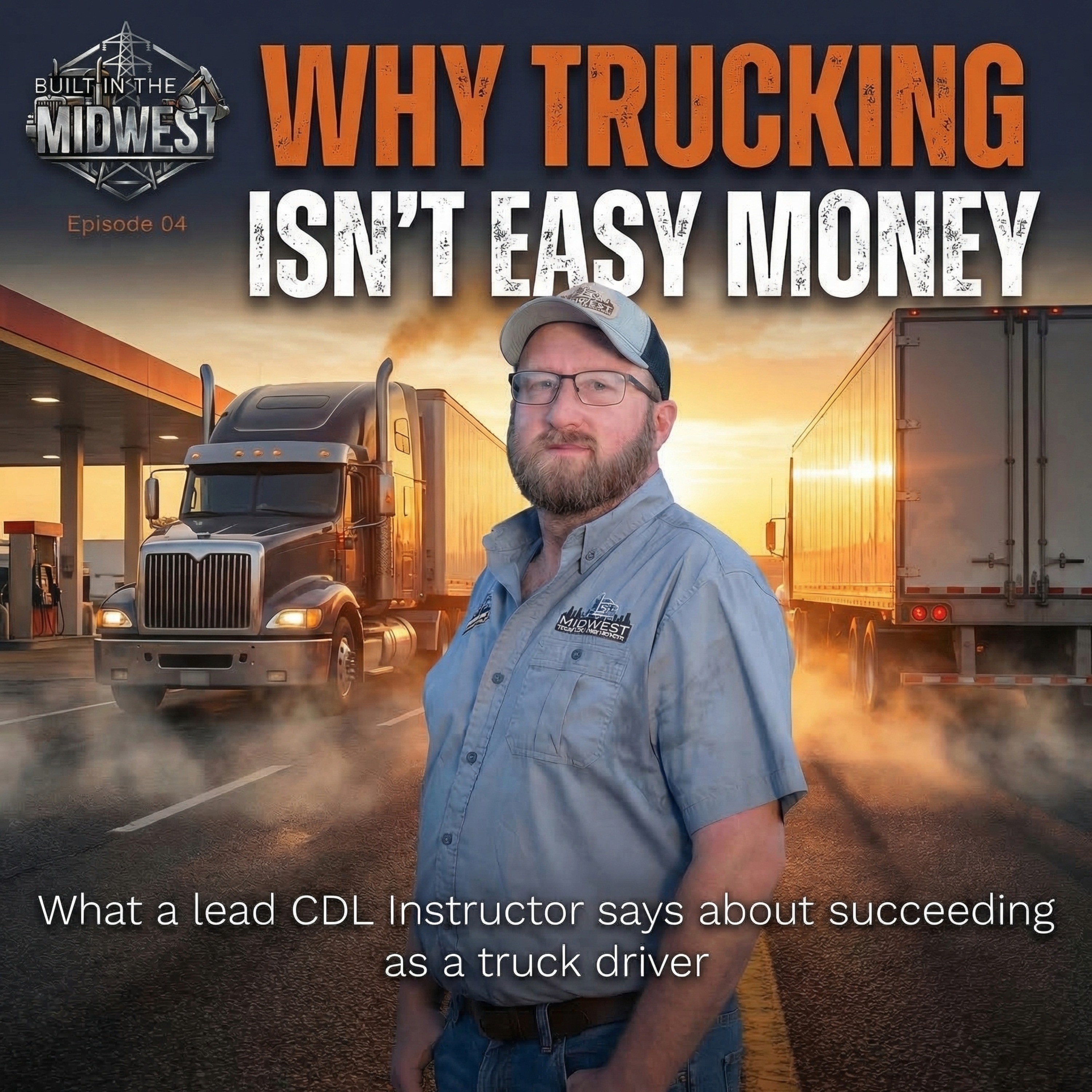
A driver clears $90K his first year. Another one with the same CDL is stuck at $55K and frustrated about it.
Bill Oglesby has watched hundreds of students come through Midwest Truck Driving School. He can spot the difference between those two drivers before they ever leave the building. This week, he breaks down what that difference actually is — and most of it has nothing to do with driving.
WHAT WE GET INTO
- Why Bill chose pneumatic tanker — and how he really made his money
- The exact habits Bill sees in students who go on to earn $80–100K+ vs. those who plateau
- What “reducing liability” means from the employer’s side — and why it’s the fastest way to get noticed
- How your reputation spreads faster than any billboard — for better or worse
- Why pre-trips aren’t boring busywork — they’re how you prove you’re worth the better truck
- The one mindset shift that separates people who burn out from people who build careers
ABOUT BILL OGLESBY
Bill is the lead instructor at Midwest Truck Driving School in Escanaba, Michigan. Before teaching, he hauled dry bulk pneumatic tanker. He got recruited to teach while hauling a load of lime, and he’s been watching students go from nervous to hired ever since.
TIMESTAMPS
00:00 — “We all have the same 24 hours.” Bill on what most people get wrong.
01:10 — The earning gap nobody talks about: why two drivers with the same CDL can end up $30K apart
05:13 — How Bill increased his income hauling pneumatic tanker
08:33 — Endorsements and the freight that pays more — what doors they actually open 10:54 — The phone call that pulled Bill off the road and into the classroom
13:07 — The loneliest part of trucking — and how drivers build real connections on the road
17:06 — “It’s just trucking. It’s going to be easy.” Why that mindset kills careers.
18:20 — 200+ divisions in trucking — if you hate what you’re doing, you haven’t found your niche yet
22:48 — The guy who shows up 20 minutes early vs. the guy who’s 10 minutes late.
24:47 — Pre-trips, dirty boots, and why the determine your career
26:02 — You want the fancy truck? Here’s how you earn it.
27:32 — You’re not just an employee. You’re a liability. How to flip that.
29:50 — The McDonald’s French fry fryer broke. It’ll be okay. (Seriously — this is about more than fries.)
33:40 — Bill’s advice to his younger self: one word that changes everything
LINKS
Episode 3 with Jillian Garcia (Schneider National): https://built-in-the-midwest.captivate.fm/episode/what-a-schneider-recruiter-learned-from-talking-to-thousands-of-drivers/
Midwest Truck Driving School: midwesttruckdrivingschool.com
CONNECT
Got a story? Know someone who should be on the show? Reach out at marketing@midwesttruckdrivingschool.com
See what we’re building at midwesttruckdrivingschool.com
Transcript
I knew if I worked hard I could get a second load that day and that's where I made my money.
Speaker A:We all have the same 24 hours in a day.
Speaker A:You make out of that 24 hours what you want.
Speaker A:Some people come into the industry and they think it's just trucking.
Speaker A:See, it's going to be easy.
Speaker A:I'm just going to go out there and I'm going to make 90 grand a year.
Speaker A:It's just driving a truck, right.
Speaker A:It's simple.
Speaker A:It's not, it's not that there's a lot more involved in it.
Speaker A:Yes, it is monotonous.
Speaker A:There's a lot of things there to check and absolutely, you're gonna have to do it every day.
Speaker B:If you could time travel back to when you were first getting started, you walked out the door rosy cheeked with your brand new cdl.
Speaker B:You're getting in the industry.
Speaker B:Anything you would wish to say to someone.
Speaker C:If you're thinking about a career in the trades and you want to know what employers actually look for, what the work is really like and what nobody tells you before you get started, you're in the right place.
Speaker C:Built in the Midwest features conversations that'll help you figure out if this path is for you.
Speaker B:I'm super pumped to be sitting down with you because as our lead instructor I know we don't like wave that title in people's faces.
Speaker B:You're the cat herder ultimately.
Speaker B:But hearing some perspectives on where you got your start in your career, why you made the jump to instructing and just what you've seen over time in the industry, how things have changed since you were in the industry to what we now teach and how people can get ahead as a driver.
Speaker B:Because we talked pretty recently of how there's a big difference from those who come in the industry and they get by and they usually kind of burn out and they're frustrated and they're unhappy and they really just aren't earning what they could to those who they come in and they love it because they're getting paid good money, they're getting the kind of routes they're looking for, they're hauling better freight and they're topping out some earning potential because they're going out and making it happen and those aren't like they don't happen by accident.
Speaker B:So I want to talk about what people can do, the mindset involved in how they can actually increase their earning potential, become a professional as a driver and not just be another guy driving a truck.
Speaker A:That's all a Personal mindset, actually, you know, I mean, if you want it.
Speaker A:There is tons of money in the trucking industry, but you have to be willing to go get it.
Speaker A:It's not going to be handed to you.
Speaker A:You can't.
Speaker A:So a guy drives for seven years hauling local freight.
Speaker A:Well, I'm just going to go.
Speaker A:I'm going to go get a lowbo and I'm going to start hauling heavy equipment.
Speaker A:No, you're not.
Speaker A:Have you ever sat in an excavator?
Speaker A:Well, no.
Speaker A:Well, you're not just gonna go load that on a trailer and haul it and make 200 grand a year.
Speaker A:It's impossible.
Speaker B:Yeah.
Speaker B:You don't have that trust.
Speaker A:No, no, you didn't.
Speaker A:The trust, the knowledge, experience, nothing.
Speaker A:And I encourage people, they start driving, you're in a truck stop somewhere, see an old guy there, take time and talk to him.
Speaker A:Ask him where he's been, what he's done, how he got there.
Speaker A:And I guarantee he didn't do it sitting in a truck stop.
Speaker A:People want to make like we talked the other day, well, I'm going to make 100 grand a year.
Speaker A:Okay?
Speaker A:You can't do that driving six hours a day.
Speaker A:You can drive 11 hours a day, work 14, drive 10 hours a day.
Speaker A:See what the change is from you driving your six hours a day, it's going to be huge.
Speaker A:Prove yourself to a company, then once you prove yourself to that company, your name spreads.
Speaker A:Just like in anything.
Speaker A:Whether you're a truck driver, whether you're a heavy equipment operator, whether you're the local concrete guy.
Speaker A:If you're the local concrete guy doing a phenomenal job, the word spreads better than any advertisement you'll ever have.
Speaker A:So make a name for yourself.
Speaker A:Don't ever say, I want to be like that guy.
Speaker A:Strive to be better than that guy.
Speaker A:Why not?
Speaker B:Because there is a reputation factor in this industry, and I think that probably gets downplayed a lot.
Speaker B:And some people may act dismissive of, well, that guy knows the owner or they schmooze their way through.
Speaker B:All right, there is a tasteful way to build relationships.
Speaker B:Yes.
Speaker A:Why did he do that?
Speaker A:Now he's successful, right?
Speaker A:I've done that with a lot select.
Speaker A:My guy may have done that with three or four businesses in his area or whatever, but they know when they call him, I need this here and I need it there by Friday.
Speaker A:It's going to get there.
Speaker A:Not calling some other guy and, oh, my truck broke down, or oh, I missed my time.
Speaker A:Build your reputation.
Speaker A:You are who you are, so you can do it.
Speaker A:Anybody can do it.
Speaker A:But you got to build that reputation for yourself.
Speaker A:It's not given to you, it's earned.
Speaker B:So when you were.
Speaker B:Give me a little context of.
Speaker B:I know you drove for quite some time because I can see when you say stuff like that, you're like, you've done it.
Speaker A:I did it.
Speaker B:So there is, you know.
Speaker B:How did you get your start in the industry?
Speaker B:What were you first hauling?
Speaker A:I primarily hauled a dry bulk tanker.
Speaker A:Pneumatic tanker.
Speaker A:Hauled, hauled lime.
Speaker A:I worked hard every day, knew what had to be done, and I knew if I worked hard, I could get a second load that day.
Speaker A:And that's where I made my money.
Speaker A:Was not sitting around, go get it.
Speaker A:Money's there.
Speaker A:Go get it.
Speaker A:You gotta go get it.
Speaker B:You would go get your first load done and then you'd do a second load the same day.
Speaker A:If I had time.
Speaker B:Okay.
Speaker B:So most people would, I think, check the box of.
Speaker B:All right, I got it where I needed to go.
Speaker A:I work today.
Speaker B:Yeah.
Speaker B:Right.
Speaker A:But I worked today.
Speaker A:Worked seven hours.
Speaker A:Okay.
Speaker A:But there's still time on that clock.
Speaker A:Right?
Speaker A:Let's go.
Speaker A:We all have the same 24 hours in a day.
Speaker A:You make out of that 24 hours what you want.
Speaker A:Some people only want to work six hours a day.
Speaker A:Some people push themselves and work 14 hours a day.
Speaker A:But the people that work six hours a day are mad because the guy that works 14 hours a day, has a boat, has a side by side, has the toys.
Speaker A:Right.
Speaker A:He earned it.
Speaker A:He earned the right to that because he works hard to have that.
Speaker B:Yeah.
Speaker B:Which is not saying that that has to be you.
Speaker B:Not everyone wants that.
Speaker B:No, no.
Speaker A:Some people are happy just.
Speaker A:Just working, just going through the day.
Speaker A:Right.
Speaker A:There's people out there that wish they had more, but don't.
Speaker A:But the opportunity is there if they buckle down and go do it.
Speaker B:Yeah.
Speaker B:What's been fascinating to me is I've looked at sort of the bell curve of the industry.
Speaker B:Right.
Speaker B:Of different types of freight.
Speaker B:What accounts for those who earn more versus those who are and less.
Speaker B:Because if you look at entry level drivers, the number changes quite dramatically.
Speaker B:And it depends on the company.
Speaker B:It depends on what kind of freight it depends on.
Speaker B:There are a lot of factors at play, but usually you're getting paid per mile.
Speaker B:And after some expenses come out, your fuel, your initial first year, getting used to the industry expenses, your personal materials, all that kind of stuff, usually people are earning less than they probably expected they would.
Speaker A:Correct?
Speaker B:Yeah.
Speaker B:They might have had a number in mind.
Speaker B:Maybe that was 60 grand a year.
Speaker B:Maybe they got hooked.
Speaker B:And a recruiter's like, you're gonna make 60 grand this year.
Speaker B:Great.
Speaker B:And then after expenses, they made like, 45.
Speaker B:And like, yeah, wait a second.
Speaker B:I'm barely cutting it.
Speaker B:What happened?
Speaker B:But then you told me a story the other day of someone who was recruited recently by Jillian, which we just did an episode with her.
Speaker B:Go check out episode three.
Speaker B:Jillian's recruiter with Schneider.
Speaker B:And she'd recruited one of our students, who in his first year was making, like, 90 grand.
Speaker A:I'm not sure if he was a student of ours, but that's a story she talks about.
Speaker A:Was a tanker driver that went there and made a lot of money his first year.
Speaker A:But he didn't sit around.
Speaker A:He worked.
Speaker A:He ran and ran to make that money.
Speaker B:So that's another sort of lever that can be pulled Depending on what kind of flow freight you want to haul.
Speaker B:There are endorsements you can earn.
Speaker A:Absolutely.
Speaker B:Can open up other opportunities.
Speaker B:So in the freight that you were hauling, did any of any special endorsements kind of come into play?
Speaker A:Tanker.
Speaker A:I had to have a tanker to haul that.
Speaker A:And hauling lime was not hazardous.
Speaker A:I didn't have to have my hazardous materials or nothing but tanker endorsement.
Speaker A:And I liked hauling the pneumatic tanker because it wasn't just driving involved.
Speaker A:There was manual labor involved.
Speaker A:When I got to the location, two to three hours to unload it.
Speaker A:Sometimes it was hard work, Sometimes it went easy.
Speaker A:But it broke the day up to.
Speaker A:I wasn't just stuck in a truck driving for 11 hours.
Speaker A:Drive three, four hours, you unload for a couple hours, and you drive back.
Speaker A:So broke the day up.
Speaker B:So when you're doing two loads in a day, I bet it was pretty.
Speaker B:I'm sure once you hit your pillow at the end of the night.
Speaker A:Oh, yeah.
Speaker A:I was wore out.
Speaker A:Yeah.
Speaker A:Yeah.
Speaker A:Yep.
Speaker A:And some days, you think, today's going to be a good day hauling that lime.
Speaker A:There's times you plug up a line, you just turn an easy load into a bad load.
Speaker A:Sometimes you plug up.
Speaker A:It could take you an hour to clear that plug, get everything running good again, it might plug up again.
Speaker A:I turn a day into a long day in a hurry.
Speaker B:You have any big, like, nightmare situations pop up?
Speaker A:Yeah, I've plugged up bad a couple times.
Speaker A:Plugged up once.
Speaker A:Bad enough that I couldn't get it unplugged on site.
Speaker A:I had to take the trailer back to the shop and have them pull the pipes out from underneath it to get it clear.
Speaker A:That's something you're not doing on the road.
Speaker B:Yeah.
Speaker B:Which is just the nature of that car.
Speaker B:Sometimes that happens.
Speaker A:It's part of the job, right?
Speaker B:Yeah, it happens.
Speaker B:So when you have some, like a setback like that you had in your mind that day, you might have.
Speaker B:Maybe that was your first load and you had the plan.
Speaker B:If you're going to try and get a second one in, and then something comes up and it sets you back.
Speaker B:How do you look at things like that?
Speaker B:I mean, how you could.
Speaker A:You could get mad.
Speaker A:Right.
Speaker A:And be frustrated with it.
Speaker A:There's no sense in getting mad.
Speaker A:It happened.
Speaker A:There's no.
Speaker A:I can't change it.
Speaker A:Right.
Speaker A:Get it off, get back home.
Speaker A:Tomorrow's another day.
Speaker A:Try again.
Speaker B:So when you.
Speaker B:So how long did you drive Tanker, first of all?
Speaker A:A year and a half.
Speaker A:Year and a half.
Speaker B:And did you jump here from there?
Speaker A:Yep.
Speaker B:Okay.
Speaker B:So what prompted leaving that and coming to teach?
Speaker A:Well, I was actually hauling a load of lime.
Speaker A:I was going up the highway and they called me from the school and asked me if I'd be interested in teaching.
Speaker A:I was not aware that the school was even looking for an instructor.
Speaker A:They reached out to me, thought about it.
Speaker A:I'll try it.
Speaker A:And ever since coming here, I really enjoy it because you get.
Speaker A:People come here, new students, young students, old students, male, female, doesn't matter.
Speaker A:You get them here first time in the truck, first couple days, you see the nervousness, the irritation they get because they're not getting it.
Speaker A:The, oh, I'll never figure this out.
Speaker A:I'll never get there.
Speaker A:To watch them progress through the program to the smile on the face at the end.
Speaker A:Then some of them come back six months, a year from now and talk to you, what they're doing now, how great it is.
Speaker A:You know, that's what I enjoy the most, is seeing the success that somebody has and watching that progression through the class of.
Speaker A:They're not really sure to being successful in the end.
Speaker A:That's what.
Speaker A:That excites me every day to see the progression.
Speaker A:First few days, start doing yard maneuvers or driving frustrated.
Speaker A:We're grinding gears, we can't get the alley dog.
Speaker A:I don't know if I'm ever gonna make this to.
Speaker A:In a few days of practice and work, their demeanor changes.
Speaker A:A smile on their face.
Speaker A:They're happy.
Speaker A:They jump out of the truck.
Speaker A:They're pumping their arms in the air.
Speaker A:You know what I mean?
Speaker A:That's excitement, right?
Speaker A:So that makes me excited.
Speaker A:Cause I'm happy for them to see that progression and succeed.
Speaker B:Yeah, absolutely.
Speaker A:That's fun for me.
Speaker B:Yeah.
Speaker B:So the validation of seeing someone come through which it is an intimidating concept to climb into something if you've never done something.
Speaker B:You didn't come from a farm or logging or anything, you've never been in a vehicle that big.
Speaker B:Now you're moving something and you've got other strangers in the vehicle with you, so you're being observed.
Speaker B:And you have to kind of navigate all these different stressors of not knowing what you're doing.
Speaker B:And then slowly that familiarity starts to click a little bit.
Speaker A:Because most of the time we have a class, there's 20 people in that class.
Speaker A:They don't know.
Speaker A:Nobody knows each other.
Speaker A:But most of the time, by the end of it, they've all made friends with each other.
Speaker A:And a lot of them still keep in contact with each other.
Speaker A:Some students I've had still keep in contact with me weekly.
Speaker A:Tell me how things are going, build relationships through it.
Speaker A:It's fun.
Speaker B:On the note of relationships, a point that I've heard come up quite a bit is this is a very typically solitary career.
Speaker B:Once you get started, especially if you're doing over the road driving, it's you in a vehicle by yourself most of the time.
Speaker A:Absolutely.
Speaker B:So how do you.
Speaker B:I mean, how does someone sort of navigate that?
Speaker B:And I know there's some personalities that are just a little bit more inclined towards this profession that thrive, but how do you kind of balance that?
Speaker A:So you get some people that, like you say, are introverted, I guess you'd say, right.
Speaker A:Stick to myself.
Speaker A:This is the perfect career for me.
Speaker A:I drive, I do my thing, I stop for the night, I'm in my truck, nobody's bothering me.
Speaker A:And there's other people that are very outgoing, which might struggle in the industry because they're not that.
Speaker A:But every time you stop truck parking, when you stop, whether rest area, restaurant, fuel station, there's always people there.
Speaker A:And that's where you meet a lot of people, make friends, is at them places.
Speaker A:Sometimes you.
Speaker A:You run in the same route pretty consistently.
Speaker A:You're stopping the same places.
Speaker A:This other guy, you've never met this guy before, and he might be from California, but he's running a different route but crossing the same path sometimes.
Speaker A:You know what I mean?
Speaker A:You're stopping there.
Speaker A:You might have lunch with them a few times a month.
Speaker A:I mean, you build relationships that way.
Speaker A:And there's always people to talk to, I guess, but you got to be willing to talk to them, too.
Speaker B:Yeah.
Speaker B:Whenever you have a.
Speaker B:You don't have a, you know, a Geographical home base that you can forge the typical sort of connections you would.
Speaker B:Where many of us are, that's community based or workplace based, where the people you see on a day to day are the people you develop connections with and those kind of become your peer group, your social circle.
Speaker B:But when you're on the road, you got to find other ways to make that happen.
Speaker B:And it might be timing based, you got to kind of line things up.
Speaker B:But there are ways and I think for people to understand that you do have to go out of your way a little bit to make it happen first, get comfortable approaching new people.
Speaker B:Because usually I've found this to be true just in life.
Speaker B:Most people are waiting for someone else to say hello first, correct?
Speaker A:Yep.
Speaker B:And then once you get that out of the way, it's, it's pretty easy, right.
Speaker A:And then you might sit back, think, well, I've been, been wanting to talk to this person for a year, you know what I mean?
Speaker A:While I finally went over and said hello.
Speaker A:Now we're great friends, we built that connection, you know what I mean?
Speaker A:We've went on vacations together, whatever.
Speaker A:But it took that break that ice.
Speaker A:But once you do that, especially truck stop, there's a lot of people in this trucking industry all over this country.
Speaker A:They're very knowledgeable, done a lot of things, seen a lot of things.
Speaker A:If you actually take the time and stop and talk to them, you're going to learn a lot from somebody.
Speaker B:Yeah, so you've mentioned that a couple times of just benefiting from the experience of others of taking the time and asking the questions of find someone who looks like maybe they've been at this for a while and seeing what's worked for them.
Speaker B:Because there seems to be a pretty large gauntlet that people have to run through.
Speaker B:Like after the first year, a lot of people drop off and then usually at about like the three year mark, it seems a lot of people also seem to exit.
Speaker B:And those who make it past that are like, all right, they, they've made it work, they've kind of adapted, they found what works for them and they're, they're good to go.
Speaker B:Do you seem to notice that to be true?
Speaker A:Yeah, because I think that people, some people will come in, come into the industry and they think it's just trucking sees, it's going to be easy.
Speaker A:I'm just going to go out there and I'm going to make 90 grand a year.
Speaker A:There's not, it's just driving a truck.
Speaker A:Right.
Speaker A:It's simple, it's not.
Speaker A:It's not that there's a lot more involved in it.
Speaker A:Get out there.
Speaker A:Let's face it, where we live, we deal with a lot of climate changes.
Speaker A:Wintertime can scare people.
Speaker A:You go down south, you got tornadoes to worry about, depending on how far south you are.
Speaker A:Hurricanes, which they're pretty well predicted.
Speaker A:And you can get out of there, mountain passes, stuff like that.
Speaker A:Chaining up.
Speaker A:Some people get running this route pretty consistent.
Speaker A:I don't like chaining up all the time.
Speaker A:I'm not doing this anymore.
Speaker A:Get out of it what you want, right?
Speaker A:I could hauling.
Speaker A:Hauling logs around here.
Speaker A:You're talking heavy weights, running early, early morning hours.
Speaker A:Weather, weather changes all the time.
Speaker A:In the mud, in the cold, self load or loading yourself.
Speaker A:That might not be for everybody, but that's why there's over 200 different divisions in the trucking industry.
Speaker A:Get your CDL and you start somewhere.
Speaker A:And just because you're doing something you don't like, doesn't mean that trucking's not for you.
Speaker A:You just haven't found the right place in the trucking industry maybe.
Speaker B:Yeah.
Speaker A:Because there's so many different things you could do up here.
Speaker A:It's difficult for us with the.
Speaker A:The market of the area.
Speaker A:There's not a lot of things here with paper.
Speaker A:We got smaller stuff, right.
Speaker A:Don't have like a lot of hopper bottom stuff.
Speaker A:You go down.
Speaker A:If you're willing to relocate, you can find anything you want to do.
Speaker A:It's out there.
Speaker A:Go down in the Midwest, a lot more grain, stuff like that for hopper bottom.
Speaker A:You go down more in the Midwest too.
Speaker A:South of here, a lot more manufacturing, stuff like that.
Speaker A:There's more stuff to move up here.
Speaker A:It's a lot of dry van stuff.
Speaker A:Pretty much, if you're littleboy stuff up here, it's already locked up.
Speaker A:Because there's not a lot of it.
Speaker A:There's already people doing it.
Speaker A:If you're willing to relocate, you go down there, there's a lot more of that, a lot more opportunities, a lot more step deck stuff to do.
Speaker A:There's opportunity.
Speaker A:If you're willing to take the opportunities and willing to change, maybe I understand.
Speaker A:I'm born and raised up here.
Speaker A:I don't really want to leave.
Speaker A:Okay.
Speaker A:So if you're not willing to leave, you're kind of in what the market is here.
Speaker A:And that's where you're gonna be at for the rest of your life, right?
Speaker A:Okay, I'm gonna make 70 grand a year.
Speaker A:If you're willing to relocate, go somewhere else, there's a lot more opportunities, different places.
Speaker A:You could make 150 grand a year.
Speaker A:We gotta be willing to take that chance.
Speaker B:I think there's a.
Speaker B:For those who are inflexible on how they achieve their goal.
Speaker B:If both things are important to you, like having the work life balance, or you want to achieve the outcome of earning a certain amount of money in a specific way, then I think that's where a lot of friction comes up.
Speaker B:Because you might look at an area like ours in Escanaba, Michigan, which, like you said, there are things up here.
Speaker B:We've got mines, we've got timber, we've got paper, we've got retailers and fuel and we have stuff.
Speaker B:But if you look at what those pay out or what that work looks like, you're like, that's not really what I'm looking for.
Speaker B:Well, then you have options.
Speaker B:You either change the way that you achieve the goal and you kind of get realistic, or you look at how can you make what you want to earn in the sort of timeframe that you want to make it.
Speaker B:And then with that might come some compromise.
Speaker B:I have an uncle who, he drove band equipment for touring bands for years and years and years, like big time performers, John Mayer and U2, and like all, you know, really cool stuff.
Speaker B:But he was gone for months on end.
Speaker B:Made good money, but it was a compromise and the work was cool.
Speaker B:He got to meet some very interesting people, got to know some of them, and the sort of stuff that most people never get to do.
Speaker B:But he was gone a lot.
Speaker A:And there's sacrifice with that too.
Speaker A:Right.
Speaker A:Being gone months at a time, you might miss Christmas with the family.
Speaker A:You might miss a child's birthday.
Speaker A:And yes, I'm not.
Speaker A:That stuff is hard to miss, not be a part of.
Speaker A:But you being on the road working, that provided a better life for the family, the children.
Speaker A:You know what I mean?
Speaker B:Yeah.
Speaker B:And those are conversations that have to get had.
Speaker B:Like, we can't make that choice for you.
Speaker A:That's a personal decision.
Speaker B:Yeah.
Speaker B:There's no right way to do it.
Speaker B:If you want to be home with family, by all means make that the priority.
Speaker B:And that can be the line in the sand, or it might be every other.
Speaker B:Or you make certain things that you kind of defend.
Speaker B:Like, all right, I can't miss Christmas.
Speaker B:You know, I might miss the birthday.
Speaker B:Can't miss Christmas.
Speaker B:Okay, well, find a way to make that work.
Speaker B:So you.
Speaker B:We talked briefly the other day around mindset and kind of becoming a professional in this industry, which I think we've kind of been alluding to kind of throughout this conversation, but I want to hear from you of what do you see from those who enter this industry and they really like, they get out there and they kill it and they love it.
Speaker B:And those who are, you can kind of tell probably pretty early that even here in training that it might be something they struggle with.
Speaker A:You can, you can see that sometimes just by looking at a person or somebody that's somebody that shows up 20 minutes early, somebody that's right on time every day, or the person that's showing up 10 minutes late every day, you can tell how that's gonna go right away.
Speaker A:The guy that's showing up early, he's determined.
Speaker A:He's the one that's gonna be successful because he's gonna.
Speaker A:A company's paying him to do a good job, he's doing a good job and he's proven that to them.
Speaker A:Those are the people that are gonna be successful, go above and beyond.
Speaker A:They're the people that are gonna advance.
Speaker A:They're the people that are gonna make more money.
Speaker A:If you're the guy that's coming in right at 8, coming in late, boots not tied, not ready for work, you're probably not going to go far.
Speaker B:So someone might hear that and be like, well, just because I showed up a couple minutes late for this, well, it's different than if I was getting paid to be here or if it was for work, of course I'd clean it up.
Speaker B:But I think there's the case.
Speaker B:I was taught that how you do one thing is how you do everything.
Speaker B:And for those who kind of push back, I think the devil's in the details.
Speaker B:The small stuff does matter.
Speaker A:Right?
Speaker A:Right.
Speaker B:So for those who are, they are looking for ways to stand out, it is shocking how few people do those little things.
Speaker B:Showing up on time, ready, showing up early, ready to go, like, mentally, physically, anything you needed to do prior, it's done and you're locked in and like focused on the task at hand, regardless of if it seems trivial or you already know it or whatever it might be.
Speaker B:So for some of the things that you guys have to teach, I feel I hear it secondhand a lot.
Speaker B:And usually it comes down to like pre trips or some of the more, shall we say, like monotonous seeming sort of things where someone might kind of question, question, like, does this really matter?
Speaker B:Like, am I actually going to be doing this every day or every time?
Speaker B:Where do.
Speaker B:Where does your brain go there?
Speaker A:Pre trip?
Speaker A:The pre trip's a good one.
Speaker A:Because yes, it is monotonous.
Speaker A:There's a lot of things there to check.
Speaker A:And absolutely, you're going to have to do it every day.
Speaker A:You're going to want to do it every day.
Speaker A:Certain things you're going to want to check every day.
Speaker A:You have to check it.
Speaker A:You're.
Speaker A:You're going to leave, you're going to haul £80,000, £120,000, depending on where you're located, £164,000.
Speaker A:And I'm not going to check my tires.
Speaker A:I'm not going to worry about my brakes.
Speaker A:That's a bad way to be.
Speaker A:You're going to make sure they're checked right every day.
Speaker A:You're going to keep.
Speaker A:Make sure all your lights are working every day.
Speaker A:Keep your truck clean.
Speaker A:And that's where you're going to sick succeed as a driver.
Speaker A:Anyways, a company is okay.
Speaker A:So here's a big thing, right?
Speaker A:The younger people, right?
Speaker A:They see all these big fancy trucks, all the chrome, right?
Speaker A:Loud trucks.
Speaker A:Well, I want that, okay?
Speaker A:A company is not just going to give you that.
Speaker A:You got to earn that, right?
Speaker A:But when you get a truck, it might be the oldest truck in the fleet, but take care of it like it's not.
Speaker A:Keep it clean, take care of that truck, prove yourself that you're worth this company to spend the money on, and give you one of those big fancy trucks to drive.
Speaker A:So if you're just going to trash a truck you have, they're not going to spend the money and invest the money in you to just have you trash it.
Speaker B:That's the other side of things that I think most people don't like to consider.
Speaker B:Like a company's taking a risk and we can bash corporations and large companies and like, oh, they've got the money.
Speaker B:That's not the point.
Speaker B:The whole model, the whole thing, the whole agreement comes down to they are letting you use a vehicle to transport cargo, and you are coming in and promising to get that where it needs to go safely.
Speaker B:You're not going to kill anyone on the way.
Speaker B:You're not going to break their stuff.
Speaker B:And that's kind of it.
Speaker B:They are there to help facilitate a business transaction.
Speaker A:Correct?
Speaker B:I think if we can, if drivers can approach that exchange, I'm going to provide as much value as my role allows me to do.
Speaker B:I. I will decrease their risk, their liability.
Speaker B:I will increase the confidence they have that I will do the job that I've been tasked to do.
Speaker B:They're gonna notice.
Speaker B:Cause most people don't do that.
Speaker A:You said A key word right there, liability.
Speaker A:What is a driver in a truck on the highway, what is he?
Speaker A:He's an employee for a company, but what else is he?
Speaker A:He's also a liability.
Speaker A:Strive to be a successful driver.
Speaker A:Do a proper pre trip every day.
Speaker A:You'll be successful.
Speaker A:Improve to that company that you are more than a liability to them.
Speaker A:You're a good employee.
Speaker B:So for people who, I mean, they come in, they show up on time, they maintain strong safety standards, no violations, they're maintaining their vehicle, they're catching stuff, any sort of wear maintenance issues early rather than breaking down and making a headache for everyone.
Speaker B:What have you kind of seen for those, how long does someone kind of have to stick with it to get noticed?
Speaker B:Have you noticed any sort of timeframe?
Speaker A:A year or two.
Speaker A:And trust me, people out there, there's people out there that notice things.
Speaker A:And as you as a driver out there, be professional when you go to, when you go to a shipper, receiver, be professional, act professional because people are going to talk.
Speaker A:You could put out, I don't care, the school construction company, whoever.
Speaker A:You can put up billboards all you want, right?
Speaker A:You could have all the billboards in the country.
Speaker A:But word of mouth can either make you very successful or can hurt you.
Speaker A:So if you are that person, that's polite, courteous.
Speaker A:When I'm stopping somewhere, I'm helping other drivers, I'm helping other people, my other teammates as drivers.
Speaker A:That word spreads throughout a company, throughout other companies.
Speaker A:And you are building, you're building your own legacy, right?
Speaker B:That's such a good point.
Speaker B:Because I think the.
Speaker B:I see a lot of people online talk about their shippers when they were waiting for to drop a load off and then they were told to come to the dock at a certain time and then suddenly it's four hours later that it has to happen.
Speaker B:And they're like, yeah, they're frustrated.
Speaker A:Like which, fair enough, I understand frustration too.
Speaker A:But don't take it out on the person that's sitting behind the glass at the ship or receiver.
Speaker A:It's not their fault.
Speaker A:And we have to remember things happen every day that we cannot control.
Speaker A:And it can't worry about things that I cannot control.
Speaker A:I can't worry about things that I cannot change.
Speaker A:Make the best of every day.
Speaker A:I'm going to do what I can.
Speaker A:If I pull up there, I'm supposed to get loaded in 20 minutes, something happens.
Speaker A:Now I sat here for three hours, I can't change.
Speaker A:That could be mad.
Speaker A:I'm not going to go in the office and holler at somebody.
Speaker A:It does no good, Right?
Speaker A:I'm going to take my load.
Speaker A:I'm going to move on.
Speaker A:Tomorrow's a new day, and that's going to set you up for success as a driver, as an individual, period.
Speaker A:Right.
Speaker A:If you can't change it, don't worry about it.
Speaker A:Don't go hollering at somebody else.
Speaker A:It's not their fault.
Speaker A:And I think sometimes, because you're correct, we see this social media, all this.
Speaker A:People post pictures and here's this person here screaming and hollering at this person.
Speaker A:It's not their fault.
Speaker A:They didn't break the french fryer fryer at McDonald's, but it's down right now.
Speaker A:It's not a big deal, right?
Speaker B:Yeah.
Speaker A:We'll get through it.
Speaker A:Trust me, you will survive this setback in your life.
Speaker B:It'll be okay.
Speaker A:It'll be okay.
Speaker A:It'll be okay.
Speaker B:I think that is a really good takeaway.
Speaker B:That is so simple.
Speaker B:But that's why I think it's so profound that when something happens.
Speaker B:We're not even talking about trucking at this point.
Speaker B:When something happens in life, if you can just have a.
Speaker B:This isn't that big of a deal, that attitude, something really interesting happens.
Speaker B:Because if you notice the people who make a big ruckus about every little thing, like they're just hair triggers, something inconsequential ruins their whole day.
Speaker B:Those type of things happen to that person all the time.
Speaker B:Because reality around us, like our experience with things around us, is not as things are.
Speaker B:It is as we are.
Speaker A:Take that in general in life, in your professional life, your personal life, things are going to happen.
Speaker A:So you wake up tomorrow morning, got a flat tire, going out there, swearing, acting like an idiot.
Speaker A:The neighbors are filming you to put you on.
Speaker A:On YouTube or whatever.
Speaker A:For what?
Speaker A:You can't change it.
Speaker A:It doesn't matter.
Speaker A:Get it fixed, move on.
Speaker A:It's not a big deal.
Speaker A:Same thing in your professional life.
Speaker A:See it.
Speaker A:I've seen it happen at different places.
Speaker A:You're sitting across the parking lot and you see a guy freaking out.
Speaker A:He's hollering, swearing.
Speaker A:It does no good, right?
Speaker A:Fix it, change it, move on.
Speaker A:And those, that's.
Speaker A:Those are personal choices too, I think.
Speaker B:Yeah.
Speaker B:I mean, it is a choice.
Speaker B:You have to adopt that manner of behavior.
Speaker B:And it takes some work.
Speaker B:So, I mean, if that's something that maybe people are struggling with, maybe they are a little bit more.
Speaker B:More reactive.
Speaker B:Just work that muscle.
Speaker B:Just when something starts bothering you, slow down, just like, is it that big of a deal.
Speaker B:Am I even going to think about this in a week from now or if the answer is no, which is probably the case, just don't let it bother you.
Speaker B:Worry and anger just means you suffer extra.
Speaker A:You suffer as a person.
Speaker B:You hold onto it.
Speaker B:Let it go.
Speaker A:We have a winter storm predicted.
Speaker A:We could end up with a foot of snow tomorrow morning.
Speaker A:We could sit around all day and complain that it's going to snow tonight and all of this, we can't change it.
Speaker A:If it happens, it happens.
Speaker A:You know what we're going to do?
Speaker A:We're going to get up tomorrow morning, shovel the driveway, come to work just like everybody else.
Speaker A:It's a mindset.
Speaker B:Exactly.
Speaker B:So for those who are, you know that maybe they've been, they're thinking about maybe getting their cdl, maybe they're thinking about getting into some of these other trades, which I think a lot of what we talked about is transferable.
Speaker B:Do you have any advice that if you could time travel back to when you were first getting started, you walked out the door rosy cheeked with your brand new cdl, you're getting in the industry.
Speaker B:Anything you would wish to say to someone.
Speaker A:Be patient.
Speaker A:You're going to go out there and expecting everything to be flawless, everything to work out as it's planned, as your day is scheduled.
Speaker A:It's not going to, I can promise you that it's not going to work that way.
Speaker A:Be patient.
Speaker A:Take one day at a time.
Speaker A:Move through your career in advance just like we talked about with frustration and stuff.
Speaker A:You can't, you can be that way.
Speaker A:Things are gonna happen.
Speaker A:You can anticipate some things.
Speaker A:There's other things you cannot anticipate going to happen.
Speaker A:Weather a breakdown, I don't care.
Speaker A:You go into the industry, oh, they gave me the oldest truck in the fleet and I've been broke down and this and that.
Speaker A:I don't care if you have a brand new truck, it's going to break down too.
Speaker A:Just be patient, build a reputation for yourself and you'll do just fine in this industry.
Speaker A:Prom.
Speaker A:Sam.