

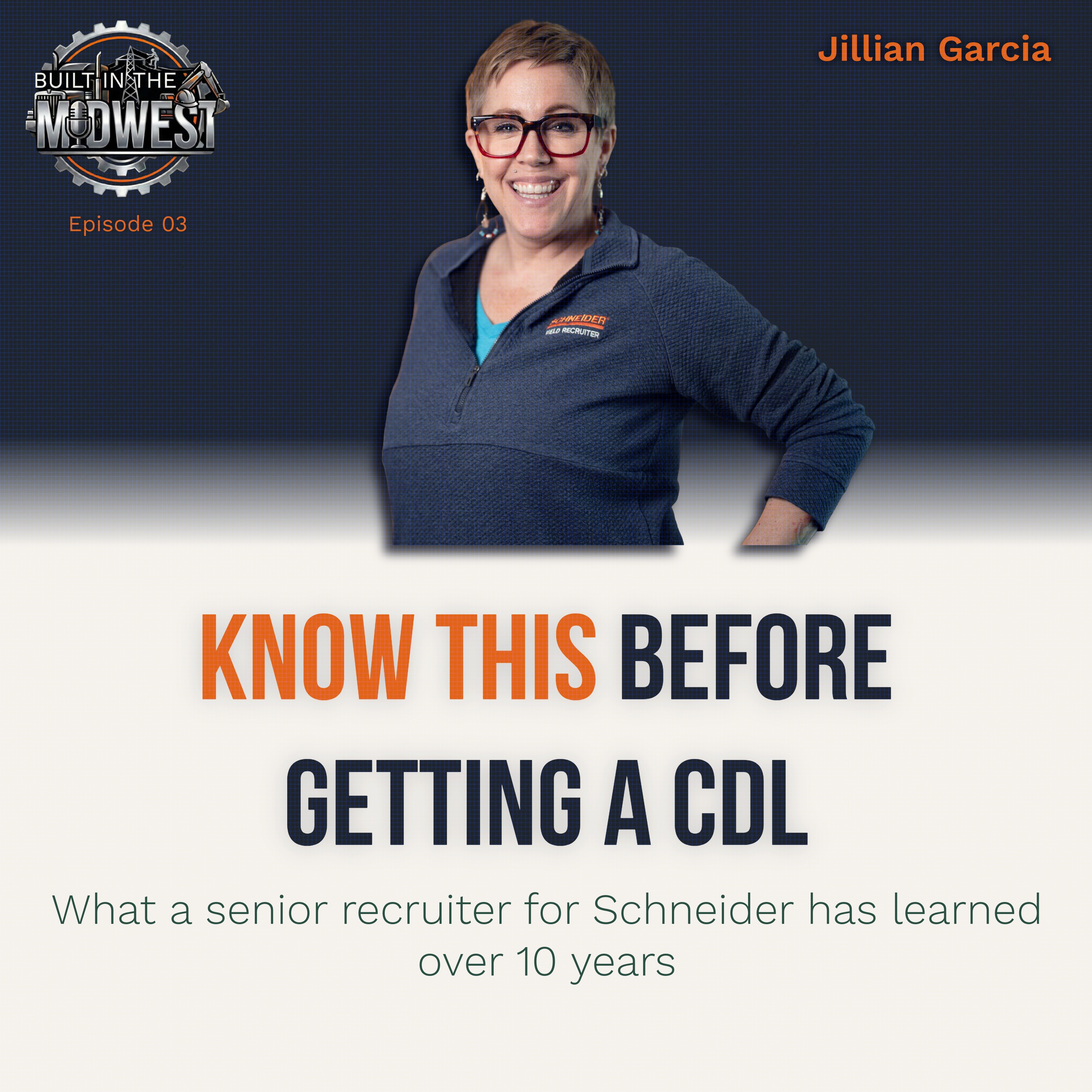
Jillian Garcia never planned on a career in trucking. She was a self-described introvert who’d spent years in childcare and the restaurant industry before a temp agency placed her at Schneider.
Ten years later, she’s a Senior Territory Recruiter covering Wisconsin and Upper Michigan — and she’s talked to more drivers than most people will meet in a lifetime. In this conversation, she opens up about overcoming social anxiety, what she actually looks for when she’s evaluating candidates, why the first year breaks some drivers and builds others, and the career paths in trucking that most people don’t know exist.
WHAT WE GET INTO
— How a girl who was “terribly shy” with social anxiety ended up doing presentations and connecting with people for a living – and why pushing past that fear changed everything
— The traits that separate drivers who build long careers from the ones who don’t make it past year one (hint: it’s not driving skill)
— Why “being teachable” is the single most important piece of advice she gives every new driver
— What the day-to-day actually looks like at a company like Schneider — home time, truck setup, dedicated vs. OTR, and the options most people don’t realize exist
— Schneider’s mirrorless truck technology and why they’re always first to test what everyone else eventually adopts
— The real talk on safety: cameras that protect drivers, tech that prevents accidents, and why “you’re the captain of your ship” isn’t just a slogan
ABOUT JILLIAN GARCIA
Jillian is a Senior Territory Recruiter at Schneider National, covering Wisconsin, Upper Michigan, and Northern Illinois. She’s been with Schneider for ten years, starting as a temp in customer service before moving into recruiting. Her grandfather drove for Schneider in the late ’70s.
She travels to CDL schools, hiring events, and job fairs across her territory, connecting with students and career changers who are figuring out their next move.
📩 GOT A QUESTION ABOUT THE TRADES?
Leave a comment or send us a message — we’ll get into it on a future episode.
LINKS
Connect with Jillian: https://www.facebook.com/JillianGarciaSNI
Midwest Truck Driving School Lineman Program: midwesttruckdrivingschool.com
North Country Heavy Equipment & Electrical Line School: https://ncheschool.com/
🔗 CONNECT
Website: midwesttruckdrivingschool.com
Email: marketing@midwesttruckdrivingschool.com
Facebook: https://www.facebook.com/CDLMidwest
Instagram: https://www.instagram.com/midwesttruckdrivingschool/
TikTok: https://www.tiktok.com/@midwesttruckdrivingskool
New episodes every Friday!
Transcript
If you're thinking about getting your cdl, make sure you're doing your research, and not just your own individual research, but talk it over with your family, with your friends, with the people that are closest to you.
Speaker A:Like, hey, I'm looking at making this change.
Speaker A:I'm looking at doing this with my life.
Speaker A:It's so rewarding.
Speaker A:It's such a rewarding job because you know that you are contributing to society in a way that is necessary.
Speaker A:We need you.
Speaker A:We need truck drivers.
Speaker B:If you're thinking about a career in the trades and you want to know what employers actually look for, what the work is really like, and what nobody tells you before you get started, you're in the right place.
Speaker B:Built in the Midwest features conversations that'll help you figure out if this path is for you.
Speaker B:Well, I'm super excited today to have the one, the only Jillian with Schneider here to do a podcast with today.
Speaker B:So thanks for being on the show today.
Speaker A:Absolutely.
Speaker A:I am honored to be here.
Speaker B:Really appreciate it.
Speaker B:So what's cool about Schneider?
Speaker B:So I was going back in the files now.
Speaker B:The school has been working with Schneider long before I've been with the school.
Speaker B:I've been with the school about seven, eight years.
Speaker B:The school's been with Schneider like, over 20 years.
Speaker B:Yeah.
Speaker A:Twice as long as I've been with Schneider.
Speaker B:Twice as long as you've been with Schneider.
Speaker B:Yeah.
Speaker B:And like, three times as long as I've been with Midwest.
Speaker B:And so.
Speaker B:But it goes to show you to the extent of the relationship that those two kind of have worked together for decades, to say the least.
Speaker B:So kind of where I want to start is maybe where you started at Schneider and in the trucking industry in general.
Speaker A:Yeah.
Speaker A:So actually, my story.
Speaker A:I know.
Speaker A:Never thought that I would end up in the transportation industry.
Speaker A:When I was a tiny little kid, my grandpa drove for Schneider.
Speaker A:But he.
Speaker B:Your grandpa drove Schneider?
Speaker B:Okay, I didn't know that.
Speaker A:Oh, yeah, yeah.
Speaker A:So my grandpa drove for Schneider in the late 70s, early 80s.
Speaker A:So when I was a tiny little kid, like, I used to crawl around in his truck and, like, had my little T shirt that said, my grandpa drives for Schneider.
Speaker A:No, he unfortunately had a stroke when I was 7 years old.
Speaker A:Had to come off the road.
Speaker A:But that was my whole experience with the transportation industry before I started at Schneider.
Speaker B:I'll be darn.
Speaker B:So.
Speaker B:But something had to have stuck there, and I.
Speaker A:It wasn't really a choice that I made, actually.
Speaker A:So I didn't go to college.
Speaker A:I did childcare for, like, a decade after high school.
Speaker A:After that, I did the restaurant industry for a while.
Speaker A:And when I got burnt out on the restaurant industry and didn't know what to do, I ended up going to a temp agency.
Speaker A:They place Matt Schneider.
Speaker B:Really?
Speaker A:It was totally random.
Speaker B:Totally random.
Speaker A:Yeah.
Speaker A:We have this role for you at Schneider.
Speaker A:I was like, okay, well, grandpa worked there, so, like, that's kind of cool.
Speaker B:Yeah.
Speaker A:So I actually started.
Speaker B:That's a good gig.
Speaker A:Well, I started in the customer service department for three months.
Speaker A:That was not for me.
Speaker B:How was that?
Speaker B:How was that?
Speaker B:Yeah, I can.
Speaker B:I can just say that was not for me.
Speaker A:That was not for me.
Speaker A:No.
Speaker A:I always say it takes a special kind of person to do the customer service side.
Speaker A:And I am not that special.
Speaker B:No.
Speaker A:But after that three month temp gig was up, the.
Speaker A:Well, I had put in my application for a full time role in customer service with Schneider because I'm like, I need a job.
Speaker A:I don't like customer service, but I need a job.
Speaker B:Did you like Schneider?
Speaker B:You just didn't like that one?
Speaker A:Everyone that I worked with was amazing.
Speaker A:They were all super friendly, supportive, all of that.
Speaker A:I just, yeah, didn't like the whole customer service thing.
Speaker B:Like, you know what?
Speaker A:But I figured if I like the
Speaker B:company, but I like to work in a different part of the company, so.
Speaker A:But I figured if I.
Speaker A:If I get in full time with customer service, maybe I can move around later on.
Speaker A:Well, the same day that Schneider called me to offer me the full time role in customer service, the temp agency called me and said, hey, we have another temp gig for you at Schneider.
Speaker A:But in the recruiting department, I was like, all right, let's try that.
Speaker B:Let's try that one.
Speaker A:Let's try that.
Speaker A:I know I like Schneider.
Speaker A:I know I don't like customer service.
Speaker A:Let's try recruiting.
Speaker B:Yeah.
Speaker A:So that was supposed to be a three month temp gig.
Speaker A:A month into it, Schneider hired me on full time.
Speaker B:I'll be darned.
Speaker B:So they saw the value in you and what you provided and your customer service.
Speaker A:I mean, I had obviously that customer service experience in the restaurant industry, but I think the restaurant industry kind of ruined me for customer service.
Speaker B:Oh, yes, absolutely.
Speaker B:But, you know, as somebody that was a bartender and server as well, it definitely forces you.
Speaker B:And I've always been outgoing, but it makes you outgoing in a different way
Speaker A:because I was not outgoing.
Speaker B:Oh, you weren't?
Speaker B:Okay.
Speaker A:No, like, so that had to be
Speaker B:a struggle for you.
Speaker A:Actually, I still consider myself, myself an introvert.
Speaker B:I don't believe that at all.
Speaker B:Not Even, like, for a second.
Speaker A:Like, not ne.
Speaker A:I mean, definitely not as much as I used to be.
Speaker A:I used to be terribly shy.
Speaker A:Just, like, social anxiety.
Speaker A:Not, like, talking to people.
Speaker A:Right.
Speaker A:The restaurant industry definitely push.
Speaker A:Pushed me out, I think.
Speaker B:I think you should be a motivational speaker here.
Speaker B:I mean, I'm telling you, like, for other people that are out there, it's like, you know.
Speaker B:But it's interesting because I've always been relatively outgoing and everything.
Speaker A:Had to force myself.
Speaker B:You had to force it.
Speaker B:So it's just totally a.
Speaker B:Totally different.
Speaker A:But it really was just overcoming that fear of, like, speaking in public or the fear of, you know, the social anxiety or whatever.
Speaker A:Once I push myself out of my comfort zone, I found, oh, hey, it's not that bad.
Speaker A:Actually.
Speaker B:I want to unpack that just a little bit, if you don't mind.
Speaker B:I know we can.
Speaker B:Okay.
Speaker B:Just a little bit more.
Speaker B:All right.
Speaker B:So other people that are like that, because I have friends that are like that that are, you know, introverts, and they don't like speaking in public, but even more so than that, they don't like crowds and they don't like going out and stuff.
Speaker B:And how did you push yourself through that?
Speaker B:I think it's easier said than done.
Speaker B:How did you do it?
Speaker A:But it really was just a choice.
Speaker A:It was just a choice to, like, yeah, this is gonna make me uncomfortable.
Speaker A:But I know that if I take that step, push myself, I'm gonna get over it and become more comfortable with it.
Speaker A:I mean, it's just like any fear.
Speaker A:I love that you have to face your fears.
Speaker B:You gotta face your fears.
Speaker B:And so for you, the best way to get over it was to put yourself in that position over and over and over again.
Speaker B:And now, like I said, it's totally.
Speaker B:You're a totally different.
Speaker B:Right.
Speaker A:And Schneider helped with that, too.
Speaker A:Like, my.
Speaker A:I mean, my original role there in the recruiting department was just answering the phones, scheduling the interviews.
Speaker A:Well, then I moved up from that to actually doing the interviews.
Speaker A:So I'm getting, you know, more and more comfortable talking with people and.
Speaker A:And then when I was the recruiter doing the interviews, Schneider.
Speaker A:So Schneider offers these classes internally that you can take just to help you in your career.
Speaker A:Help fancy advancement.
Speaker A:Yeah, exactly.
Speaker B:So one makes you better at the job as well.
Speaker A:So one of the classes that they offered was giving effective presentations.
Speaker A:So before I ever knew that I was going to be in this role, I took that class because I knew, like, okay, public speaking is definitely a fear that I have, and this could help me Tremendously.
Speaker A:Right.
Speaker A:I knew that it could help me in my personal life, too.
Speaker A:I know that I have things that I have overcome that I can help other people with.
Speaker A:And if I want to help other people with it, I got to put myself on a stage.
Speaker B:Yeah, absolutely.
Speaker A:Yep.
Speaker A:So I took that class, Effective Presentations, and I think it was like six months after that that I got this role where I literally am doing presentations for my career.
Speaker B:Well, yeah, exactly.
Speaker B:Well.
Speaker B:And I'll tell you what, I've seen a lot of presentations, and not to toot your horn, but the way you connect with students and the way you interact and, and the way you present yourself is amazing.
Speaker B:I mean, it looks like you've been doing it for years and years and years.
Speaker B:And I mean that, you know, so clearly.
Speaker B:And I think that that is a big takeaway for people that are listening.
Speaker B:But, you know, to overcome your fears, put yourself in that fearful position where it sucks and it hurts and, you know, but that's the best way.
Speaker A:Not always be something that works out like that.
Speaker A:Maybe you step into something and you're like, yeah, no, actually this is more than just a fear.
Speaker A:This is.
Speaker A:I just don't really like this.
Speaker A:That's fine.
Speaker A:Yeah, that's fine.
Speaker A:But you never know if you don't try.
Speaker B:No, exactly.
Speaker A:And I, I just, I think I had gotten to a point in my life where I was like, you know, I. I have too many regrets already.
Speaker A:I don't want more.
Speaker B:I don't want.
Speaker A:So I'm going to push myself.
Speaker B:I'm push myself and.
Speaker A:Right.
Speaker B:And you know what?
Speaker B:If I fail, I fail.
Speaker A:Exactly.
Speaker B:But, but if you, if I succeed,
Speaker A:it's not really a failure.
Speaker B:No, it's not.
Speaker A:Right.
Speaker A:You're going to fall down.
Speaker A:You're going to fail.
Speaker A:No matter what you're doing, you're going to fail in life.
Speaker B:So true.
Speaker A:If you learn from it, it's not a failure.
Speaker B:It's not a failure.
Speaker B:No, no.
Speaker B:And that's, that's a great, that's a great way of looking at failures, too, that it's not a failure if you learn from it and you grow and you're able to progress from it.
Speaker B:And all of a sudden you're, you're a better version of yourself having gone through it.
Speaker A:It was a, it was a quote that I had heard from Mary Pickford, who was an old, like, silent movie era actress.
Speaker B:Oh, interesting that she said, like Charlie Chaplin.
Speaker A:Yeah, yeah.
Speaker A:That era.
Speaker A:Yeah, she, she said.
Speaker A:And I don't remember it exactly, but it was this thing like this thing we call failure is some.
Speaker A:It's.
Speaker A:It's not about the.
Speaker A:Or how did she say.
Speaker A:I forget how she said it, but she said, like, it's.
Speaker A:It's not about this, the falling down.
Speaker A:It's about the staying down.
Speaker A:Oh, yeah, you'll fall down, but if you stay down, then it's failure.
Speaker B:Yeah.
Speaker A:If you get up, then it's never a failure.
Speaker B:No, it's not.
Speaker B:It's not.
Speaker B:Because you've learned from it and you've gotten up and now you're.
Speaker B:I mean, like the old saying, what doesn't kill you makes you stronger.
Speaker A:Exactly.
Speaker B:There is some truth to that, you know, sometimes.
Speaker B:What did I see on Facebook the other day?
Speaker B:Not that I go there for my quotes all the time, but it was.
Speaker A:I think that was where I found that man.
Speaker B:Yeah, exactly.
Speaker B:But it was like, the sweet isn't so sweet without the bitter.
Speaker B:And it's like.
Speaker B:Yeah, like sometimes the lows make for higher highs.
Speaker B:Right.
Speaker B:So you have some.
Speaker A:You wouldn't appreciate the sun if you didn't have the nighttime.
Speaker B:Absolutely.
Speaker A:We wouldn't appreciate summer if we didn't have the winter.
Speaker B:And you wouldn't appreciate your success if you didn't have some failures.
Speaker B:So.
Speaker B:No, I think.
Speaker B:I think that's a beautiful thing.
Speaker B:Well, all right.
Speaker B:So I'm glad we did that.
Speaker B:All right.
Speaker B:That's what I wanted.
Speaker B:I was like, you know what, this is really interesting, Julian, because I didn't know this.
Speaker B:I've been working with you for years.
Speaker B:I did not know that side of you at all.
Speaker B:So I appreciate you kind of opening up about that.
Speaker B:I'm an open book, so it means a lot.
Speaker B:It really does.
Speaker B:All right, so going back to Schneider, how long have you been at Schneider and.
Speaker B:And what's your.
Speaker B:Your role right now?
Speaker A:So I have now officially been with Schneider for 10 years.
Speaker A:For 10 years.
Speaker A:th of:Speaker A:So it's been 10 years.
Speaker A:Yeah.
Speaker A:I started just screening the applications to then going up and doing the interviews.
Speaker A:And then from that I moved up to what we call outbound recruiting, where I was cold calling people that hadn't even applied yet, telling them about our opportunities, convincing them to apply, taking them through the whole hiring process to now this role where I am the field recruiter.
Speaker A:So I don't go into the office anymore.
Speaker A:I travel around.
Speaker A:I cover Wisconsin, the UP and Northern Illinois, go around to all the truck driving schools in the area, talk to the students.
Speaker A:I do hiring events, job fairs, all of that.
Speaker A:And if I'm not traveling.
Speaker A:I'm working from home, calling my leads.
Speaker A:Hey, you know, we talked a little while ago.
Speaker A:Just wanted to check in.
Speaker B:See, and I love your Facebook page.
Speaker B:Cause I see you.
Speaker B:You're always bouncing around here and going here and doing this.
Speaker A:Yeah.
Speaker B:Presentations.
Speaker B:So literally, your life is a bunch of presentations and talking to people and connecting with people, which is.
Speaker A:And it's huge.
Speaker A:And it's connecting with people that I.
Speaker A:That I really love about this job.
Speaker A:Like, there's.
Speaker A:There's just a difference between talking to someone on the phone about their application.
Speaker B:It's totally different.
Speaker B:Yeah.
Speaker A:Right.
Speaker A:Having that personal conversation with someone, making that connection, trying to figure out, okay, what is it exactly that you're looking for?
Speaker A:How can I help you find something that fits your needs?
Speaker A:And.
Speaker A:And really, a lot of times people that are getting their cdl and looking to drive trucks are.
Speaker A:Maybe it's a second career for them or maybe, you know, they've had.
Speaker B:You do see that, a lot of
Speaker A:life, and they're trying to reset people
Speaker B:getting career changes, and they want to do something different.
Speaker A:I mean, I get a lot of people that were like, teachers and.
Speaker A:And they're just burnt out now and need something different, or people that were law enforcement and, you know, they can make more money just sitting behind the wheel of a truck than they are out risking their lives.
Speaker B:So they think about it like, right, right.
Speaker B:What do I want?
Speaker A:It is someone trying to restart their life.
Speaker A:And I just.
Speaker A:I love that I get to be a part of that.
Speaker B:Yeah, no, that's absolutely amazing.
Speaker B:And so there is a kind of intrinsic reward, you would say, with what you do, being able to change people's lives.
Speaker B:Even when we talked, we were just talking about Matthew beforehand, and, like, you knew him, and you're like, oh, yeah, you know what?
Speaker B:You made that personal connection with him.
Speaker B:And maybe it was your personal connection that you made with him, which is why, you know, not only is he applying, but he's interviewing and, you know, and at this point, kind of it's a little bit out of your hands, but, you know, you give.
Speaker B:You give him.
Speaker A:He applied before I met him.
Speaker B:Okay.
Speaker A:But I will say, yeah, I mean, that.
Speaker A:That does happen a lot where, like, I. I make a connection with someone.
Speaker A:Yeah, they.
Speaker A:They really just.
Speaker B:And all of a sudden, it's like
Speaker A:my style over the style of other recruiters or whatever.
Speaker B:Absolutely.
Speaker B:Well, and the fact that you.
Speaker B:You kind of shook their hand, they.
Speaker B:You get to know them, and all of a sudden it becomes more personal now.
Speaker B:Yeah, it's like, you know what?
Speaker B:No, I want to go.
Speaker B:I want to go.
Speaker B:We were just talking about Heather a little bit ago, doing good, and she's loving Schneider and everything else.
Speaker B:And it's like, that's the goal.
Speaker B:That's what we want.
Speaker B:So looking at people and you've worked with a lot of different people kind of getting into this industry, what would you say?
Speaker B:And I know you've seen a lot of success and you've seen some failures with students as well.
Speaker B:What would be factors that are consistent for success and maybe some factors that you've seen on maybe expectations for failures for people getting into it?
Speaker A:I think the biggest thing, first of all is do your research before getting into the industry.
Speaker A:It's not a regular 9 to 5 job.
Speaker A:You're not going to be home every day.
Speaker A:You're not even going to be around other people all the time.
Speaker A:It is a lot of time alone in a truck and you're just not going to be home as often.
Speaker A:You have to be okay with that.
Speaker A:You have to do your research on the industry in general before putting that money and putting that time in to get this.
Speaker B:Absolutely.
Speaker A:That, first of all, is going to make you more successful when you know exactly what you're getting into.
Speaker B:Absolutely.
Speaker B:So having that realistic expectation of the industry and, and I've heard, you know, and this is something that maybe even as a school, we can, we can, we can do a better job with that.
Speaker B:Where some people, and I've heard it before, well, I want to make this much.
Speaker B:I want to be home every night.
Speaker B:And it's like, what industry do you think you're getting into here?
Speaker B:You know, because good money and you
Speaker A:can get good home.
Speaker B:Absolutely.
Speaker A:But the other thing is, it's not just about the industry.
Speaker A:It's.
Speaker A:You're starting out in a brand new career.
Speaker B:Yeah.
Speaker A:You start out at the bottom, no matter where you go.
Speaker B:Exactly.
Speaker A:Right.
Speaker A:You do it.
Speaker A:You can make good money, you can get good home time.
Speaker A:You're gonna have to put your time in, though.
Speaker B:Absolutely.
Speaker A:And the other thing is that'll make you successful is your attitude.
Speaker A:What kind of attitude do you have going into it?
Speaker A:If you come into it thinking, I know what I want, I know what I'm doing, I'm gonna do it my way.
Speaker B:The world owes me everything.
Speaker A:You're just not gonna go far.
Speaker B:No, no.
Speaker A:The most important thing is be teachable.
Speaker A:Continue to ask the questions.
Speaker A:Listen to the people that have been doing this for years that are trying to help you out.
Speaker A:If you're teachable, you'll go far.
Speaker B:Absolutely.
Speaker B:Absolutely.
Speaker B:So looking at people that want this as their career, and I've heard this on both sides, that people come to the school and said, you know what, this is what I want to do as my career, and I'm excited about it.
Speaker B:And other people are like, well, this is just what I want to do until I find something else.
Speaker B:What are your thoughts on that?
Speaker B:Do you see a lot of people that get in this and stay in this for their career?
Speaker A:Yeah, I think the majority of the people that get into it do, because I think the majority know what it is they're getting into.
Speaker A:It's not just a meantime thing or, you know, a way to pass time until something else comes along.
Speaker A:Most people that are going into this, they know they're putting in time and money and effort to get their CDL in the first place.
Speaker A:Most of them, yeah, are absolutely industry.
Speaker B:I've heard from a lot of students that getting their CDL and going through that process was one of the hardest things that they've done because the theory is tough.
Speaker B:All the backing maneuvers that you have to do on the road and the nervousness of being in traffic and you got non synchronized 10 speed.
Speaker B:And we still train with a lot of non synchronized transmissions.
Speaker B:But I really do believe it makes you a much better driver.
Speaker B:Right.
Speaker B:hen I was in driver's ed on a:Speaker B:And I tell you what, I remember stalling it on a hill and there's a car behind me beeping, and I'm trying to start it while hitting the brake and we got a hill start.
Speaker A:Mine was a:Speaker B:You do, you do.
Speaker B:Yeah.
Speaker A:And it was the very first time my dad took me out.
Speaker A:It was pouring down rain.
Speaker A:Like we were parked in front of a building.
Speaker A:I could not even see the building.
Speaker A:That's how heavy the rain was.
Speaker A:And of course, we're on an upgrade too.
Speaker B:So of course you're always on a hill in Emmanuel.
Speaker B:You just, you absolutely are.
Speaker A:And I love that you guys are still training, training on manual transmissions.
Speaker A:Like, even though the industry is going,
Speaker B:yeah, the industry is going automatic.
Speaker A:It just makes you that much better of a driver.
Speaker B:I really do believe it does.
Speaker B:I really do believe it does.
Speaker B:And you know, I look at when I went through drivers, I learned on a manual.
Speaker B:That's it.
Speaker B:And my, my parents pushed me to that because they, you know what, when you have to do 19 things at once and have to shift While looking out the road and doing your blinkers and everything.
Speaker A:Yeah.
Speaker B:It makes you a better.
Speaker B:It makes you a better driver, and it really did.
Speaker A:It does.
Speaker A:I. I will like some.
Speaker A:My dad took me out and taught me when I was 14.
Speaker B:Fantastic.
Speaker A:I have four siblings, as far as I know.
Speaker B:Older, Younger.
Speaker A:I'm the second oldest.
Speaker B:Second.
Speaker B:Okay.
Speaker A:I'm the second oldest.
Speaker B:So my kind of charting, spearheading for the rest of the family.
Speaker A:My older sister, my dad did not take her out at all until she had her.
Speaker A:Her temps.
Speaker A:The first time that she got behind the wheel, she hit a parked car.
Speaker B:No.
Speaker B:No.
Speaker A:So I think.
Speaker A:I think that's probably why you remember that I'm going to her when she's
Speaker B:full, give her a little more time to.
Speaker A:Right.
Speaker A:But I'm also the only one that my dad taught in a manual transmission.
Speaker A:Oh.
Speaker A:And all of my siblings will admit that I'm the best driver of all of us.
Speaker B:Wow.
Speaker B:Interesting.
Speaker A:And I swear it's because it was.
Speaker B:It's because of.
Speaker B:Because there's a manual transmission.
Speaker B:Because there is a lot going on.
Speaker B:And like, just that little.
Speaker B:That little hill.
Speaker B:I'll never forget it, because I was freaking out, and there's cars behind me, and I had stalled it on the hill, and now you had to hit the brake, and you're trying to let the clutch out, and you got to break from the fuel, but then trying to worried about rolling back even more, and I'm like, oh, my God.
Speaker B:Like, it's just nuts.
Speaker B:And so maybe that makes me a better CDL instructor, too, because, like, when they're freaking out, I'm like, just relax.
Speaker B:No big deal.
Speaker B:That's the thing, too.
Speaker A:If you want to be a truck driver, you have to be able to multitask.
Speaker B:Oh, yeah, absolutely.
Speaker A:Like, even if you're in an automatic transmission, there's a lot going on.
Speaker B:There's still a ton going on.
Speaker B:Just to be able to multitask, because you're going to areas that you've never been to before on roads that you've never driven on, underneath overpasses that you've never been under.
Speaker A:You got to watch your gps.
Speaker A:You got to watch the cars around you.
Speaker B:You got to watch.
Speaker A:Watch the signs you like the hours of service.
Speaker B:And then now we're getting into construction season, so you know that.
Speaker B:So we're gonna see a lot of that going on.
Speaker B:So.
Speaker B:Yeah, no, it's.
Speaker B:It's a.
Speaker B:It's a.
Speaker B:It's a fun industry, though.
Speaker B:That's.
Speaker B:That's.
Speaker A:That's for sure.
Speaker A:Keeps you on your toes.
Speaker B:I will tell you.
Speaker B:You know, we see a lot of students that get into this industry and a lot of people that, you know, and people always ask, okay, who comes through the school?
Speaker B:And it's literally 18 to 80 and everybody in between.
Speaker B:I mean, you get.
Speaker B:You get kids right out of high school that want to get in this trade, and you get a lot of people that are looking for changes.
Speaker B:You know, you were talking about police officers.
Speaker B:I've seen a lot of police officers lately that.
Speaker B:That were like, you know, what kind of.
Speaker A:I'm kind of over the stress of.
Speaker B:The stress.
Speaker A:Law enforcement, and.
Speaker A:And the pay is not.
Speaker B:No.
Speaker A:What they deserve for what they do.
Speaker B:And, like, corrections officers is really common.
Speaker B:And, like, some of the stories I've heard from corrections officers, I'm like, I don't care how much they pay me.
Speaker B:I. I don't know if I could ever be a correct job.
Speaker B:I'm like, what those guys go through,
Speaker A:it's a scary job.
Speaker B:It is.
Speaker B:Like.
Speaker B:And, like, when you're on high alert all the time, just waiting for somebody to do something, I'm like, nope, nope.
Speaker B:Like, I like to smile and enjoy.
Speaker B:Like, part of my job today is getting talked to Jillian.
Speaker B:So I love that.
Speaker B:This is what I love to do.
Speaker B:So I can't imagine being stressed and anxious at work and everything and everything like that.
Speaker A:It's definitely a different thing.
Speaker A:You're just behind the wheel of the car.
Speaker A:Yeah, there's.
Speaker A:Behind the wheel of the truck.
Speaker A:Yeah.
Speaker A:There's a lot of things that you have to pay attention to, too.
Speaker A:But also.
Speaker B:Yeah.
Speaker A:Yeah, I like.
Speaker A:For me, like, yeah, I travel a little bit in my car, and that really is, like, my time to decompress.
Speaker B:Oh, yeah.
Speaker A:From all.
Speaker A:Just the pressures of life and being a mom and, like, and all of that.
Speaker B:Do you listen to the podcasts or audiobooks?
Speaker A:I.
Speaker A:You know, I'm a. I'm.
Speaker A:I don't really.
Speaker A:It's all music.
Speaker B:Okay.
Speaker A:I'm a musician.
Speaker A:I'm a singer, so I'm the one that's in my car.
Speaker B:You're a singer, too?
Speaker A:Top of my line.
Speaker B:I didn't know that about you.
Speaker B:We have to do more podcasts because I've learned a lot about you.
Speaker A:I had no idea there was one class here.
Speaker A:I think it was, like, a year ago.
Speaker A:Yeah, it was just about a year ago, or last summer, maybe early last summer, that one of your students had a guitar with them in class.
Speaker B:I know who that student is.
Speaker A:The blue guitar.
Speaker B:Exactly.
Speaker B:Yes.
Speaker B:Yes.
Speaker B:Because he loved playing guitar and he brought it to every class.
Speaker A:Yeah, I. I did jam a little Johnny Cash for them before my presentation.
Speaker A:No.
Speaker B:Folsom Prison Blues.
Speaker B:Yes.
Speaker B:All right, all right.
Speaker B:I'm a fan.
Speaker B:Yeah.
Speaker A:I mean, Johnny Cash was my.
Speaker A:My grandpa's absolute favorite.
Speaker A:My grandpa who drove for Schneider.
Speaker B:Yes.
Speaker A:Johnny Cash was his favorite.
Speaker A:He wore all blacks all the time.
Speaker A:He was.
Speaker A:When he passed away, he was buried in his blacks.
Speaker A:He like.
Speaker B:Yeah, he's a huge, huge fan.
Speaker A:Yeah.
Speaker A:So Johnny Cash, like, I'm not a huge fan of country music, but I will take Johnny Cash all day, every day.
Speaker B:Absolutely.
Speaker B:Some of that older country.
Speaker B:I really do like, like the older stuff.
Speaker B:The older stuff.
Speaker B:Yeah.
Speaker B:Just there is something about it.
Speaker B:Yeah.
Speaker B:All that.
Speaker B:Yeah, you know that.
Speaker B:No, nothing.
Speaker B:Nothing.
Speaker B:All that.
Speaker A:I didn't.
Speaker B:Didn't expect that, though.
Speaker A:So.
Speaker B:Singing, playing guitar.
Speaker B:There's a whole other side of Jillian here that I'm not familiar with.
Speaker B:So I was just reading transport topics here the other day, and I saw that Schneider is in the top 10 of biggest for hire carriers in the country or in the world or something.
Speaker B:You know, talk about that if maybe, if you don't mind on really how big Schneider is and how a big company can provide a lot more than maybe others.
Speaker A:Right.
Speaker A:So.
Speaker A:And I know a lot of people get nervous about, oh, a big corporate company, you know, which, you know, I understand that hesitation, but.
Speaker A:Schneider's been around since:Speaker B:It's been around a long time.
Speaker B:Like, we have a lot of good
Speaker A:time to figure things out, figure out what works, what doesn't.
Speaker B:Yeah.
Speaker A:We've had a lot of time to build up the.
Speaker A:Just the different opportunities that we have.
Speaker B:Absolutely.
Speaker A:Newer companies, smaller companies don't have all those different options to offer.
Speaker A:You know, we.
Speaker A:We have everything from even the technology
Speaker B:and your trucks that it's seen online.
Speaker B:It's like, you guys are always like the tip of the spear when it comes to the best technology out there.
Speaker A:I want to stay ahead of the game, like, especially now when there's all this AI stuff and whatever, you know, you might as well use it to your advantage.
Speaker A:Right.
Speaker A:So, yeah, absolutely.
Speaker A:Incorporating a lot of that stuff in our operations and as well.
Speaker A:But yeah, I mean, we have everything from over the road to dedicated accounts tanker.
Speaker A:We've got, you know, daily home time for.
Speaker A:In some areas.
Speaker A:I won't say it's.
Speaker A:It's everywhere.
Speaker A:It is more rare that it comes available.
Speaker A:But we're.
Speaker A:We're also Taking advantage of the opportunities to take on new freight.
Speaker B:Yeah.
Speaker A:Where.
Speaker A:Especially in these last few years when the market hasn't been so great.
Speaker B:No, it hasn't.
Speaker A:And smaller companies have had to close their doors.
Speaker A:We've been able to buy those companies out, take on their freight, you know, there.
Speaker A:And, and usually it's.
Speaker A:I know there was one in Wisconsin that we bought out where it was an older couple that owned it and they were wanting to retire and didn't have family to pass it down to anyway.
Speaker A:So we're like, you know, we'll take it.
Speaker A:We'll.
Speaker A:We'll buy.
Speaker B:Come with me.
Speaker A:You know,
Speaker B:we got you covered on that.
Speaker B:No, but that is.
Speaker B:I'll tell you what, just speaking to that, that part I've seen a lot of local businesses and small businesses because they have no one to pass on to.
Speaker B:And this is becoming like a terrible trend right now where they just close them down.
Speaker B:They just close them down.
Speaker B:And like all the people that work there and everything else, they're just out those jobs and so being able to take it and say, no, continue it on and we'll keep it going, I think that's great because I've seen way too many small, very successful small businesses just close down because there isn't that next generation to take them over.
Speaker A:Well, if you hear those companies, give them my number.
Speaker B:Okay, I will, I will.
Speaker B:I definitely will.
Speaker B:Absolutely.
Speaker A:Always look.
Speaker A:Looking for more options, more freight.
Speaker A:Of course, you know, the more freight we have, the more drivers we can give jobs to.
Speaker B:Absolutely.
Speaker B:So you are primarily kind of in the Midwest, in the Midwest region.
Speaker B:Talk about maybe hiring right now.
Speaker B:Are you bringing on new drivers right now and from start to finish, kind of through your training program?
Speaker B:Because this is something I think a lot of people don't realize that after truck driving school and you get your cdl, doesn't mean you're done.
Speaker B:And I tell a lot of students that your training has just begun.
Speaker B:The day you pass get your cdl, your training has just begun.
Speaker B:Because it really, it really.
Speaker B:There's a whole finishing program there that we don't really talk about a lot, but we do talk about.
Speaker B:And the fact that this will happen.
Speaker B:Right.
Speaker B:You're not getting your truck on your own on day one.
Speaker B:Nothing like that.
Speaker B:Talk about that side of things.
Speaker A:Yeah.
Speaker A:And I think most people have realistic expectations when it comes to that.
Speaker A:They know, you know, they're still going to go through an orientation.
Speaker B:They're still green, they're still learning.
Speaker A:But I have had the comments that, well, I just Went through truck driving school.
Speaker A:So why do I have to go through more training?
Speaker A:Well, because there's more to it than just driving the truck.
Speaker A:Right.
Speaker A:So we are going to take you and refine your skills and take you to that next level.
Speaker A:So, yeah, you know how to drive the truck now.
Speaker A:You pass that test, you know how to turn those corners, you know how to, you know, do those tight right turns and back that truck up.
Speaker A:But yeah, we're going to take it to the next level.
Speaker A:We're going to make sure that you are fully confident behind the wheel.
Speaker A:And really our orientation and training is only about three weeks long.
Speaker A:Okay.
Speaker B:Yeah.
Speaker A:So a lot of companies, it will
Speaker B:be longer than us.
Speaker A:Okay.
Speaker A:And if it's shorter than that, I would say might not be enough time.
Speaker A:It might not be enough to make sure that you are.
Speaker B:So kind of ideally, if everyone is meeting their, your expectations and everything, it's like, okay, we can get out of here in three weeks.
Speaker B:If maybe you need a little bit longer.
Speaker B:If they need a little bit longer, that's fine.
Speaker A:Yep.
Speaker A:But yeah, our orientation is very interesting.
Speaker A:Individualized as well.
Speaker A:It's actually phases of orientation and you'll move up each phase based on proficiency.
Speaker B:So it's proficiency based that way, which is great.
Speaker A:If you're a little further ahead of other people in your class, you don't have to sit and wait for them to catch up.
Speaker A:You just move on to the next phase.
Speaker B:Might be able to get out of that, the whole thing a little bit sooner.
Speaker A:It may not get your own.
Speaker A:It may take you four weeks.
Speaker A:So, yeah, it is, it is very individualized, which I think is different than a lot of other companies as well.
Speaker B:Yeah, absolutely.
Speaker B:And then what can people expect?
Speaker B:And you know, we talked about some of these expectations a little bit, but I think it's important for people getting into this that they realize that, you know, yes, there's some, you know, home daily or home weekly jobs, but for a lot of otr, that it's about being out weeks at a time.
Speaker B:And you might be able to talk a little bit more to that.
Speaker A:Yeah, yeah.
Speaker A:And I mean with us, even if you do over the road, we can still get you home every other weekend.
Speaker B:Okay.
Speaker A:So you don't have to stay out.
Speaker B:So it's not like, you know, and, and I'm like, I'm not old, but apparently I'm a little old school because,
Speaker A:well, you're younger than me.
Speaker B:I know, but I just remember when I was actually on the road, like it was very common to see Guys out three, four weeks at a time.
Speaker B:And so you're telling me, like, maybe you can.
Speaker A:I mean, we do have drivers that literally don't have a home.
Speaker A:They have a PO Box for their mail, and they live in their truck.
Speaker A:And they, you know, save a whole lot of money not having to pay rent or mortgage.
Speaker B:So they have no bills.
Speaker A:Right.
Speaker B:That kind of sounds pretty good.
Speaker B:Ye.
Speaker A:That.
Speaker A:But.
Speaker B:But I'm gonna go home and talk to my wife.
Speaker B:All right, honey, I got the perfect plan.
Speaker A:All right.
Speaker B:No bills.
Speaker B:We're on the road.
Speaker B:All right.
Speaker A:But yeah, no, if you need to be home, you can get home every other week.
Speaker A:A lot of our over the road drivers are out 11 to 12 days.
Speaker A:Home every other weekend for three days.
Speaker A:Okay.
Speaker A:So you can still be home every other week in most areas.
Speaker A:We have plenty of jobs that can get you home every week.
Speaker A:Now.
Speaker A:Yeah.
Speaker A:You will want to plan on sleeping in the truck.
Speaker A:Now with us, you are assigned your own truck.
Speaker A:No one else is using it.
Speaker A:So you can leave your personal items in it.
Speaker A:You'll have a refrigerator.
Speaker A:You'll have a bed.
Speaker B:That's how there's no.
Speaker B:There's no slip seating.
Speaker A:Right.
Speaker B:That.
Speaker B:That way.
Speaker B:Which is.
Speaker A:Right.
Speaker B:Which is huge because you have a
Speaker A:couple of accounts that would be slip seating, but most positions, it's your truck.
Speaker B:You can set it up how you want it on the inside and everything.
Speaker A:A TV in there if you want to.
Speaker A:We have drivers that.
Speaker A:That used to be professional chefs and have a little stove top in their truck.
Speaker B:Oh, come on.
Speaker B:Yeah, exactly.
Speaker A:You know, do their little coolers in
Speaker B:there so they get their different or
Speaker A:different gamers and have their whole gaming system set up in their trucks.
Speaker A:So.
Speaker A:Yep, that's your little apartment, your little home away from home.
Speaker B:Well, and I think that's something that a lot of people don't realize is like, today's semi trucks are kind of designed as like little campers.
Speaker B:Right.
Speaker B:I mean, there's so much storage.
Speaker B:There's so much storage, and you have everything that you need in there.
Speaker B:People have the microwaves and the refrigerators and like little burners and it's just like, you know what, it's comfortable in there.
Speaker A:We talked to one of our female drivers a few weeks ago that said she brings her sewing machine with her in the truck.
Speaker B:No sewing machine.
Speaker A:Whatever your hobby is.
Speaker B:If I'm sitting there delivering a load or picking one up, what a good opportunity.
Speaker B:I love that.
Speaker B:I love that.
Speaker B:You know, something that I still talk to them a lot of different people about.
Speaker B:And Was.
Speaker B:Was Covid and how.
Speaker B:Covid.
Speaker B:Covid changed, I think, our work environment in a lot of respects.
Speaker B:But also it made people realize that maybe their job that maybe wasn't deemed essential.
Speaker B:And there's a lot of people that got laid off and they realized that.
Speaker B:Really.
Speaker B:And correct me if I'm wrong, but really nobody in the trucking industry did.
Speaker A:Right.
Speaker B:Because we kept moving.
Speaker A:Right.
Speaker B:You know, and I think.
Speaker B:Could you talk about maybe how Schneider got through Covid and.
Speaker B:And their success, you know, being able to get through it.
Speaker A:Yeah.
Speaker A:So.
Speaker B:And.
Speaker A:And that's the thing.
Speaker A:Like, there.
Speaker A:There's.
Speaker A:We're always going to need truck drivers.
Speaker B:Yeah.
Speaker A:There's always going to be freight that needs to move.
Speaker A:You know, we.
Speaker A:We always need food on the shelves at the grocery store.
Speaker A:We always need clothing and toiletries and all that on the shelves at the stores.
Speaker A:Right.
Speaker B:Gas in people's vehicles.
Speaker B:That'll always be.
Speaker A:It would take something catastrophic to get to the point where we.
Speaker A:I don't need truck drivers.
Speaker A:Like, we would literally all have to go Amish.
Speaker B:Yeah.
Speaker B:You know, horse and buggy.
Speaker A:Right.
Speaker A:Like, we're all.
Speaker B:You talk about getting some chickens here.
Speaker B:You know, I don't know.
Speaker A:I'm going part.
Speaker B:It's a slippery slope.
Speaker B:You're going here.
Speaker A:I mean, I still am gonna go to the store to buy clothes and toiletries and, you know, I'm not sewing my own clothes here.
Speaker B:But.
Speaker B:But that's important.
Speaker B:I think a lot of people don't realize is that everything you see around us, everything around you, including the car that you drive.
Speaker B:All right.
Speaker B:It all came here.
Speaker B:It came to us on a truck.
Speaker B:Right.
Speaker B:And so that stuff never.
Speaker B:Never ends, never stops, even during COVID Nobody stopped eating during COVID Right.
Speaker B:And I remember the grocery stores being picked thin there for a minute and
Speaker A:everything, but we still.
Speaker A:We still needed drivers.
Speaker A:Like, even if people were just ordering food on Uber Eats while the truck still needed to deliver the food to the restaurants.
Speaker B:Absolutely.
Speaker B:Truckers are really the backbone, I think, of America in a way, and I think Covid really taught us that.
Speaker B:I mean, I haven't seen them totally get rid of our service regulations or have those exemptions.
Speaker B:There was massive hours service exemptions during COVID and everything.
Speaker B:And I think a lot of people that we trained that got laid off from COVID and they said, you know what?
Speaker B:I just need a job.
Speaker B:And there's all these jobs in the truck industry.
Speaker B:And all of a sudden they realized how valuable that CDL was in those jobs that were out there.
Speaker A:We Never stopped hiring throughout it.
Speaker A:We still always need drivers.
Speaker A:You know, even if we scale back how many drivers we hire.
Speaker B:Yes.
Speaker A:I mean, we're, we're still, we're such a big company.
Speaker A:There's always going to be something that we're hiring for.
Speaker B:Absolutely.
Speaker A:And there's going to be 150 drivers.
Speaker B:I imagine you have all these drivers that are retiring probably on a weekly basis, and it just is.
Speaker A:Absolutely.
Speaker B:It's a part of it.
Speaker A:Older generation, the boomers, they're starting to retire now.
Speaker A:So, yeah, we, we're always going to, to need more drivers.
Speaker B:And that's, you know, that's not gonna, that's not gonna slow down.
Speaker A:Exactly.
Speaker B:Yeah, especially, especially with the, with the boomers, because you have a massive population that are retiring.
Speaker B:And then we just, we have a, some younger people getting into it, but it's like, all right, we need more people getting into these trades and, and everything else.
Speaker B:So the last thing I want to talk about is the safety side of trucking now.
Speaker B:Now, you mentioned, you mentioned that side of things because, you know, CDL drivers, it is one of the more dangerous jobs that are out there.
Speaker B:But I do know Schneider has a lot of different safety things that other companies don't have.
Speaker B:Could you talk about that at all?
Speaker A:Yes.
Speaker A:I mean, safety is always our number one priority, 100%.
Speaker A:Nothing trumps safety.
Speaker A:We tell our drivers, you're the captain of your ship.
Speaker A:You're the one that's out there in the truck seeing what's going on around you.
Speaker A:If you ever hit unsafe conditions, you have the authority to say, I need to stop, pull over, shut down, and I will let you know when it's safe for me to go again.
Speaker A:No one's ever going to try to guilt you into going a little bit further.
Speaker A:It's, it's just.
Speaker A:There's just nothing in the trailers that's worth risking your life, risking your lives of other people on the road for.
Speaker A:And yeah, we're, we're always looking at new safety features in our equipment, like the collision mitigation system, where, you know, if you're out on the highway and a little car comes and pulls in front of you and slams on their brakes, that truck's automatically gonna break.
Speaker B:It's automatically gonna break.
Speaker B:Yeah.
Speaker B:See, that stuff never existed when I was in the, in the trucking industry.
Speaker B:So.
Speaker B:Yeah, so, but, but that's a huge part of safety where it might be a lot may brake faster than you could get to that breakpoint.
Speaker A:Right.
Speaker A:And then there's, you know, the Lane departure warnings.
Speaker A:We have some like front facing and side facing cameras on our trucks that are triggered in case of any incident so we can get a view of what's going on around you.
Speaker B:Absolutely.
Speaker A:One of the dangers of being a truck driver is the ignorance of other people.
Speaker A:People that are not truck drivers.
Speaker B:Yes, absolutely.
Speaker A:They don't understand how the trucks work.
Speaker A:You can't brake as fast as a car can break.
Speaker A:That is a huge, heavy piece of equipment.
Speaker A:It's dangerous.
Speaker B:Absolutely.
Speaker A:You need to know how to handle it and you need to.
Speaker B:You almost have to expect the unexpected from other people.
Speaker A:Exactly.
Speaker A:You have to anticipate.
Speaker B:That's the word I was looking for.
Speaker A:You have to be able to anticipate the actions of other drivers and that
Speaker B:other people aren't going to be rational
Speaker A:sometimes or they're going to hit you and then try to blame you when no, you were paying attention.
Speaker B:And like those cameras.
Speaker B:I think I was talking to you about that.
Speaker B:How those cameras actually, you know, in so many instances they exonerate the driver.
Speaker A:Yep.
Speaker A:They help protect the driver from lawsuits.
Speaker A:Because no one's not like you're not on camera.
Speaker B:You're actually not like spying on the driver.
Speaker B:It's not about spying on it.
Speaker B:It's about, it's about when somebody does something dumb outside your truck and runs into you or ruins you or their fault.
Speaker A:Not our driver's fault.
Speaker B:Yeah, yeah.
Speaker B:So if anything like, and I will tell you nowadays, I would not want to drive on the road without a camera in the truck.
Speaker B:Right.
Speaker B:And I love the fact that on the sides as well because people just do some dumb stuff out there and I don't want to be to blame because I can't prove my innocence.
Speaker A:Exactly.
Speaker B:And you have those cameras and I just think, I just think that's so good.
Speaker A:I'll even recommend that drivers have their own driver facing camera with them just in case there ever is a question about, well, you know, were you on your phone, Were you not paying attention, Were you not sure.
Speaker B:So it makes it even more personal.
Speaker B:Say no, I had two hands on the wheel.
Speaker A:Right.
Speaker A:Here's my video proof.
Speaker B:They cut me off and slammed on the brakes.
Speaker B:I tried to get to the brakes as quick as possible because typically that would be on the.
Speaker B:You'll see the truck driver's fault in that point.
Speaker B:But if I can prove you slammed on your brakes in front of me and brake checked me and I hit you.
Speaker B:But because you caught me off somebody race.
Speaker B:Well now, now I'm in the clear, you know, so yeah.
Speaker B:Wow.
Speaker A:Wow.
Speaker A:So.
Speaker A:And we're.
Speaker A:We're working on installing the mirrorless technology as well.
Speaker B:I've seen some of your guys videos on that, and it's bizarre.
Speaker B:It doesn't look, it looks.
Speaker B:It's a truck, but it looks like it's missing some important things.
Speaker A:Right, Right.
Speaker A:So there's no mirrors on the sides.
Speaker A:And I know there's a, There's a couple of other companies, companies that are testing out the technology as well.
Speaker A:But we, as far as I know, we're the only ones that have the exemption to not have to have the mirrors on the outside.
Speaker A:On the right anymore.
Speaker B:And because the, the mirror in itself, you know, acts as a big blind spot right there.
Speaker B:I've seen that before because I, I teach students.
Speaker B:All right, we're gonna, we're gonna kind of dip and dive around that mirror to make sure we can see well.
Speaker B:Yeah.
Speaker B:Because.
Speaker B:And because a vehicle could be hiding
Speaker A:right in that mirror now.
Speaker B:You don't.
Speaker B:So it's almost.
Speaker B:By getting rid of mirrors, you almost get rid of some of your blind spots too, potentially.
Speaker B:As long as the, the cameras and the screens, everything works properly.
Speaker A:Right.
Speaker A:So.
Speaker A:And it's, it's slow going getting it
Speaker B:in all of our trucks.
Speaker A:You know, we want to make.
Speaker A:Percent reliable.
Speaker A:So what happens if those cameras go out?
Speaker A:You can just reattach mirrors.
Speaker B:But at the same time, I've been in this industry long enough, and you guys have been pivotal on trying out, testing out this experimental new technology.
Speaker B:I think of like back in the day when, like, side skirts, you know, were just coming out.
Speaker B:Chevy was one of the first to come out with side skirts and even the wheel covers.
Speaker B:The wheel covers to give you better fuel efficiency.
Speaker B:And I think of def, you guys were the first ones to buy the most trucks with the selective catalog reduction systems and the DEF and the DPF filters.
Speaker B:And so, you know, what you do is kind of paving the way for everyone else.
Speaker B:And so you kind of take the brunt of the struggle.
Speaker B:And then once you prove it works in a successful, then everyone else, like, everyone's sitting back like, we'll wait till.
Speaker B:See if Schneider does this.
Speaker B:But you see that, don't you see that?
Speaker B:It's like, yeah, let Schneider, you know, pay for all this, and then that's fine.
Speaker A:We'll be the one to be the first.
Speaker B:But yeah, but I think that there's a lot of credit there.
Speaker B:That.
Speaker B:And, you know, I think it's important to give credit where credit's due.
Speaker B:Where you guys are the, the forefront of a lot of this technology, the forefront of these new trends, we can
Speaker A:afford to do things like that, test things out.
Speaker B:Absolutely.
Speaker B:And you know what?
Speaker B:Not everything works, but the stuff that does.
Speaker B:All of a sudden, you don't see trailers on the road without side skirts anymore.
Speaker B:All right?
Speaker B:You don't see.
Speaker B:And there's so many things that you guys have done.
Speaker B:You don't see trucks on the road without selective catalytic reduction systems and DPF and def.
Speaker B:So what you guys do is just, it's contagious to the whole industry.
Speaker B:You know, everyone else follows suit, like, let's make sure Schneider's successful and then.
Speaker B:And then we'll go from there.
Speaker B:Yeah.
Speaker B:So I love it.
Speaker B:I love it.
Speaker B:So once again, I want to thank you, Jillian.
Speaker B:All right.
Speaker B:With Schneider, and if anyone has made it this long in the podcast.
Speaker B:All right, we're going to put some links down below on your information or Schneider's information.
Speaker B:But I will tell you, as a school that's been working with schneider for over 20 years, great company to work with, great company to work for.
Speaker B:A lot of great opportunities.
Speaker B:And like I said, we'll put that information down below.
Speaker B:So is there anything else?
Speaker B:I'll give you the last word.
Speaker A:You know, I want to thank you first of all for having me on here and to anyone that is listening and looking for, you know, a school to go to, we've been recruiting from you guys for 20 years because we know that you're doing good, solid training, you're sending qualified candidates.
Speaker B:That means a lot that are going
Speaker A:to be hard working and disciplined.
Speaker B:That truly means a lot.
Speaker B:We really appreciate that.
Speaker B:Yeah.
Speaker B:Well, and that's where it's a great partnership.
Speaker B:It truly is a win win where we can work together and we both benefit and away from it.
Speaker B:So thank you, Jillian.
Speaker B:You have a wonderful day and thanks for being a part of the show today.
Speaker A:Thanks for having me.